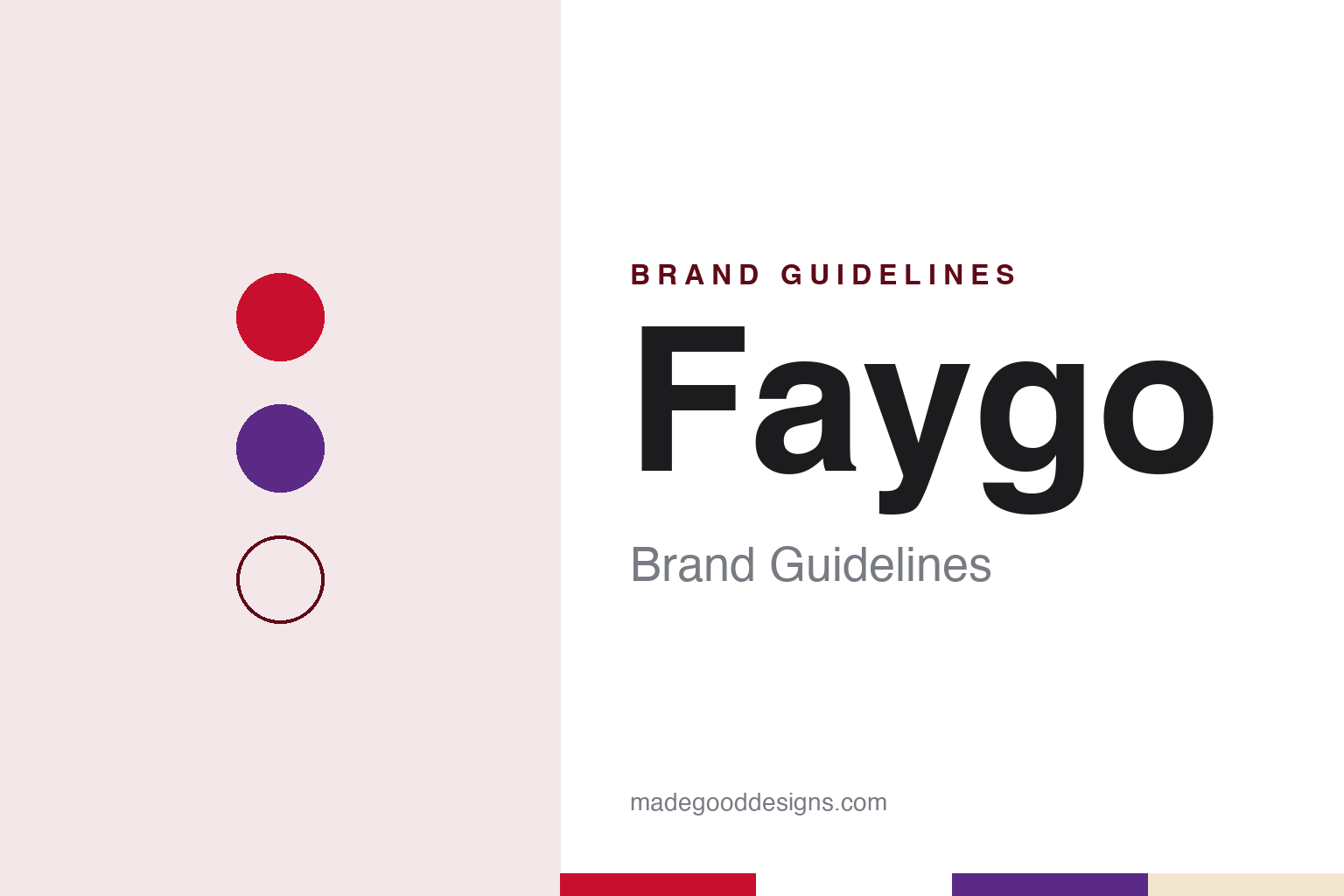
Faygo Brand Guidelines
Detroit pop from the Feigenson brothers since 1907.
Aa
Two constants: a Redpop red, grape and Rock & Rye cream palette and a retro soda-fountain script register. Abstract homage — not a Faygo product or mark; no bottle, can or logo is reproduced.
Feigenson Brothers
Two bakers, a horse and cart, and frosting flavours.
Faygo began in Detroit in November 1907 as Feigenson Brothers Bottling Works. Its founders, Ben and Perry Feigenson, had come to Detroit from Russia and were trained as bakers, according to the company history in the International Directory of Company Histories (St. James Press, 2001). Their first drinks — strawberry, fruit punch and grape — were adapted from the flavourings of their cake frostings, a story The Detroit News repeated for the brand’s centenary in 2007. The brothers made a batch, stopped the line, and took the bottles round on a horse-drawn wagon, and the two families lived above the small bottling plant.
Over the next decade the business grew enough for the brothers to buy their own homes, hire their first employees and add a second wagon. New flavours followed, among them a sassafras soda and a lithiated lemon, and the firm built a larger plant on Beaubien Street. In 1921 the company shortened its name to Faygo; the International Directory of Company Histories says the reason was that the shorter word fitted more easily on the bottles. A first delivery truck and home deliveries followed in the early 1920s, as did a vanilla soda, a seltzer, an imitation of Nehi called Ace Hi, and Rock & Rye, named after a Prohibition-era drink and still in the range a century later.
In 1935 Faygo moved to a larger bottling plant on Gratiot Avenue in Detroit, the site English Wikipedia still describes as its working plant. In the 1940s a second generation — Perry’s son Mort and his cousin Phil — joined the business, and the brothers handed it to their sons by the middle of the decade, The Detroit News reported. Until the late 1950s Faygo sold its drinks only in Michigan, because they kept for a short time; the same report says company chemists solved that with a filtration system for the plant’s water.
Colour
A cowboy, a boat song and a nostalgic redraw.
Faygo’s public image was built largely on local television. In the late 1940s the company hired the Detroit agency W.B. Doner, and in the 1950s it ran animated spots starring the Faygo Kid, a cartoon cowboy, and Herkimer the Bottle Blower. The Detroit News dates the Faygo Kid to 1956, in adverts for Faygo’s old-fashioned root beer. The International Directory of Company Histories says those spots ran on the tagline “Which way did he go? He went for Faygo!” and that the Faygo Kid advert was later inducted into an advertising hall of fame.
From 1965 Faygo advertised on Detroit Tigers baseball broadcasts. The broadcasts reached beyond the area Faygo served, and the company responded by shipping to the warehouses of wholesale food brokers rather than to individual shops, which carried the brand into new states. In the early 1970s a campaign filmed on the Bob-lo boat, the ferry to an amusement park on the Detroit River, produced a song, “Remember When You Were a Kid,” that viewers asked for; the company pressed it on 45 rpm records. The comedian Joan Rivers later fronted the diet line for Doner. Through the 1960s the range grew to include a premium Royal line, a diet line that soon made up about half of sales, and imitations of national drinks, and at the end of the decade the original strawberry soda was renamed Redpop.
On the pack, the key documented date is 2001. The International Directory of Company Histories says Faygo’s logo and packaging were redesigned that year for the second time in a decade, with a softer and more nostalgic look, and that a line of retro 16-ounce glass bottles was introduced using the company’s 1950s logo design. For the 2007 centenary Faygo ran a label-design contest; The Detroit News reported about ten thousand entries and a winning Centennial Soda from a fourth-grade teacher in Ohio. The script lettering itself is covered in our separate note on what font Faygo uses.
Typography
Design and documentation.
The seven brands in this group are all soft drinks from different regions of the United States: Cheerwine, Moxie, Faygo, Vernors, Big Red, Ale-8-One and Sun Drop. American regional soft-drink brands in general sit at many different points in the trade, from family firms that still carry a founder’s name to names that now belong to much larger drinks groups, and a single brand can be sold everywhere from a corner shop to a supermarket shelf.
A soft-drink brand’s identity is usually carried less by a single product than by a bottle or can, a name and the flavour it promises, because the company behind the name may have changed hands, moved its production or grown far beyond the place where it started. That makes the questions behind each name worth asking plainly: who started it, who owns it now, and where its drinks are actually made and bottled.
Each guide separates what independent sources record from what the company says about itself — its founding story, its owners over time, where its drinks are made and how its packaging has changed — and marks plainly what rests only on the company’s own word.
Aa
A retro soda-fountain script for a Detroit pop with a 1950s logo revival. (Specimen set in Lobster, a script STAND-IN; NOT the Faygo logo.)
Faygo
From the Feigenson family to National Beverage.
Faygo stayed with the Feigenson family for nearly eighty years. As the second generation neared retirement, the family sold the business in 1986 to TreeSweet, a Texas juice maker, as the Chicago Tribune reported in February 1986. TreeSweet sold Faygo on to National Beverage Corp. of Fort Lauderdale, Florida, in 1987; the International Directory of Company Histories notes that National Beverage had been formed in 1985 to buy the West Coast soda maker Shasta, and that under its new owner Faygo was largely left to continue on its own path. Today Faygo Beverages, Inc. is a wholly owned subsidiary of National Beverage and is still based in Detroit.
The International Directory of Company Histories describes the Gratiot Avenue plant as having grown by the late 1990s into a site of about 300,000 square feet that took in neighbouring bottling buildings once owned by Pepsi and Coke, with Faygo also produced in other plants around the country as needed. The range has kept widening: a non-carbonated Ohana line of punches, tea and lemonade arrived in 1996, and in 2013 MLive reported a ginger ale called Faygo Gold, a flavour that put it up against the crosstown Vernors. In September 2009 Bon Appétit ranked Faygo’s root beer the best-tasting American root beer. The brand also became tied to the Detroit group Insane Clown Posse, who sprayed audiences with Faygo; English Wikipedia, citing Vice and a 2004 book, says the company kept its distance.
For a design guide, Faygo shows how a regional soda can run a long list of flavours under one script name, and how a mid-century logo can be brought back as a heritage cue. Compare it with its Detroit neighbour Vernors and with the North Carolina cherry soda Cheerwine. For this guide we use Redpop red, grape and Rock & Rye cream with a retro script, an unofficial interpretation; no product or logo is reproduced.
Explore & save
Keep Faygo’s identity on hand — save it to a board in the Made Good inspiration library.
Faygo identity set
Pin the Faygo Redpop red, grape and Rock & Rye cream palette and the retro soda-fountain script register to your own board.