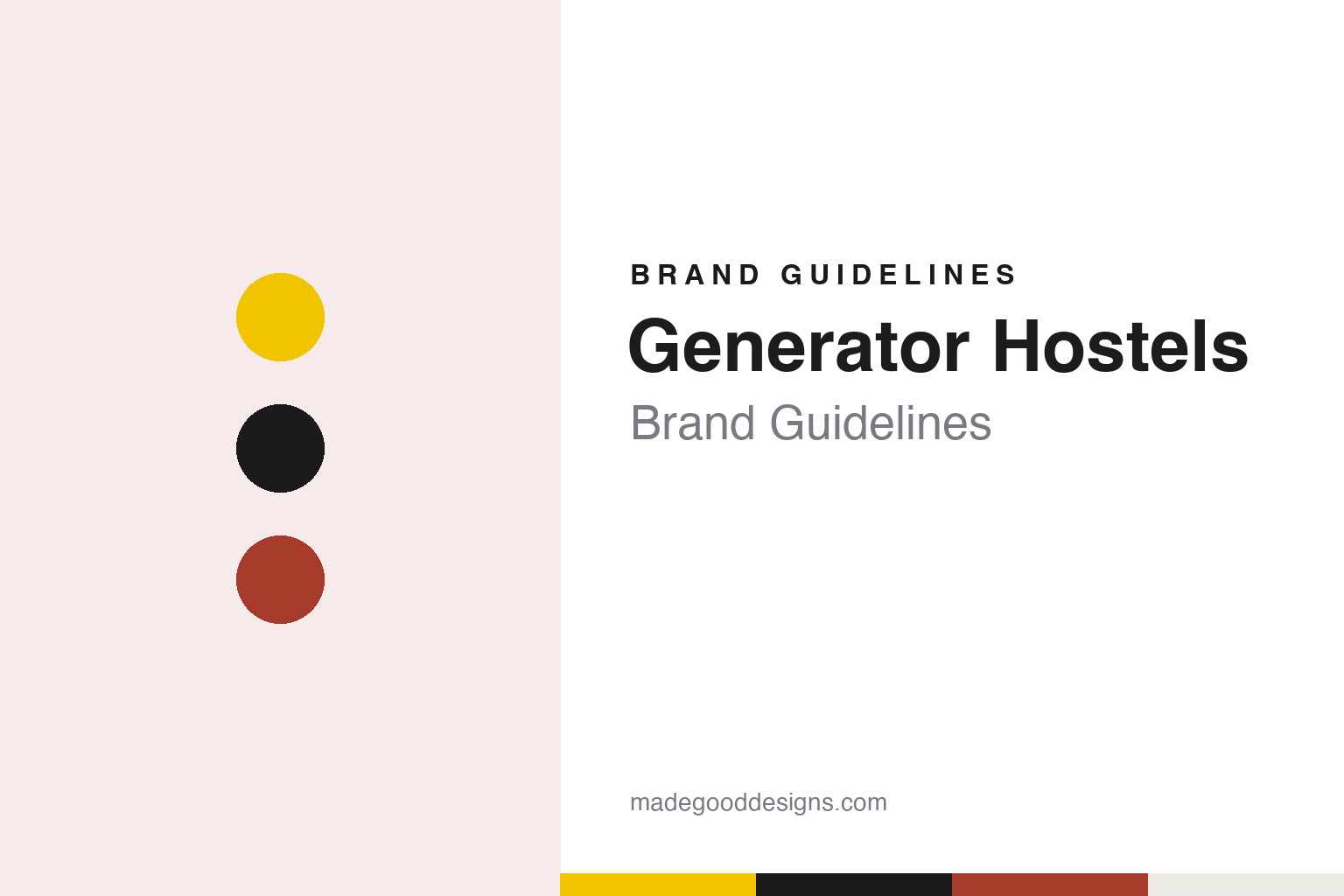
Generator Hostels Brand Guidelines
A London hostel of 1995 that learned to speak through its walls.
Aa
Two constants: a canary yellow, black and brick red palette and a heavy grotesque register for lettering used at the scale of a room. Abstract homage — not a Generator product or mark; no logo or sign is reproduced.
A London hostel of 1995 that grew across Europe
The Duffys, a former police station and a 2014 relaunch.
Generator began as a single hostel in London in 1995. English Wikipedia says it was set up as one property by the siblings Louise and Kingsley Duffy, and The Guardian, reporting on 5 March 2014, likewise dated the opening of Generator’s London branch to 1995. The newspaper recalled that at the time the common picture of a hostel was one of dingy rooms, metal bunks and wall paintings, and it described Generator as a hostel brand that had become known for stylish, contemporary interiors.
Wikipedia traces the spread of the brand from that one building. It says the company opened its second hostel, in Berlin, in 2002, and that in 2007 the two properties were acquired by the investment firm Patron Capital. The hotel design magazine Sleeper reported on 14 September 2015 that Josh Wyatt had led the origination of the Generator business on behalf of Patron in 2007. From 2011, Wikipedia says, openings followed in Copenhagen and Dublin, then a second Berlin site along with Venice, Barcelona and Hamburg, before Paris in February 2015, Amsterdam in March 2016 and Stockholm in June 2016.
The original London address was rebuilt as the flagship of this larger group. The Guardian said the relaunched Generator London would open at the end of March 2014 with modern, design-led bedrooms and a range of social spaces, among them a lounge with a piano, a cafe and a new check-in area, plus features that pointed to the city, including a London bus turned into a DJ booth. Sleeper, in a first look published on 31 March 2014, said the hostel was housed in a former police station and quoted Anwar Mekhayech, a partner at the design firm DesignAgency, calling the job “the tricky task of updating a fifteen year old hostel”. He said the building was a labyrinth of rooms, which led the team to create a series of concept spaces, and that the goal was to accentuate Generator’s newly developed branding and design-style while paying tribute to London’s mod character.
The same article listed the details through which the brand spoke inside the building. Guests were greeted by a laser-cut “hello” on a reception desk inspired by the British Navy, while a custom train-station board displayed travel information. The Shoreditch art collective Acrylicize supplied bold graphics, rich patterns and British cultural references; a chill-out room was painted canary yellow, the dorm rooms were wrapped in boldly coloured camouflage graphics, and a piano in a pink lounge was hand-painted by Goodwives and Warriors. The reception itself was built from reclaimed wood and brick.
Colour
DesignAgency, city themes and a run of owners.
Generator’s look has been developed with one design partner across many cities. Sleeper reported on 11 March 2015 that DesignAgency, an interiors firm based in Toronto, was Generator’s Global Design Partner and designed each location, under the creative direction of Anwar Mekhayech. Each hostel took a theme from its city. In Paris, the magazine said, an eight-storey office block of 1985 in the 10th arrondissement was gutted by the Parisian architects Studios d’Architecture Ory & Associés, and the interiors were inspired by the cinematic experience of strolling the city’s streets. Guests entered beneath a lit marquee hung over a Mondrian-inspired reception desk; an upper lounge carried a typographic mural by the Dutch artist Ceizer; and the bar was dressed as a Paris metro platform, with curved metro tiles and retro seat fabrics. Mekhayech told the magazine the project let the team give the interiors “a bold attitude and a unique spirit”.
The same approach travelled north. Sleeper reported on 15 July 2016 that Generator had opened in Stockholm, close to the city centre, in a scheme by DesignAgency that aimed to reflect the culture and aesthetics of the city, with communal areas built around food, art, music, design and performances by local artists, and an events space for a talks series called GenTalks. The magazine had reported in September 2015 that Fredrik Korallus, who had previously led brands such as Radisson Blu, Park Inn by Radisson and Regent Hotels, was the new chief executive.
Ownership then changed several times. HOTELSMag reported on 13 March 2017 that Patron Capital and Invesco Real Estate, which had taken a stake in 2014, were selling Generator to the private equity firm Queensgate Investments. Sleeper reported on 12 May 2017 that the deal was complete, that Queensgate planned to own the portfolio for the long term, and that Alastair Thomann and Andre Guettouche, both formerly of Penta Hotels, had been appointed chief executive and chief operating officer. That report summed up the brand as focused on capital-city addresses, design-led interiors and shared social spaces.
HOTELSMag reported on 15 May 2025 that Brookfield Asset Management was acquiring Generator’s European business from Queensgate, citing earlier reporting by the Financial Times. The same report said the sale did not include Generator’s properties in the United States or its sister brand Freehand Hotels, which Queensgate had bought in 2019. On 20 July 2026 the magazine reported that Xavier Mufraggi, formerly head of Club Med’s North America and Caribbean division, had been named chief executive following Brookfield’s acquisition of the company in 2025, with renovations of the London, Paris, Dublin and Hamburg hostels planned for 2026 and 2027.
Typography
Design and documentation.
In a boutique hotel the lobby often does more brand work than the logo. It is where a guest first meets the name, the lighting, the music and the people at the desk, and it is usually the room that appears in photographs shared by guests and visitors. When a single name runs several properties, a common approach is to keep a recognisable tone while letting each building borrow from its neighbourhood: a local material on the bar, a reference to an earlier use of the site, colours drawn from nearby streets. The identity then works less like a template and more like a set of habits that travel from city to city.
Much of that identity is carried at hand scale. Key cards, room-door signs, do-not-disturb hangers and bathroom amenities repeat the mark on objects that guests handle many times a day and sometimes take home. Many hotels also give their restaurants and bars their own names, so a second identity has to sit beside the first on menus, napkins and street signage without competing with it. All of this asks a lot of the core mark. It has to read in metal or neon on a façade seen from across the road, and it also has to survive being stitched small on a pillow tag, printed on a shampoo bottle or embossed on a card. A system that plans for both sizes from the start tends to hold together better than one that adapts later.
Aa
A heavy grotesque — the register of lettering painted, cut or lit at the size of a wall rather than a page. (Specimen set in Archivo Black, a sans STAND-IN; NOT the Generator logo.)
Generator
A hostel brand told through its rooms.
The first element of the Generator identity is the hostel, recast. From a single London building of 1995 it grew into a chain that trade coverage repeatedly describes as design-led, and The Guardian’s report on the 2014 relaunch set it against the older image of dingy rooms and metal bunks.
The second element is the city theme. Under DesignAgency, each Generator borrows its props from its place: a London bus and a Navy-style desk in a former police station, a cinema marquee and metro tiles in Paris, local art and performance in Stockholm. The name stays constant while the rooms change their accent.
The third element is lettering and graphics used as decoration. A laser-cut greeting, a station departure board, wall-to-ceiling camouflage and a typographic mural all put type and pattern at the scale of the room, so the identity is read as much on the walls as on any sign.
For a design guide, Generator shows how a hostel brand can carry its identity through interiors that change from city to city. Compare the The Hoxton Brand Guidelines and the Ruby Hotels Brand Guidelines. For this guide we use canary yellow, black and brick red with a heavy grotesque sans, an unofficial interpretation; no product or logo is reproduced.
Explore & save
Keep Generator Hostels’s identity on hand — save it to a board in the Made Good inspiration library.
The Generator identity set
Pin the Generator canary yellow, black and brick red palette and the wall-scale grotesque register to your own board.