Sir Hotels Brand Guidelines
An Amsterdam honorific that gives every hotel a first name.
Aa
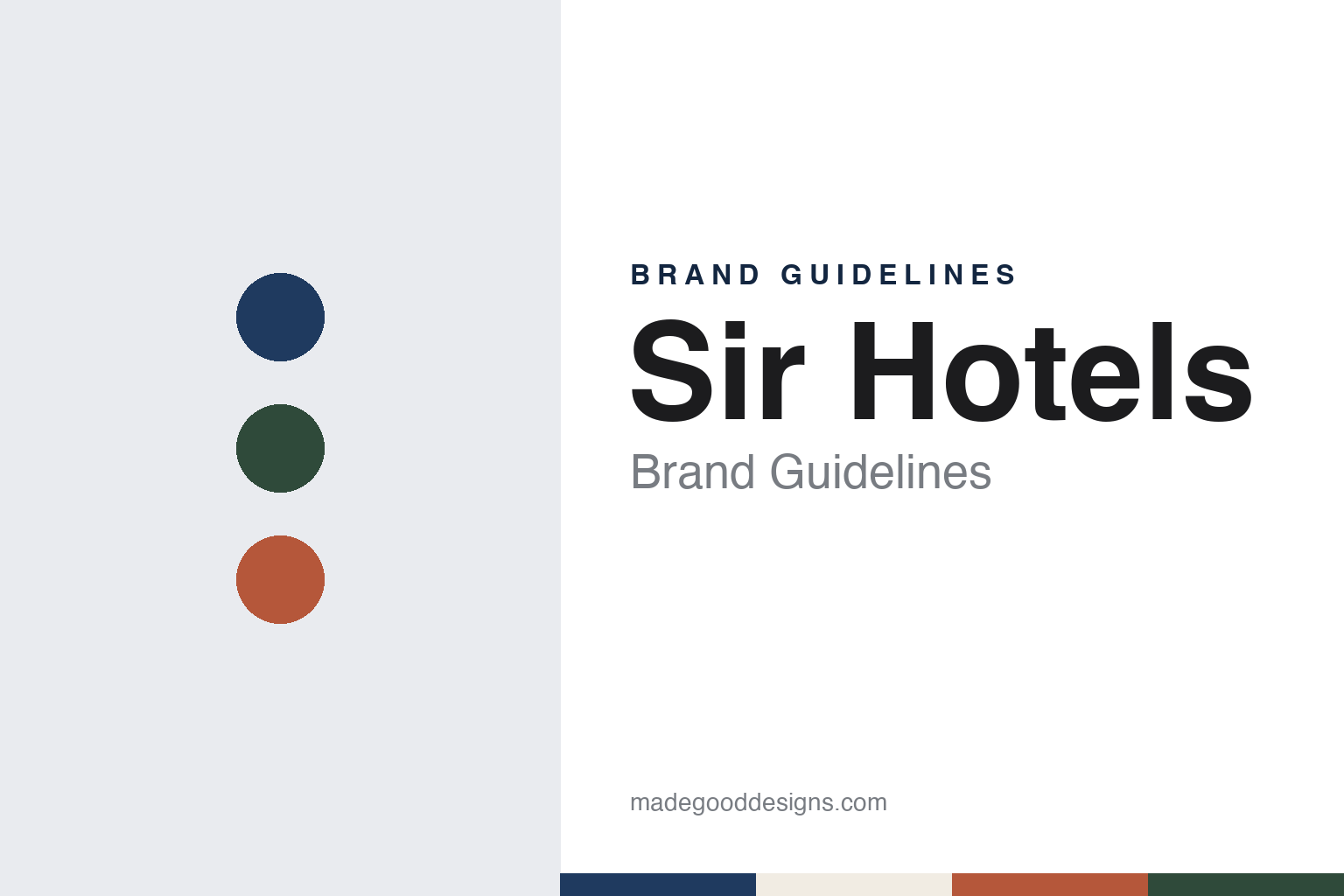
Two constants: a deep blue, forest green and terracotta palette and a high-contrast serif register for a name that works like a title. Abstract homage — not a Sir Hotels product or mark; no logo or sign is reproduced.
A diamond factory in De Pijp
Liran Wizman, Park Centraal and Sir Albert.
Sir Hotels is a hotel brand of the Amsterdam-based group Sircle Collection, founded by the entrepreneur Liran Wizman. The company’s own history says the collection began in Amsterdam in 2013 with Sir Albert, a hotel in a former diamond factory in the De Pijp district. The hotel design magazine Sleeper, in a profile of Wizman published on 16 September 2020, described the building in the same way, as a former diamond-cutting factory, and said Sir Albert was designed by the studio Baranowitz + Kronenberg to channel old-world luxury with industrial leanings.
The same profile set out the background to the brand. Sleeper said Wizman was born in Tel Aviv and had worked as a lawyer and economist before moving into hotel development, and that he founded the hotel management company Grand City Hotels Group in 2001. It dated the start of the Sircle story to 2006, when he acquired Park Hotel Amsterdam, an early twentieth-century building between the Rijksmuseum and the Vondelpark that was reworked by FG Stijl and is now called Park Centraal Amsterdam. Wizman told the magazine that this project was where he was drawn into the design side of hotels, and that “since then I’ve really liked to focus on design.”
According to Sleeper, the collection had its formal beginnings in 2011, and Sir Hotels was the label with which the group began creating brands of its own. The magazine said the idea was to combine the comfort of a luxury hotel with the neighbourhood feel of something more affordable and authentic, and that Sir Albert translated the “big town” feeling of Amsterdam into a hotel that tapped into its local community. Wizman described the thinking behind it: “For me, a hotel is something that needs to serve the neighbourhood and the city as much as it does the guest.” He said that a collection of spaces where locals and guests can mix lets a hotel become a destination within the city rather than just a venue.
The designers of Sir Albert were already known to him. Sleeper said Baranowitz + Kronenberg had worked with Wizman on the Amsterdam restaurant Momo, and that the studio went on to design Sir hotels in Berlin, Barcelona and Ibiza: Sir Savigny, Sir Victor and Sir Joan. Wizman told the magazine that working with a designer is a very personal process, “because you need to speak the same language.”
Colour
One designer per city, then a new umbrella name.
Sir Hotels has no single house interior. Wizman’s approach, as he described it to Sleeper in 2020, is to choose a designer for each city: “When selecting designers, we look at who has done work in the city, and then what the city needs.” For Sir Adam in Amsterdam, he explained, the way the building looked out onto the water reminded the team of the Hudson River, so the New York studio ICrave was brought in. The company’s own history says Sir Adam is in the A’DAM Tower and opened shortly after Sir Savigny, which arrived in Berlin’s Charlottenburg neighbourhood in 2016, and that Sir Victor opened in Barcelona in early 2019. Sleeper added that the brand also reached Germany and Ibiza with Sir Nikolai and Sir Joan.
Food and drink form part of the same vocabulary. Sleeper said that The Entourage Group, a food and drink company Wizman set up with Yossi Eliyahoo, was behind The Butcher burger restaurants at Sir Adam, Sir Joan and Sir Savigny and the Mr Porter restaurants in Amsterdam and Barcelona. At Sir Victor, Wizman said, the group created Mr Porter as “a standalone venue with its own character”, and gave the rooftop bar its own branding.
In January 2020 the parent company took a name built on the brand. Sleeper reported on 20 January 2020 that the Amsterdam group Europe Hotels Private Collection had become Sircle Collection, covering Sir Hotels, Max Brown Hotels and Park Centraal Hotels. The refreshed identity was designed by the London studio Studio Frith and, the magazine said, included a new logo, clean and simple illustrations and a vibrant colour palette, alongside a new website and guest platform. In its September 2020 profile Sleeper said the new name drew its inspiration from the Sir Hotels brand, and Wizman said it was meant to bring the group together “as one family, to connect all those dots.”
Later projects carried the brand to new designers. Sleeper reported on 8 November 2021 that a new Berlin hotel, Sir Frankie, was being designed by the Berlin designer Werner Aisslinger, and that a Sir hotel in Lisbon’s Bairro Alto was being designed by Lázaro Rosa-Violán; it described Sir hotels as combining contemporary, design-led interiors with nostalgic details. On 22 September 2025 the magazine reported the opening of Sir Devonshire Square, the brand’s debut in London, in a restored seventeenth-century textile warehouse in East London’s Devonshire Square courtyard. Its interiors were directed by the studio Maison 191, led by Samuel Wright, and drew on Bauhaus geometry and the textile work of Anni Albers, with guestrooms in deep blues, greens, browns and earthy reds set against natural timber. The company’s history says Sir Prague also opened in 2025.
Typography
Design and documentation.
In a boutique hotel the lobby often does more brand work than the logo. It is where a guest first meets the name, the lighting, the music and the people at the desk, and it is usually the room that appears in photographs shared by guests and visitors. When a single name runs several properties, a common approach is to keep a recognisable tone while letting each building borrow from its neighbourhood: a local material on the bar, a reference to an earlier use of the site, colours drawn from nearby streets. The identity then works less like a template and more like a set of habits that travel from city to city.
Much of that identity is carried at hand scale. Key cards, room-door signs, do-not-disturb hangers and bathroom amenities repeat the mark on objects that guests handle many times a day and sometimes take home. Many hotels also give their restaurants and bars their own names, so a second identity has to sit beside the first on menus, napkins and street signage without competing with it. All of this asks a lot of the core mark. It has to read in metal or neon on a façade seen from across the road, and it also has to survive being stitched small on a pillow tag, printed on a shampoo bottle or embossed on a card. A system that plans for both sizes from the start tends to hold together better than one that adapts later.
Aa
A high-contrast serif — the register of a title placed before a first name, set like a calling card. (Specimen set in DM Serif Display, a serif STAND-IN; NOT the Sir Hotels logo.)
Sir Hotels
A title, a first name and a designer per city.
The first element of the Sir Hotels identity is the building. The brand began in a former diamond factory in De Pijp, and its London hotel occupies a restored textile warehouse; the company says each Sir combines historic architecture with art, locally inspired design and guest experiences that embrace the community around it.
The second element is the designer chosen for the city. Baranowitz + Kronenberg in Amsterdam, Berlin, Barcelona and Ibiza, ICrave at the waterside Sir Adam, Werner Aisslinger in Berlin and Maison 191 in London each worked to an approach that Wizman framed around what a city needs. The name stays fixed while the interiors change, which the company sums up in its line that no two Sirs are the same.
The third element is the family name. The “Sir” title gives each hotel a first name, from Albert and Adam to Victor and Frankie, and in 2020 it supplied the root of the parent company’s new name, Sircle Collection, with an identity by Studio Frith.
For a design guide, Sir Hotels shows how a short honorific can link a set of hotels whose interiors are designed city by city. Compare the citizenM Brand Guidelines and the 25hours Hotels Brand Guidelines. For this guide we use deep blue, forest green and terracotta with a high-contrast serif, an unofficial interpretation; no product or logo is reproduced.
Explore & save
Keep Sir Hotels’s identity on hand — save it to a board in the Made Good inspiration library.
The Sir Hotels identity set
Pin the Sir Hotels deep blue, forest green and terracotta palette and the honorific serif register to your own board.