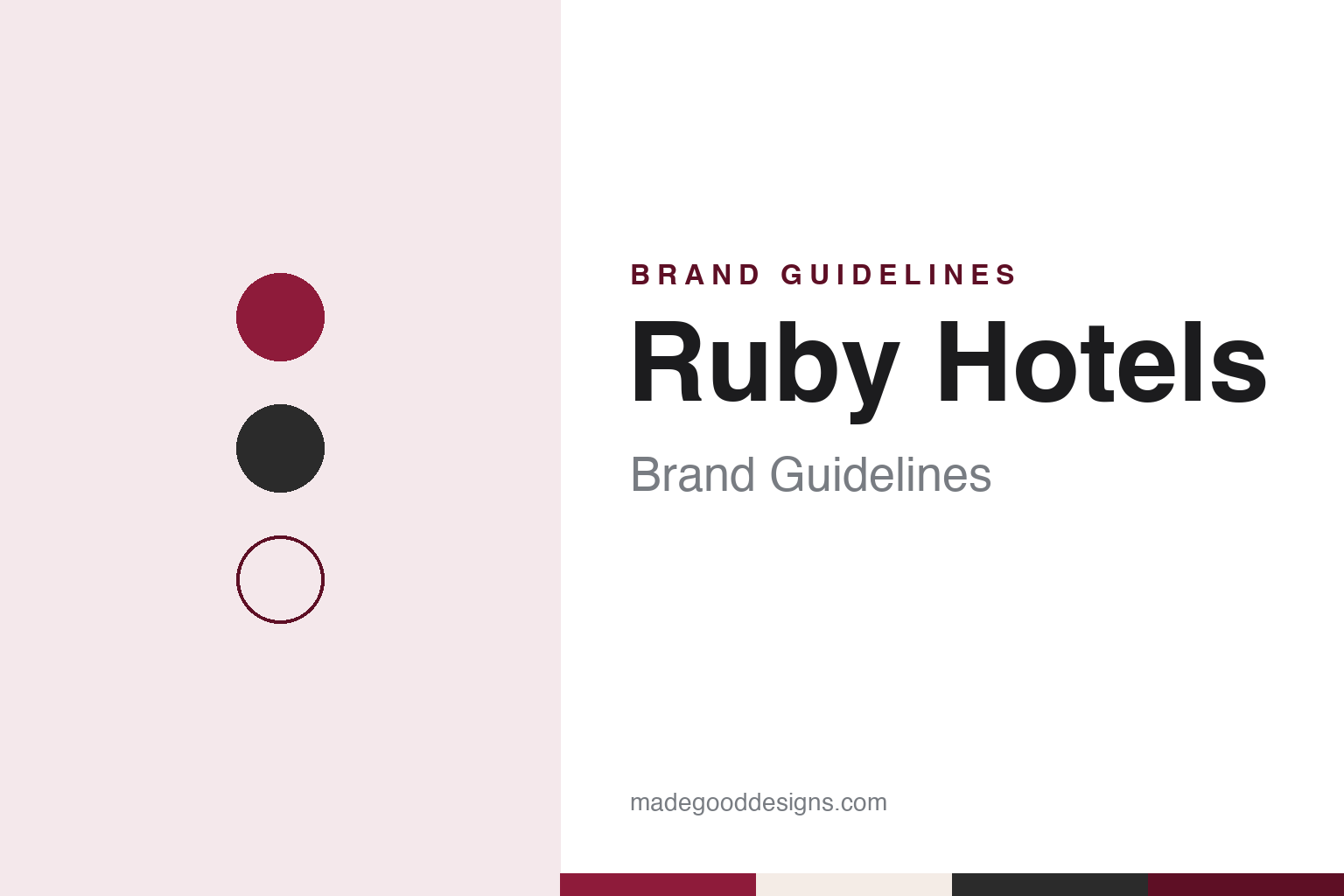
Ruby Hotels Brand Guidelines
A Munich hotel name of 2013 that pared luxury back to the bed, the shower and the bar.
Aa
Two constants: a ruby red and graphite palette and a high-contrast serif register for a name its founder called sensual and a little daring. Abstract homage — not a Ruby Hotels product or mark; no logo or sign is reproduced.
A hotel name from Munich
Michael Struck, a dream and “lean luxury.”
Ruby is a hotel brand from Munich. The design trade magazine Hotel Designs, in a report of 20 November 2018, described the company as Munich-based and said the Ruby Group was launched in 2013 under its founder and chief executive Michael Struck. A press release from IHG Hotels & Resorts dated 18 February 2025 also gave 2013 as the year Ruby was established. The travel blog Germany Is Wunderbar, writing on 22 November 2018, described Struck as a Munich-based entrepreneur who had previously run a group of five-star hotels, and said he aimed Ruby at what he called the “cosmopolitan avantgarde,” travellers who choose hotels by peer reviews rather than by star ratings.
In a question-and-answer interview with Boutique Hotel News published on 2 November 2015, Struck said he had founded two hotel groups before Ruby and had been managing director of a mid-sized European hotel chain, and that Ruby came from a decision to take a more radical approach. He said the name came to him in a dream, and he described Ruby as sensual, intelligent and a little daring. English Wikipedia notes that all of the hotels carry women’s first names, and the 2015 interview gave two Vienna examples, Ruby Sofie and Ruby Marie.
Struck summed up the idea as “lean luxury”: offering guests what they want, but no more. In the 2015 interview he described small but ergonomically planned rooms with a yacht-like interior and high-quality finishes, close attention to beds and showers, a bar, a coffee shop serving breakfast from local suppliers, and self-service check-in that freed staff to greet guests. He said the guests Ruby had in mind were cosmopolitan and valued originality and character, and that the company defined them by shared values rather than by age, gender or income. He said each hotel has its own character, with the standardised parts of the system kept “below the surface” where they do not affect that individuality.
Colour
Shared bars, guitars and local stories.
The design language followed from what was left out. Hotel Designs reported in 2018 that the Ruby model did without features usually associated with high-end hotels, such as in-house restaurants, minibars and room service, in favour of communal areas with breakfast and a “maxi bar.” It described modular architecture and flexible layouts used to make the most of awkward buildings, public areas that mixed an industrial look with a music theme, brightly coloured corridor carpets, and white rooms with bold lighting and fittings. It also mentioned in-room tablets and phones loaded with city guides, a self-check-in system, and plans for a first UK hotel on London’s South Bank. Germany Is Wunderbar said a single shared space served as bar, breakfast room, lounge and reception, and described rich textiles, hardwoods and wood wall panelling, bedding and lighting developed with advice from sleep scientists, and an amplifier and electric guitar that guests could borrow from reception.
Each building’s past was used as material. In the 2015 interview Struck said Ruby Sofie in Vienna occupied a former concert hall and event venue, and that its stories shaped the interior design. He described Ruby Marie, on Vienna’s Mariahilfer Strasse, as occupying a building of 1911 that had been Austria’s first department store. English Wikipedia says the brand combines new construction with conversions of existing buildings such as former offices and shops. The IHG release of 2025 described Ruby as a premium urban lifestyle brand whose hotels blend design with local stories tied to each city, with bars open around the clock and space-efficient layouts.
The 2025 release announced that IHG Hotels & Resorts had acquired the Ruby brand, making it IHG’s twentieth brand. It said IHG was not acquiring The Ruby Group’s operating company, which would continue to run the open hotels and those it develops under the brand through individual franchise agreements, and that the hotels would join the IHG One Rewards programme between later in 2025 and March 2026. Struck was quoted saying IHG had a proven record of preserving identity and culture when integrating brands.
Typography
Design and documentation.
In a boutique hotel the lobby often does more brand work than the logo. It is where a guest first meets the name, the lighting, the music and the people at the desk, and it is usually the room that appears in photographs shared by guests and visitors. When a single name runs several properties, a common approach is to keep a recognisable tone while letting each building borrow from its neighbourhood: a local material on the bar, a reference to an earlier use of the site, colours drawn from nearby streets. The identity then works less like a template and more like a set of habits that travel from city to city.
Much of that identity is carried at hand scale. Key cards, room-door signs, do-not-disturb hangers and bathroom amenities repeat the mark on objects that guests handle many times a day and sometimes take home. Many hotels also give their restaurants and bars their own names, so a second identity has to sit beside the first on menus, napkins and street signage without competing with it. All of this asks a lot of the core mark. It has to read in metal or neon on a façade seen from across the road, and it also has to survive being stitched small on a pillow tag, printed on a shampoo bottle or embossed on a card. A system that plans for both sizes from the start tends to hold together better than one that adapts later.
Aa
A high-contrast display serif — the register of a short name with a jewel’s colour and a founder’s description as sensual and a little daring. (Specimen set in DM Serif Display, a serif STAND-IN; NOT the Ruby Hotels logo.)
Ruby Hotels
Luxury edited down to essentials.
The first element of the Ruby identity is the editing. From the start Michael Struck described the brand by what it would and would not offer, keeping the bed, the shower and the bar and removing much of the rest. That brief shows in the design: compact rooms planned like a yacht cabin, one shared space doing several jobs, and machines taking over the check-in desk.
The second element is the name. A single short word, said by its founder to have come in a dream, is paired in each city with a woman’s first name, so that every hotel reads as a character within one family rather than as a numbered branch.
The third element is the building. Former concert halls, department stores and offices supply the stories that the interiors draw on, while music, borrowed guitars and the bar give the public rooms a shared tone from city to city. When IHG bought the brand in 2025, Struck spoke of preserving the identity and culture of the brands it integrates.
For a design guide, Ruby shows how a hotel brand can be defined by subtraction and still feel considered. Compare the citizenM Brand Guidelines, another compact-room lifestyle hotel in Europe, and the 25hours Hotels Brand Guidelines, a German brand also built on local stories. For this guide we use ruby red, graphite and warm white with a high-contrast serif, an unofficial interpretation; no product or logo is reproduced.
Explore & save
Keep Ruby Hotels’s identity on hand — save it to a board in the Made Good inspiration library.
The Ruby Hotels identity set
Pin the Ruby Hotels ruby red, graphite and warm white palette and the high-contrast serif register to your own board.