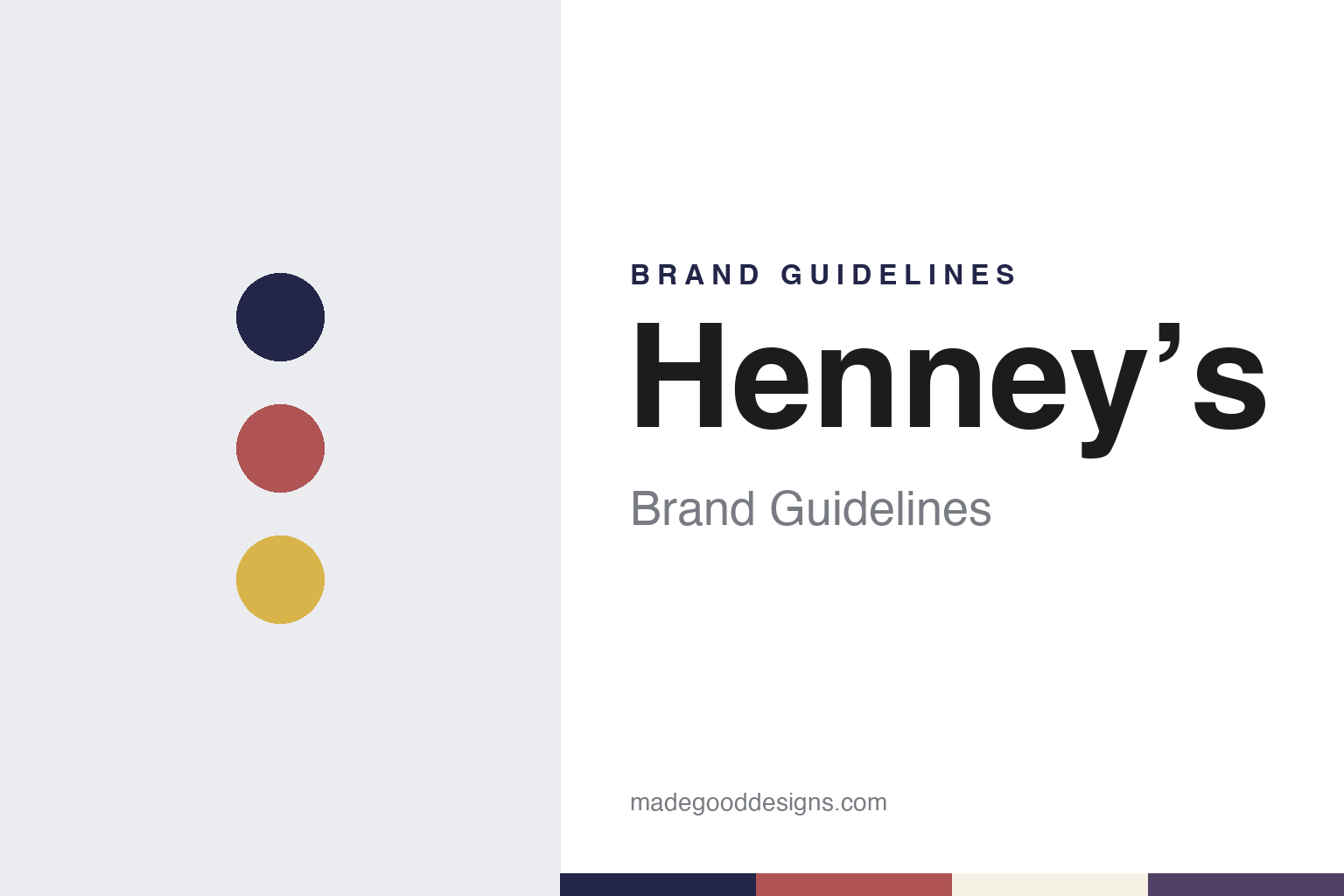
Henney’s Brand Guidelines
Mike Henney’s Herefordshire cider, from a hobby in 1996.
Aa
Two constants: a navy, plum and cider red palette and an engraved capitals serif register. Abstract homage — not a Henney’s product or mark; no label, logo or bottle is reproduced.
From the airing cupboard
One cider maker and a hobby that grew.
Henney’s is a Herefordshire cider brand named after the man who started it. “Mike Henney started making cider as a hobby in 1996,” the company’s website says. At that time, it says, the cider was five gallons fermented in his airing cupboard, “but the hobby got a bit out of hand.” By the company’s own figure, production in 2013 reached more than 250,000 gallons — “no longer in the airing cupboard.”
The business is based at Bishops Frome, a village and parish in eastern Herefordshire, south of Bromyard, through which the River Frome flows, according to English Wikipedia. The trading company, Henney’s Cider Company Limited, was incorporated in May 2003, and Companies House lists it as active, with accounts filed to March 2026 and a confirmation statement dated March 2026, classified under the manufacture of cider and other fruit wines.
The trade press first records the brand under a second name. The Grocer reported in October 2005 that Henney’s was “the producer of the Frome Valley cider brand,” named Mike Henney as managing director, and said the company already had national listings for its Frome Valley Dry cider at Tesco and for its Medium at Asda and Booths. Henney told the magazine that his plan was “to double production this year,” saying the rate of sales growth of Frome Valley had encouraged it.
Colour
A small company with key partners.
Henney’s describes itself as a small business that works through partners rather than one large plant. “The business is still run by Mike in close collaboration with some key service providers,” its website says. It names two. Wyre Croft Farm at Bishops Frome, the company says, supplies apples and also mills and presses the fruit and stores the juice; Branded Drinks Bottling in the Forest of Dean, it says, provides packing and warehousing. The company gives Mike Henney’s aim as making “the best cider possible” and providing customers with a great service, which he believes is best achieved “by keeping every process as simple as possible.”
Its account of the cider-making is detailed. The company says the fruit is washed at the mill in autumn, with orchard debris and rotten apples removed, then milled and pressed in a hydraulic press, and that the juice is dosed with a small amount of sulphite, rested for about twelve hours and then fermented with a cultivated Champagne yeast for several weeks until all the sugar has turned to alcohol. The cider is then separated from the spent yeast and held in tanks to mature for at least four months, the company says, before bottling and pasteurisation in a steam tunnel.
It also sets out what it does not do. “Unlike many makers, Henney’s do not add fermenting sugars to the fresh juice or concentrate the juice and re-hydrate,” its website says, so that the declared alcohol can be reached with minimal dilution or none. The company says all its ciders are genuine craft products made from locally grown apples, and it presents them under the Herefordshire cider protected geographical indication, which, it explains, can be used only by cider that meets minimum requirements on provenance and ingredients. These are the company’s own descriptions.
Typography
Design and documentation.
The seven brands in this group are cider and alcohol-free drinks names: Old Mout, Dunkertons, Sheppy’s, Henney’s, Ceder’s, Big Drop and Lucky Saint. Four are ciders, and three were built around drinks without alcohol: an alcohol-free alternative to gin and two alcohol-free beers. Brands like these sit at many different points in the trade, from family cider makers that still carry a founder’s name to labels that now belong to much larger drinks groups, and to young companies started to fill a gap on the shelf.
A cider or an alcohol-free drink is usually recognised less by what is in the glass than by a label, a name and the place or story it promises, because the company behind the name may have changed hands, moved its production or had its drinks made by someone else from the start. That makes the questions behind each name worth asking plainly: who started it, who owns it now, and where its drinks are actually made.
Each guide separates what independent sources record from what the company says about itself — its founding story, its owners over time, where its drinks are made and how its labels and cans have changed — and marks plainly what rests only on the company’s own word.
Aa
An engraved-capitals serif, after the small capitals of the brand’s website. (Specimen set in Cinzel, a serif STAND-IN; NOT the Henney’s logo.)
Henney’s
Three names on the shelf.
The range is short and named plainly. The company’s product page shows five bottled ciders — Medium, Dry, Sweet, Vintage and Autumn Gold — and the brand has used several names on its labels: Henney’s itself, Frome Valley and England’s Pride. The Grocer reviewed England’s Pride in June 2010, during the football World Cup, calling it “a cider from a small supplier in Bishops Frome” and listing its competition as Gaymers, St Helier and Kopparberg, the Swedish fruit cider; one of its reviewers, a retail buyer, described a clear glass bottle with “a striking label” for the summer of football, and the magazine’s own writer tied the cider to the flag of St George then on display across the grocery trade.
Its website is a record of the brand’s look in its own right. The pages credit Wordsearch Ltd as their web designer, set their text in Georgia, a serif, and specify a palette of deep navy, slate indigo and plum for type, with a muted red for links; much of the text is set as images in small capitals. A copyright line dated 2025 shows the site still being maintained.
The company still carries the founder’s name, and its story centres on one person: Mike Henney, the founder named on its website, and the partners he works with at Bishops Frome and in the Forest of Dean.
For a design guide, Henney’s shows how a small producer can build a brand on a founder’s name, a valley and a county’s protected name. Compare Westons, the family cider maker of Much Marcle, also in Herefordshire, and Bulmers, the Hereford cider. For this guide we use navy, plum and a cider red with a serif, an unofficial interpretation; no product or logo is reproduced.
Explore & save
Keep Henney’s’s identity on hand — save it to a board in the Made Good inspiration library.
Henney’s identity set
Pin the Henney’s Frome navy, plum and cider red palette and the engraved capitals serif register to your own board.