HiKoo Brand Guidelines
The house yarn line of a Seattle-area needle and yarn distributor.
Aa
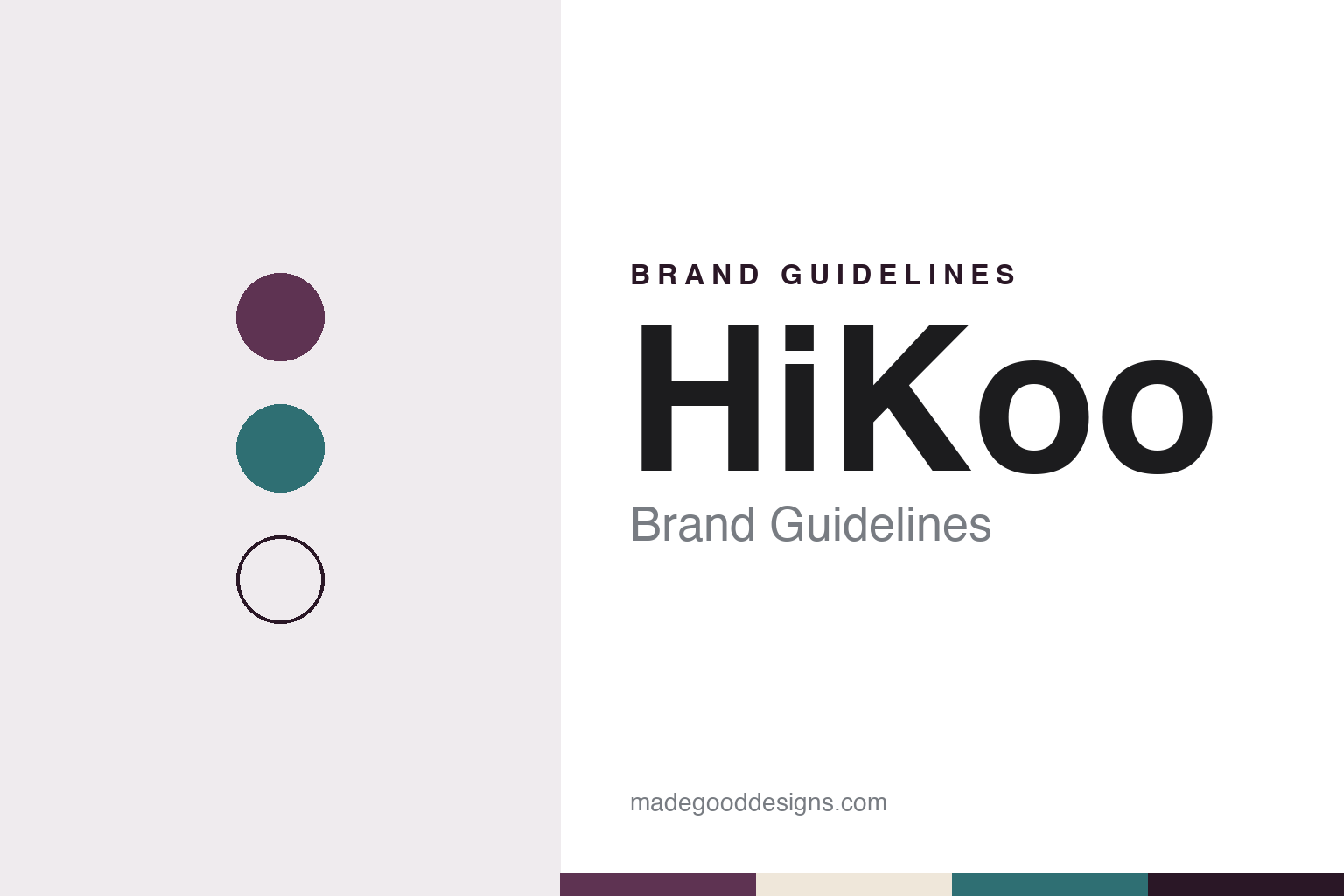
Two constants: a plum, cream and teal palette and a friendly sans register. Abstract homage — not a HiKoo product or mark; no yarn label, logo or packaging is reproduced.
Skacel Collection
A needle importer that built its own yarn line.
HiKoo is not a mill. It is the house yarn line of Skacel Collection, Inc., a wholesaler of hand-knitting yarns and needles whose warehouse and offices are, in its own words, “just south of Seattle, Washington”; its website and trademark filings give the address as Kent. The company sells to local yarn shops and approved online retailers rather than direct to knitters, and HiKoo reaches knitters the same way.
Skacel tells its own story in some detail, and all of it is the company’s account. It says the business was founded in 1987 by Ingrid and Hans Skacel, a German-born couple who had settled in the United States, as a distributor of European yarns. A year later, the company says, Ingrid Skacel met Thomas Selter, the owner of the German needle maker addi, and began importing addi circular needles; the “addi Turbo” name, Skacel says, came from a shop owner who reported that the needles sold at “Turbo” speed. Skacel still describes itself as the sole US and Canadian distributor of the skacel by addi needle line, the artfelt felting range and the German yarn maker Schoppel.
Ownership has stayed close to the founders. The company says their daughter Karin Skacel took over in 2006, and that the business is now owned by Rob Delmont, who joined in 1998 as a sales coordinator and rose to president. We could not check the ownership change against an independent source, so we give it as the company’s statement.
Colour
A trademark filed in 2012, a first use claimed in 2010.
The clearest record of who owns HiKoo is the United States trademark register. The word mark HIKOO, for hand-knitting yarns, is registered to Skacel Collection, Inc. of Kent, Washington. According to the register data, the application was filed on 23 October 2012 and registered on 11 June 2013; it claims first use on 15 October 2010, and the registration has since been renewed. That settles a point the company’s own pages leave vague: although Skacel’s “About us” page lists HiKoo next to the lines it distributes for other makers, the name itself belongs to Skacel.
The earliest HiKoo pages preserved by the Internet Archive date from late 2014, when Skacel’s website was selling Simplicity yarn and a HiKoo Sock Puppets pattern that it said was designed by Kathy Gometz for the company. A HiKoo page archived in September 2015 summed up the line in one sentence: “High quality fashion yarns at affordable prices.” By February 2023 the company was describing HiKoo as “a line of quality yarns created to inspire and delight” and said there were more than two dozen yarns in it. That month it also ran a HiKoo Haiku Contest for knitters in the United States, inviting poems of five, seven and five syllables — a play on the brand’s name.
The range leans on blends. CoBaSi, which Skacel introduces with “Finally, a wool-free sock yarn!”, mixes cotton, viscose from bamboo, silk and elastic nylon. Simplicity is a machine-washable superwash merino blend that the company calls “family-friendly.” Concentric is a baby alpaca gradient that Skacel says was designed by its own team of colour specialists, and Sueño blends superwash merino with bamboo viscose. In October 2026 Skacel’s website listed seventeen HiKoo yarn pages, from fine sock yarns to a light, airy alpaca chainette.
Typography
Design and documentation.
The seven brands in this group all sell yarn for hand knitting and crochet, but they come from only three countries. From Denmark comes CaMaRose; from the United States, Quince & Co., Spincycle Yarns and HiKoo; and from Germany, Pascuali, Wolle Rödel and ONline. Grouping them this way shows how differently the same craft can be organised within one national market, and how much a yarn brand’s name, colours and paperwork can say about the kind of business behind it.
Some yarn brands are mills, spinning fibre in buildings they own. Others are design houses that choose the fibre, set the colours and write the patterns, then have the yarn made by spinners elsewhere. Some dye by hand in small batches; some sell mainly through specialist wool shops; others sell mainly to knitters directly, online or through their own stores. A brand’s look — its ball bands, its pattern books, its photography — usually follows from which of these it is.
Each guide separates what independent sources record from what the company says about itself — who founded it, who owns it now and where its yarn is made — and marks plainly what rests only on the company’s own word.
Aa
A friendly sans — a warm, shop-counter register. (Specimen set in Lexend, a sans STAND-IN; NOT the HiKoo logo.)
HiKoo
Designed by a distributor, sourced from suppliers.
Where HiKoo yarn is spun is the least documented part of the brand. Skacel describes itself as a wholesaler and distributor, not a spinner, and in the sources we checked it does not name the mills that make HiKoo or give a country of manufacture for most of the line. The exception is Sueño DK, which Skacel calls “this Peruvian yarn.” Several other descriptions name where the fibre comes from rather than where the yarn is made: Sueño Worsted uses what Skacel calls Peruvian superwash merino, Alpico combines baby alpaca with Peruvian Pima cotton, and Highland Lux is described as Andean highland wool with kid mohair. We give those as the company’s descriptions; they do not by themselves say where each yarn is spun or dyed.
What Skacel does claim as its own work is the design of the line — its colours, its blends and the patterns written for it. That fits the brand’s place in the market. HiKoo sits alongside the European lines Skacel imports, but it carries the distributor’s own name on the trademark register, so the colours, blends and put-ups are Skacel’s own decisions rather than those of a maker it represents.
Two name traps are worth noting. The domain hikoo.com is not HiKoo’s website; when we checked it in October 2026 it was a parked page, and HiKoo yarns are presented on Skacel’s own site. A separate “HIKOO” trademark for camera mounts and phone cases, filed in 2018 by a company in Shenzhen, is unrelated and, according to the register data, was cancelled in January 2026.
For a design guide, HiKoo shows how a distributor can build a house brand around the shops it already serves. Compare Schoppel, the German yarn maker Skacel represents in North America, and Cascade Yarns, another yarn house from the Seattle area. For this guide we use plum, cream and teal with a sans, an unofficial interpretation; no product or logo is reproduced.
Explore & save
Keep HiKoo’s identity on hand — save it to a board in the Made Good inspiration library.
HiKoo identity set
Pin the HiKoo plum, cream and teal palette and the friendly sans register to your own board.