Spincycle Yarns Brand Guidelines
The Bellingham handspinners who became wool-mill owners.
Aa
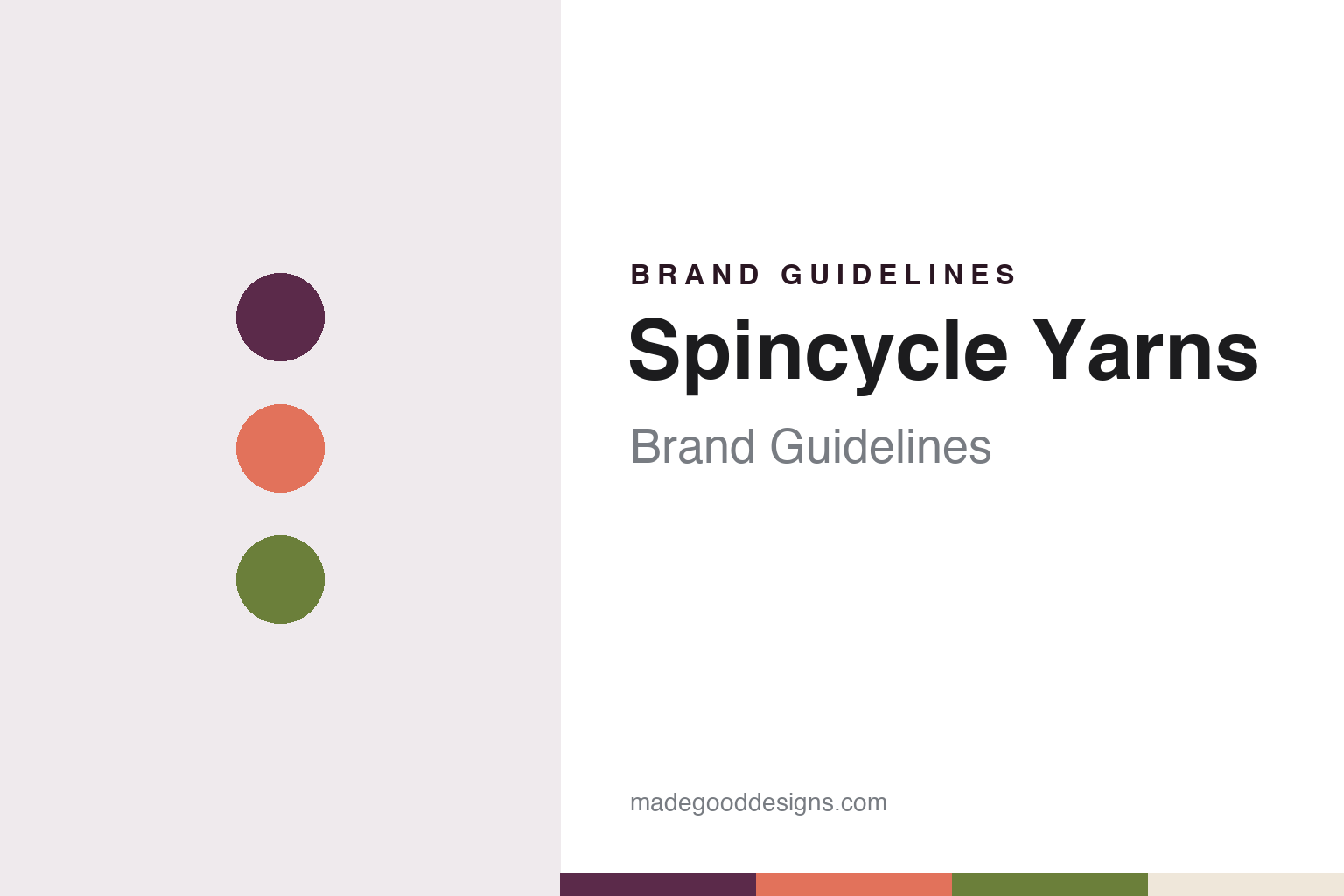
Two constants: a plum, coral and moss palette and a soft serif register. Abstract homage — not a Spincycle Yarns product or mark; no skein, label or logo is reproduced.
A handspinnery
Two dyers, a farmers’ market and a spinning wheel.
Spincycle Yarns began in Bellingham, Washington, in 2004. The company says it was started that year by Kate Burge-Tibi and Rachel Price as a handspinnery: the two of them kettle-dyed and spun small batches of yarn by hand and sold them at Bellingham’s farmers’ market. In a founders’ note on the company’s website, Price writes that the pair met while working at the town’s food co-op, found that they were both dyers and spinners, and soon quit their day jobs to make yarn full time.
The earliest independent record we found is a copy of the company’s website from December 2005, archived by the Internet Archive’s Wayback Machine. It is titled “Spincycle Handspun Yarns – Handspun Yarn from Bellingham, WA,” lists a studio in downtown Bellingham, and announces a booth at the Pacific Arts Holiday Market, a seasonal craft fair in the town. That fits the company’s account of a small handspun business selling direct to knitters in its first years.
The company writes its name “Spincycle Yarns,” with a lower-case c, and we follow that spelling. Handspinning was the foundation, and the company says the hardest part of growing was learning to make machine-spun yarn that still looked like its handspun. Full-time handspinning, Price writes, “wasn’t physically or financially sustainable.”
Colour
From kettle to mill.
The step up came through a local mill. The company says it persuaded a small mill near Bellingham — a micro mill that was then just opening — to work with it on a millspun two-ply yarn, and that this became Dyed In The Wool, still the yarn most associated with the brand. Spincycle says it kept its dyeing methods the same, “only with much bigger pots,” so that the mill yarn looked like its handspun.
That is the core of what the company presents as its signature. Most yarns, it explains, are milled first and dyed afterwards, which gives solids, tonals, speckles or dip-dyed effects. What it describes instead is a yarn whose colours change slowly along the strand, with hues that “sunset into one another” and surprise tones where one colour blends into the next, so that each skein is as unique “as a fingerprint.” The phrase “dyed in the wool” refers to colour added to the fibre before it is spun. Its FAQ also warns knitters that skeins of the same colourway bought at different times may not look alike.
When the owner of that first mill decided to retire, the founders write, they bought all of its milling equipment and moved it into a warehouse big enough for a dye house, a mill and offices. The company dates the moment it became a mill owner to 2017. Its FAQ says more than ten tons of wool pass through the mill each year, and that the mill and dye house are not open for tours.
Sourcing is a large part of the pitch. The company says its wool is “grown, processed, dyed & spun in the USA.” Its superwash blend, used in Dyed In The Wool, Dream State and Plump, is Rambouillet, Targhee and Merino wool from sheep raised mainly in South Dakota and Wyoming; its non-superwash yarns use Corriedale, Rambouillet and Columbia wool from Colorado and Wyoming; and it says all of its sheep are non-mulesed. The one stage it does not handle itself is scouring and combing, which its FAQ says is done at the Chargeurs wool plant in South Carolina. The exception to the American sourcing is Nocturne, which the company says is non-superwashed European merino. Metamorphic, which the company calls its recycled wool yarn, uses up spare fibre; the company says it throws almost none away and composts what it cannot use.
Typography
The yarn trade.
The seven brands in this group all sell yarn for hand knitting and crochet, but they come from only three countries. From Denmark comes CaMaRose; from the United States, Quince & Co., Spincycle Yarns and HiKoo; and from Germany, Pascuali, Wolle Rödel and ONline. Grouping them this way shows how differently the same craft can be organised within one national market, and how much a yarn brand’s name, colours and paperwork can say about the kind of business behind it.
Some yarn brands are mills, spinning fibre in buildings they own. Others are design houses that choose the fibre, set the colours and write the patterns, then have the yarn made by spinners elsewhere. Some dye by hand in small batches; some sell mainly through specialist wool shops; others sell mainly to knitters directly, online or through their own stores. A brand’s look — its ball bands, its pattern books, its photography — usually follows from which of these it is.
Each guide separates what independent sources record from what the company says about itself — who founded it, who owns it now and where its yarn is made — and marks plainly what rests only on the company’s own word.
Aa
A soft, warm serif for a yarn maker that began at a farmers’ market. (Specimen set in Fraunces, a serif STAND-IN; NOT the Spincycle Yarns logo.)
Spincycle Yarns
A mill in a small city.
Spincycle has grown from two spinners into a small manufacturer, and its founders describe themselves as the mill’s owners. The company said that by 2023 its team had grown to more than twenty people, and that everything from dyeing and spinning to packing, shipping, design, media and marketing is done in-house. It says new production staff take about three months, or 500 hours, to train, because few people in the United States now have experience of working in wool mills; it lists a living wage, health care and a retirement plan with profit sharing among its employee benefits.
The business has a retail side too. Its shop, Spincycle Yarns & Supply Co., is in downtown Bellingham and sells the company’s own yarns alongside other makers’ yarns, fabric and notions. The company says it bought a vacant building in Bellingham’s downtown core in 2022 and plans to renovate it to house the dye facility, mill, offices and shop, with solar power for the machines and, eventually, mill tours. In October 2026 its website still described the mill premises as a leased warehouse and the renovation as planned; we did not find an independent report of the purchase, so we give it as the company’s account.
Its range has widened from Dyed In The Wool to yarns including Dream State, Wilder and Trine, and the company says that once it could scale up production, collaborations with knitwear designers followed. In 2026 its website promoted a knit-along linked to Rhinebeck, the New York sheep and wool festival.
For a design guide, Spincycle Yarns shows how a production method can become a brand: the slow colour shifts are the look, and the story of an American mill is the message. Compare Brooklyn Tweed, another American-wool yarn maker, and madelinetosh, the Fort Worth hand-dyer. For this guide we use plum, coral, moss and fleece tones with a soft serif, an unofficial interpretation; no product or logo is reproduced.
Explore & save
Keep Spincycle Yarns’s identity on hand — save it to a board in the Made Good inspiration library.
Spincycle Yarns identity set
Pin the Spincycle Yarns plum, coral and moss palette and the soft serif register to your own board.