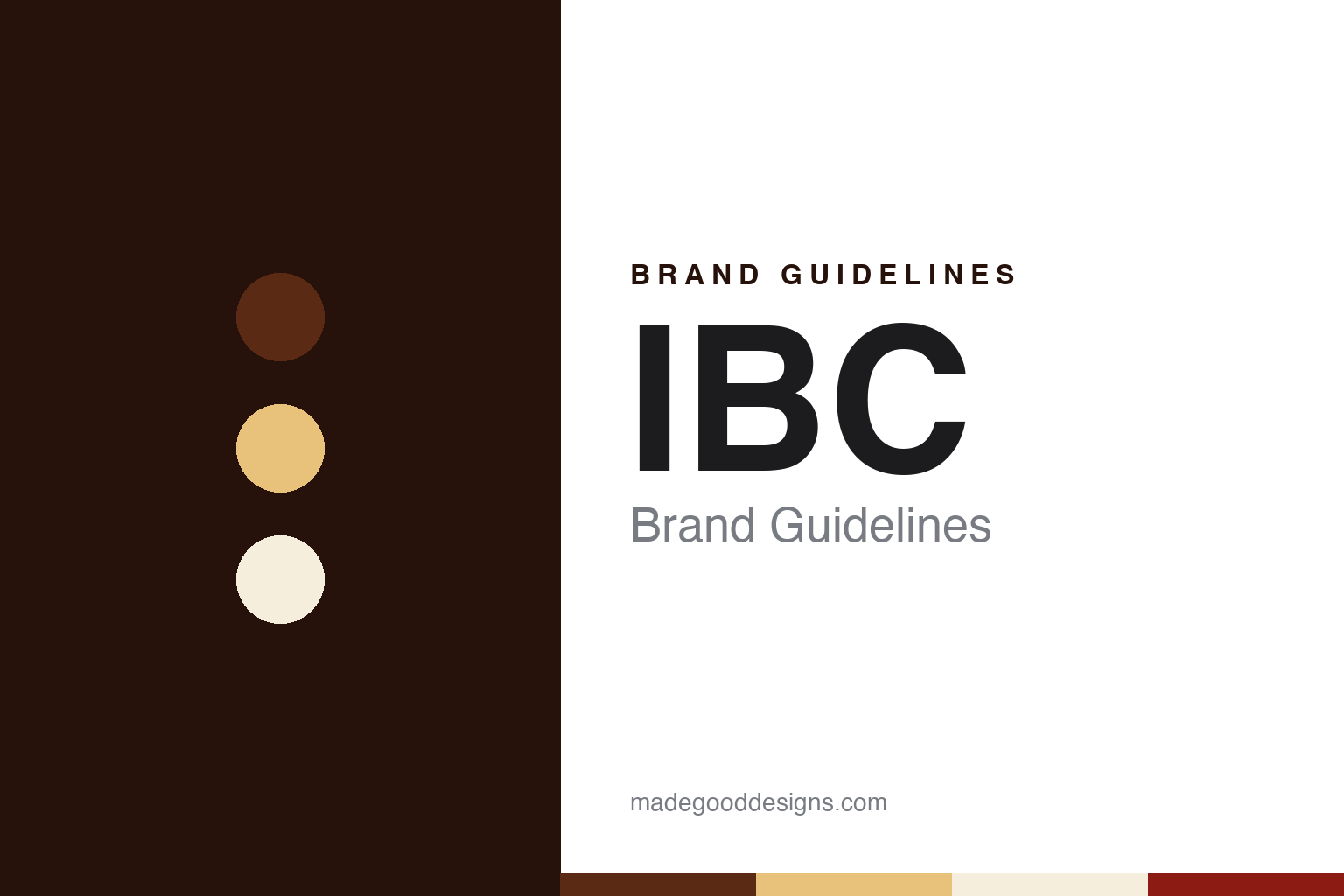
IBC Brand Guidelines
A brewers’ syndicate, a Prohibition root beer and a tall brown bottle.
Aa
Two constants: a sassafras brown, amber glass and label cream palette and a western display serif register. Abstract homage — not an IBC product or mark; no bottle, label or logo is reproduced.
A brewers’ syndicate in St. Louis
The Griesedieck family, rival breweries and a soft drink for Prohibition.
IBC is an American root beer whose initials come from a brewing business. The letters stand for the Independent Breweries Company, a syndicate of breweries in St. Louis, Missouri. Today the brand belongs to Keurig Dr Pepper, and its own website says that IBC has provided sodas “since 1919”.
The syndicate grew out of a contest between brewers. A history of the Griesedieck brewing family published by the Griesedieck Bros. Brewery Company, edited from the St. Louis Globe-Democrat and archived in April 2008, says a group of English financiers tried to set up a brewing “trust” in the city by buying up as many breweries as they could. In response, the history says, the Griesediecks joined several other brewers, including the Columbia (Alpen Brau) brewery, the Gast brewery in Baden and the A.B.C. brewery on South Broadway, to create a syndicate of their own: the Independent Breweries Company.
The combination did not prosper as a brewing business. The same family history says the company was weighed down from the start by high overhead and low profits, with too many highly paid executives drawn from the merging firms, and that it eventually went into receivership. One of its sidelines, it adds, survived: IBC root beer.
That sideline was a product of Prohibition. The Dr Pepper Museum in Waco, Texas, wrote in a post of 15 October 2014 that in 1919 the Griesedieck family, as operators of the Independent Breweries Company, developed an alternative to their usual alcoholic drinks in response to Prohibition. The result, the museum said, was a root beer native to St. Louis that became a local hit. The Griesedieck history describes the same pressure from the brewers’ side: Prohibition made life difficult for every brewer in the country, and the family’s Griesedieck Bros. brewery tried to stay open by producing grape soda, root beer and near beer before it was mothballed to wait for legal beer to return.
The brewery behind the root beer did not survive the period. The Dr Pepper Museum says the brewery closed, and that the trademark for the drink then changed hands twice during the 1920s and 1930s, while the root beer continued to appear in local restaurants. The name outlived the company that gave it: three initials from a brewers’ syndicate became the name of a soft drink.
Colour
The Seven-Up Company, Dr Pepper and Keurig Dr Pepper.
The brand’s move from a local drink to a regional one came through a national soft-drink company. The Dr Pepper Museum’s 2014 account says the root beer experienced a major resurgence after the Second World War, when The Seven-Up Company purchased IBC and began promoting it throughout the Midwest and the South.
The next change of ownership came with a merger of soft-drink makers. The museum says that in 1986 the Dr Pepper Company purchased The Seven-Up Company, and that this finally made IBC available nationwide. The brand’s current website still describes IBC as a registered trademark of Dr Pepper/Seven Up, Inc., the name that joins the two companies, and it carries a Keurig Dr Pepper privacy notice.
By 2014 the brand sat inside the Dr Pepper Snapple Group. The museum’s post placed IBC in that group’s portfolio alongside its spin-off flavours, a Cream Soda and a Black Cherry, and alongside other root beers including A&W, Hires and Stewart’s.
The present owner took shape in 2018. Supermarket News reported on 29 January 2018 that Keurig Green Mountain, the coffee company owned by the Austrian investment firm JAB Holding Co., had agreed to acquire Dr Pepper Snapple Group. The article listed IBC Root Beer among Dr Pepper Snapple’s beverage brands, together with 7-Up, Sunkist, Crush, Canada Dry, Schweppes, Hires Root Beer and Stewart’s. The Daily Meal reported on 1 February 2018 that under the merger Dr Pepper Snapple Group would be renamed Keurig Dr Pepper, and it too named IBC Root Beer among the brands Keurig would control. Keurig Dr Pepper has owned IBC since that 2018 merger.
The result is a brand whose ownership map runs through several familiar soft-drink names, from Seven-Up to Dr Pepper, Dr Pepper Snapple and Keurig Dr Pepper, while the three initials on the label still point back to a group of St. Louis brewers.
Typography
Design and documentation.
A soft drink rarely meets its buyer as a single object. The same name has to work on a can, on a glass bottle, on a plastic bottle, on a cardboard carton and on the front of a fountain machine in a restaurant or a cinema, often at very different sizes and under very different light.
That is why a soda brand’s identity tends to live in a few portable pieces rather than in one fixed layout: a wordmark that can be printed around a curved surface, a colour that can be recognised across a store aisle, and a flavour cue that tells the drinker what is inside before the lid comes off. Bottles and cans also change over time as packaging technology moves on, so a brand’s look is often a record of several decades of redrawn labels.
Each guide in this group asks the same plain questions: who started the drink, who owns it now, how its labels and cans have changed, and which parts of its story rest on independent dated reporting rather than on the company’s own account.
Aa
A spurred, Wild West display serif — the saloon-sign register of a root beer born in a brewers’ city. (Specimen set in Rye, a display serif STAND-IN; NOT the IBC logo.)
Initials, glass and a bar-room pour
A brewer’s monogram, a tall brown bottle and a root beer served in Seattle bars.
The core of IBC’s identity is its name. Three capital letters taken from the Independent Breweries Company carry the brand,. The Dr Pepper Museum’s account of 2014 and the Griesedieck history both present the root beer as the survivor of a St. Louis brewing venture, and the brand’s own website opens with the line that IBC has provided sodas “since 1919”, offering the founding year as part of the pitch.
Packaging played its part when the brand travelled. The Seattle Times reported on 3 July 1991, in a column by Tom Stockley, that I.B.C., which it described as a St. Louis root beer, had been introduced in Seattle about a year and a half earlier. The writer said the drink looked “classy in its tall brown bottle with glass embossed label”, and he credited it with helping move root beer from crowded grocery shelves into the city’s smarter bars and restaurants.
The same column described how the brand reached those tables. A local wine and beer distributor, Bert Mason of Unique Wine & Beer Co., had taken on I.B.C. as a sideline to his wine business, the paper said, and the root beer could be found in places such as Duke’s restaurants, the Century Square Bar & Grill, the Beeliner Diner, the Five-Spot and Ivar’s. The same column noted that root beer had found its way onto the drink lists of upscale bars and popular watering holes in the city.
The flavour range has since widened around the original. The Dr Pepper Museum’s post of 2014 named IBC Cream Soda and Black Cherry as spin-offs sharing the brand, which keeps the three initials as the constant across flavours.
For a design guide, IBC shows how a set of initials from a defunct brewers’ syndicate can become a soft-drink brand, and how a tall brown glass bottle with an embossed label can borrow the cues of beer for a drink without alcohol. Compare it with 7Up, the brand of the Seven-Up Company that bought IBC, and Dr Pepper, whose company took IBC national in 1986. For this guide we use sassafras brown, amber glass, label cream and brewery red with a western serif, an unofficial interpretation; no product or logo is reproduced.
Explore & save
Keep IBC’s identity on hand — save it to a board in the Made Good inspiration library.
IBC identity set
Pin the IBC sassafras brown, amber glass and label cream palette and the western display serif register to your own board.