Imperial Brand Guidelines
A plantation mill on Oyster Creek, a hotel name and a company town.
Aa
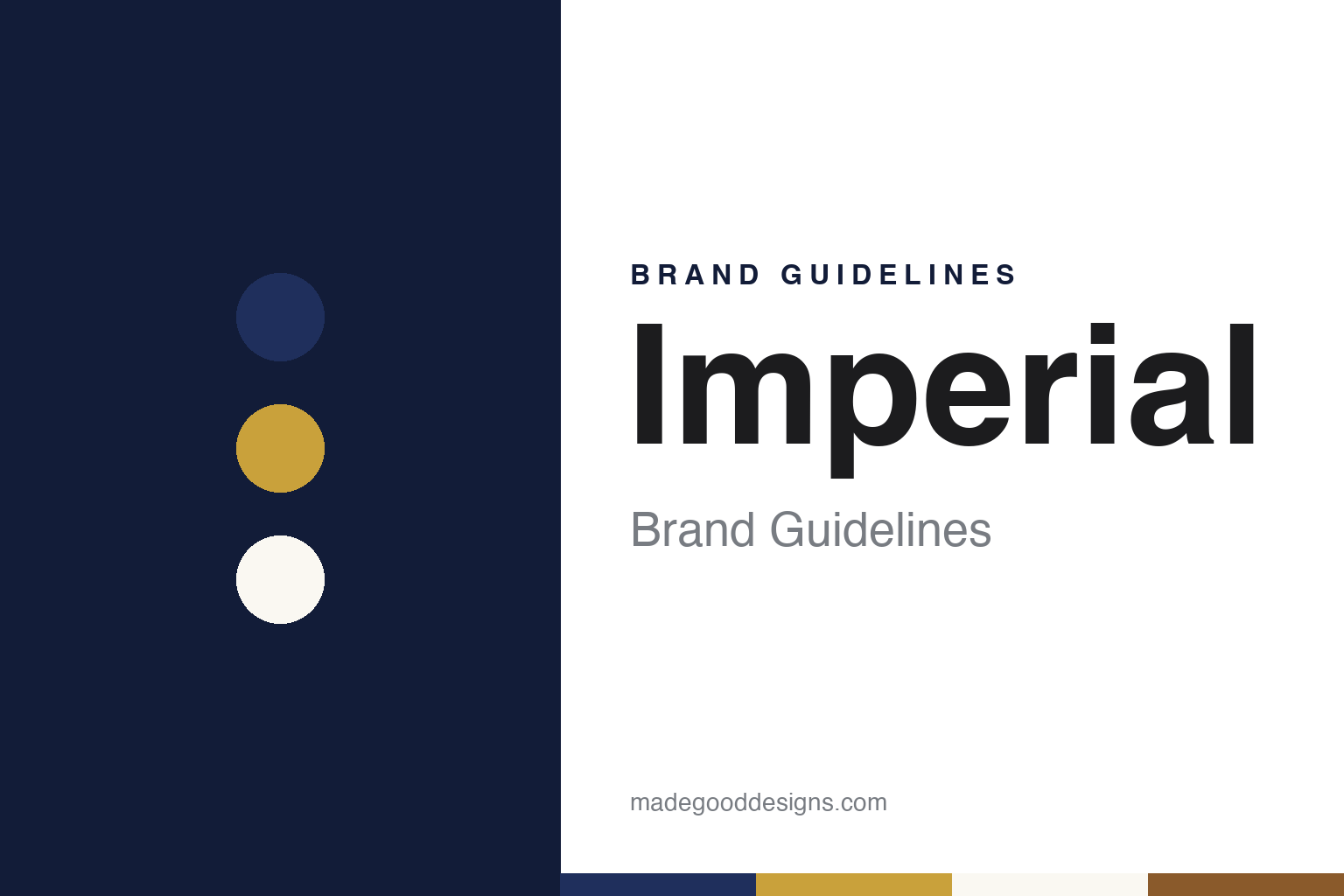
Two constants: a crown navy, cane gold and refined white palette and a classic display serif register. Abstract homage — not an Imperial Sugar product or mark; no bag, crown or logo is reproduced.
A mill on Oyster Creek
Plantation sugar, a Galveston family and a name borrowed from a New York hotel.
Imperial is an American brand of granulated, brown and powdered cane sugar, and its history is bound up with a single Texas town. The Handbook of Texas Online, published by the Texas State Historical Association, says in an entry by Diana J. Kleiner first published on 1 November 1995 that the business had made refined cane sugar and blackstrap molasses on the same site at Sugar Land, in Fort Bend County, since 1843.
The early owners were planters. The Handbook of Texas says that in the 1840s Nathaniel F. Williams developed the Oakland Plantation, growing cotton, corn and sugarcane, and sold the land to Benjamin F. Terry and William J. Kyle around 1852. After the Civil War most of the land passed to E. H. Cunningham, who built a large sugar refinery on the property around 1879. The company’s own website tells the start more briefly: it says that in 1843, along the banks of Oyster Creek, the Williams brothers built a sugar mill. English Wikipedia names Samuel May Williams as the founder.
The Imperial name came with new owners from Galveston. According to the Handbook of Texas, in 1906 the Kempner family, led by Isaac H. Kempner and in partnership with William T. Eldridge, bought the Ellis Plantation, and in 1908 the partners acquired the neighbouring Cunningham Plantation with its raw-sugar mill and cane refinery. The partnership changed the name to Imperial Sugar Company. The Handbook says Kempner took the word from a small raw-sugar mill called Imperial on the Ellis Plantation and associated it with the Imperial Hotel in New York. The company’s website gives 1905 as the year the Kempner family bought the Imperial Mill and incorporated the company.
The first leaders were family members. The Handbook of Texas says Dan Kempner, one of Isaac’s younger brothers, served as the first president until 1914, when Isaac replaced him, and that Eldridge moved to the site as general manager to build the town of Sugar Land.
Colour
A company town, a cane-and-beet merger, Louis Dreyfus and U.S. Sugar.
For half a century the refinery and the town were one business. The Handbook of Texas says the partnership owned all of the land and businesses in Sugar Land, organised the Imperial State Bank in 1907, ran a company store and built homes for employees. In 1917 the Imperial and Cunningham sugar companies were merged into a new Imperial Sugar Company, and in 1919 the Sugar Land businesses were placed in a trust estate called Sugarland Industries, with Imperial as one department. The Handbook says raw sugar was imported from 1902, that the company needed a federal loan to survive the Depression, and that under wartime rationing Imperial supplied the sugar for Texas and Oklahoma.
Ownership then narrowed and widened again. The Handbook says the Kempner family bought out the Eldridge interest in 1946, and that in 1953 W. H. Louviere became the first president from outside the family. In 1956 the company sold a large block of its stock to the C and H Sugar Refining Company of California and Hawaii, and it bought the stock back in 1967. Sugar Land incorporated as a city in 1959. The Handbook dates the merger with the beet processor Holly Sugar Corporation, which formed Imperial Holly Corporation, to 1989; English Wikipedia gives 1988 and says the name returned to Imperial Sugar Company in 1999.
English Wikipedia records that the company filed for Chapter 11 protection in January 2001 and emerged that August, and that it closed its original Sugar Land refinery in 2003 while keeping its headquarters in the city. It also records a fatal sugar-dust explosion at the company’s refinery at Port Wentworth, Georgia, on 7 February 2008.
Two sales followed. The Houston Chronicle reported on 1 May 2012 that Sugar Land-based Imperial Sugar was being acquired by Louis Dreyfus Commodities, and listed its brands as Imperial, Dixie Crystals and Holly. Florida Trend, in a report from the News Service of Florida, said United States Sugar Corporation announced in March 2021 that it had agreed to buy Imperial from Louis Dreyfus, with the Port Wentworth refinery at the centre of the deal. Food Processing reported on 30 November 2022 that the Justice Department had sued to stop the purchase, that a federal district judge ruled against the government on 23 September, and that U.S. Sugar’s lawyers said in a 29 November court filing that the acquisition was complete. U.S. Sugar has owned Imperial since 2022; the brand’s website says Imperial became a wholly owned subsidiary of the Florida company that year.
Typography
Design and documentation.
The brands in this group sell three of the plainest things in an American kitchen: sugar, cooking oil and fruit spread. Each sits on a different shelf, in a different kind of pack. Sugar usually travels in a paper bag or a carton, oil in a clear or tinted bottle, and fruit spread in a glass jar with a lid, so the look of the brand is carried by a label, a name, a colour and the shape of the container.
Many names on these shelves have also outlived their first owners. A refinery, a press or a family kitchen may have started the brand, and a different company may now make, bottle or pack it, sometimes far from where it began. That makes the plain questions worth asking: who started it, who owns it now, and where it is made.
Each guide separates what independent sources record from what the company says about itself — its founding story, its owners over time, where its products are made and how its packs and labels have changed — and marks plainly what rests only on the company’s own word.
Aa
A high-contrast display serif — the formal, heritage register of a sugar name taken from a hotel. (Specimen set in Playfair Display, a serif STAND-IN; NOT the Imperial Sugar logo.)
A crown, a town and a shelf of cookbooks
A hotel name, a crown on a city seal and recipe booklets from 1915 to 1968.
The name itself was chosen for its associations. In the Handbook of Texas account, Isaac Kempner linked the word Imperial with a New York hotel as well as with a small plantation mill. A later source, A. C. Greene’s 1998 book Sketches from the Five States of Texas, is cited by English Wikipedia for the statement that the company was renamed to emphasise quality.
The mark has spread beyond the bag. English Wikipedia’s article on Sugar Land says the city is home to Imperial Sugar’s headquarters and that the Imperial Sugar crown logo appears in the city seal and logo. The same article says the former refinery site has been redeveloped as part of a master-planned community named Imperial.
The brand’s present-day voice is built on that history. Its website opens a section titled “Our Heritage” with the words “Since 1843” and describes Imperial as a staple in family kitchens across Texas and the Southeast. The products it lists are granulated sugar, light brown sugar, dark brown sugar and powdered sugar. A “Heritage Collection” of recipes carries short memories from home cooks, and the copy leans on grandmothers, family celebrations and recipes handed down.
The richest design record is a shelf of recipe booklets. The site hosts a Vintage Cookbooks page with downloadable scans of company booklets dated from 1915 to 1968, among them The Household Economist of 1915, A Barrel Full of Imperial Recipes of 1920, Teena in the Kitchen, which appears in editions dated 1954 and 1964, and a 125th Anniversary booklet of 1968. Other titles on the page deal with canning, home freezing, candy-making, summer drinks and cake decorating.
The family of brands is wider than the Imperial bag. The Houston Chronicle named Imperial, Dixie Crystals and Holly as the company’s brands in 2012, and English Wikipedia says the Port Wentworth plant was first built as the Dixie Crystals refinery in 1916–1917 and joined Imperial in 1997. Under U.S. Sugar, the Imperial name now sits alongside the products of a Florida grower and refiner whose website describes it as feeding American families since 1931.
For a design guide, Imperial shows how a brand name taken from a hotel and a mill can become a crown on a city seal, so that a refinery’s identity outlives the refinery itself. Compare it with C&H, the California refiner that once held a stake in the company, and Domino, another American cane-sugar name. For this guide we use crown navy, cane gold, refined white and brown sugar with a serif, an unofficial interpretation; no product or logo is reproduced.
Explore & save
Keep Imperial’s identity on hand — save it to a board in the Made Good inspiration library.
Imperial Sugar identity set
Pin the Imperial crown navy, cane gold and refined white palette and the classic display serif register to your own board.