Jardine Matheson Brand Guidelines
Two surnames, a noon gun and a tower of round windows.
Aa
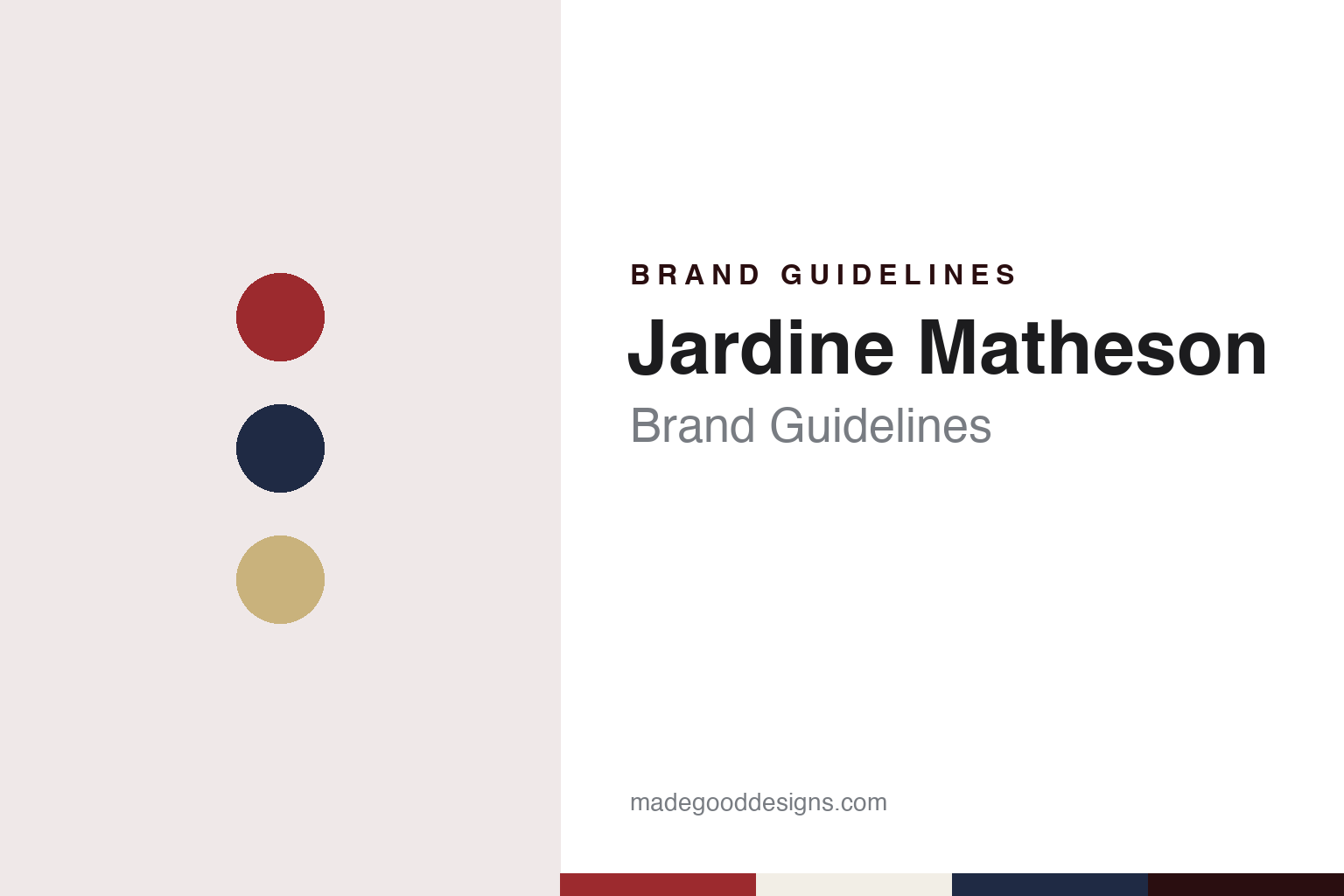
Two constants: an Ewo red, harbour navy and brass palette and an Old-style serif register. Abstract homage — not a Jardine Matheson asset or mark; no logo, flag or wordmark is reproduced.
A partnership of two Scots
Canton, 1832.
Jardine Matheson is a group whose name is a pair of surnames joined at the hyphen of a partnership. Wikipedia says the firm of Jardine, Matheson & Company emerged in 1832 from a long chain of partnership changes in a trading business that went back to Cox & Reid, founded in 1782, and that had passed through several names before it became Magniac & Company. William Jardine, a graduate of the University of Edinburgh medical school, joined that business in 1825 at the invitation of its principal, Hollingworth Magniac. James Matheson, another Edinburgh graduate, joined three years later. Wikipedia says Matheson’s arrival came as Magniac prepared to retire, and the business took the two newcomers’ names.
The Royal Gazette of Bermuda, in a history of the firm published on 18 May 2001, said the two men shipped tea into London after the end of the East India Company’s monopoly, and that the company’s early trade also included opium sold into China. Wikipedia says that after 1842 the firm set up its headquarters on Hong Kong Island, and it has remained a Hong Kong-based group since.
The family that runs it today is linked to the founders by marriage rather than by surname. Wikipedia says the group is controlled by the Keswick family, descendants of William Jardine’s older sister, Jean Johnstone, through the marriage of her daughter to Thomas Keswick. William Keswick became an early head of the firm, and Wikipedia says Ben Keswick serves as executive chairman. The head of the business has long carried the Cantonese-derived title tai-pan, a word for the head of a trading house.
The group’s legal shape has changed several times while the two surnames stayed the same. Wikipedia says the firm listed in Hong Kong in 1961. The Christian Science Monitor, in a report from Hong Kong dated 21 May 1997, said Jardine moved its corporate charter to Bermuda in 1984, and the Royal Gazette said the same in 2001. Wikipedia adds that the holding company arranged a primary share listing in London in 1990, and that a restructuring in 2021 made Jardine Strategic a wholly owned subsidiary. Through each change, the group kept the name the two partners gave it in 1832.
Colour
A Chinese name on the street map.
Jardine Matheson has a second name, and it is written in Chinese. Wikipedia says the firm’s Chinese name is Yee Wo, 怡和, often romanised as Ewo. The name sits on Hong Kong’s street map: Wikipedia says Yee Wo Street in Causeway Bay takes its name from it, and that streets such as Jardine’s Bazaar, Jardine’s Crescent, Matheson Street and the hillside district of Jardine’s Lookout recall the firm and its founders. Those names date from the years when the company’s offices stood at East Point, and they turn the group’s identity into a set of addresses.
One piece of that identity is not a logo but a sound. On 27 October 2013, the South African Sunday Times published a report by Paul Ash describing how, a few minutes before noon, a man in a dark uniform and peaked cap leaves the Jardine Matheson building in Causeway Bay, crosses under Gloucester Road and unlocks the gates of a small park at the edge of the harbour. The park holds a Hotchkiss three-pounder naval gun on a pedestal. At noon the gunner pulls the lanyard and the gun fires a single round.
Ash wrote that the ritual dates to the 1860s, when Jardine welcomed its visiting tai-pans with a round from a gun on the shore. When the gun was fired while a Royal Navy warship lay in the bay, the British commander ordered that, as a penalty, Jardine fire a gun every day at noon. Wikipedia says Jardines remains responsible for keeping up the tradition. Noël Coward put it into a lyric in “Mad Dogs and Englishmen”, and Ash quoted the line about Hong Kong’s “noonday gun”.
The firm has also lent its story to fiction. Wikipedia says its history inspired James Clavell’s novels Tai-Pan (1966) and Noble House (1981), whose fictional trading house, Struan’s, was loosely modelled on the firm and its founders. The television miniseries of Noble House used the Jardine building as Struan’s headquarters. A company name that is a pair of surnames, a Chinese name that is a street, a noon gun and a novelist’s trading house are the pieces of the group’s public image that people meet.
Typography
Partners, a gun and a tower.
Across Asia, many business groups carry a single family name or a short set of initials over a wide spread of trades. The same word can sit above a department store, a bank branch, a mobile network, a housing estate and a shipping office, and the identity work is less about one product than about holding that name steady across very different places. A house flag or monogram, often older than any of the companies now beneath it, tends to do the heavy lifting: it turns up on ship funnels, annual-report covers, office lobbies and staff lanyards long after the original trading business has changed shape.
Property is where these identities become physical. A group’s name or mark placed on a tower, mall or estate turns architecture into signage, and renaming a building or a chain of malls is a brand decision made in full public view. Designers studying these names usually look at three things: how the parent mark sits beside the marks of the businesses it owns, whether a founder’s name or initials survive a rebrand, and how a colour or letterform stays recognisable at the scale of a skyline as well as on a receipt.
Aa
An old-style serif — after a group name built from two partners’ surnames. (Specimen set in Libre Caslon Text, a serif STAND-IN; NOT the Jardine Matheson logo or any Jardines typeface.)
Jardine Matheson
A tower of round windows.
Where Jardine Matheson’s identity takes physical form, the clearest example is a building on the Central waterfront. The M+ museum in Hong Kong holds the architectural archive of the firm Palmer & Turner, now P&T Group, given to the museum in 2020, and its catalogue record for the project describes a building constructed at Connaught Place in 1973 as the Connaught Centre. M+ says it was designed by James Hajime Kinoshita, and that it was built with a metal frame and curtain walls with circular windows, which M+ singles out as the building’s distinctive feature.
The building took the group’s name later. M+ says that Jardine, Matheson & Company moved in as a principal tenant and that the tower was renamed Jardine House in 1989. The archive record also notes that the outer wall was originally faced mainly in mosaic and concrete, and that it was replaced with aluminium cladding from 1982. The circular windows are part of the original design described in the record.
The group’s names also sit on hotels and property. Wikipedia says Hongkong Land was established in Hong Kong in 1889 by Sir Paul Chater and William Keswick, and that the Mandarin Hotel opened in Hong Kong in 1963; it is now part of Mandarin Oriental, the hotel group in which Jardines holds its interest. Each of those businesses carries its own name and mark rather than the group’s.
For a design guide, Jardine Matheson shows how a trading house can hold its identity in a partnership name, a Chinese name written into the street map, a daily noon gun and a tower of round windows, while its companies trade under their own names. Compare Mandarin Oriental, the hotel group in the Jardine family of companies, and Swire, the other Hong Kong trading house with nineteenth-century British roots. For this guide we use Ewo red, harbour navy and brass with a serif, an unofficial interpretation; no product or logo is reproduced.
Explore & save
Keep Jardine Matheson’s identity on hand — save it to a board in the Made Good inspiration library.
Jardine Matheson identity set
Pin the Jardine Matheson Ewo red, harbour navy and brass palette and the Old-style serif register to your own board.