Mission Brand Guidelines
A Monterrey flour miller, a California tortilla plant and a name sold far beyond both.
Aa
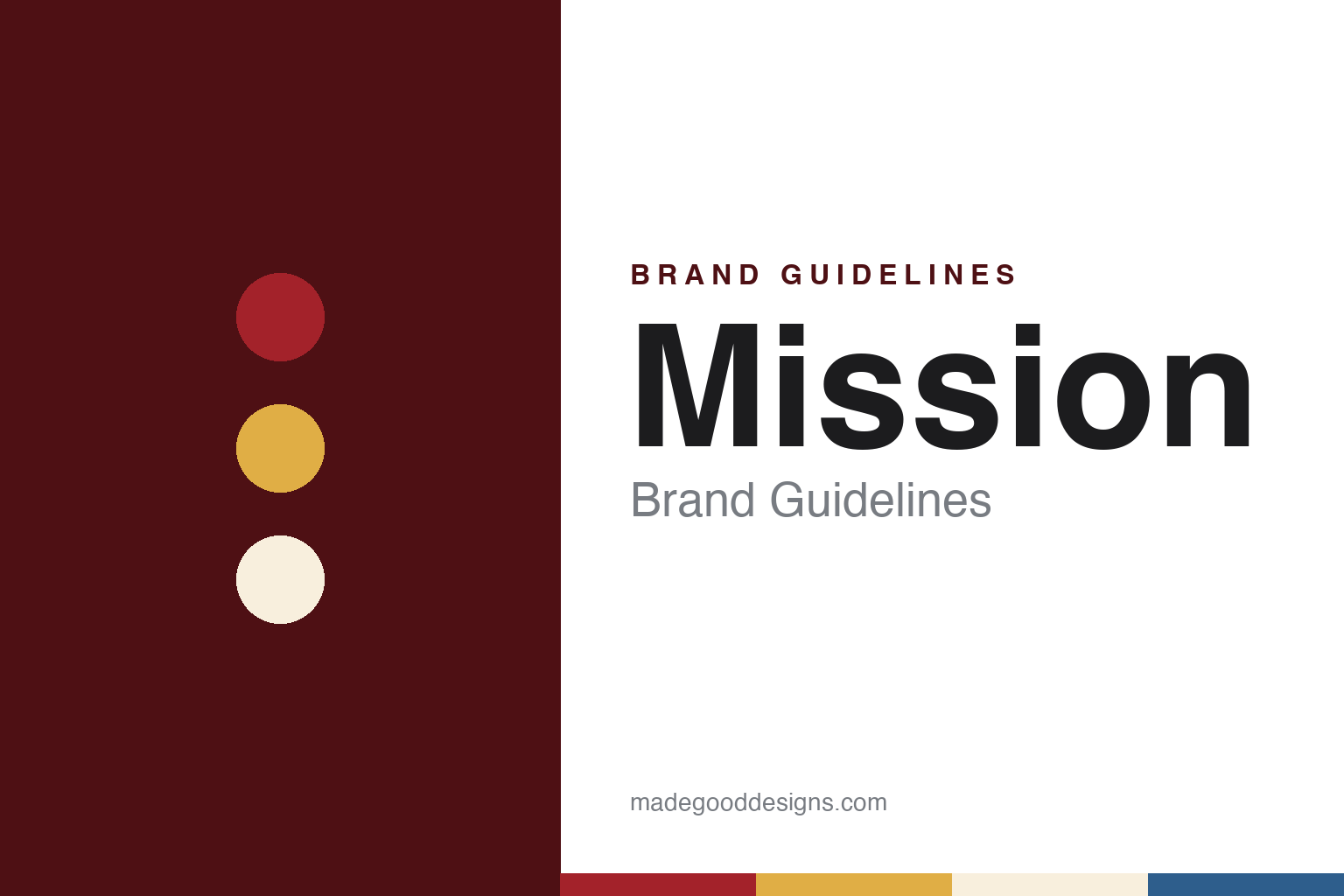
Two constants: a Mission red, masa gold and tortilla cream palette and a heavy grotesque sans register. Abstract homage — not a Mission product or mark; no package, tortilla or logo is reproduced.
From Cerralvo to California
A corn-flour mill in Nuevo León and a tortilla plant on the West Coast.
Mission is the tortilla brand of Gruma, the Mexican corn-flour and tortilla company based in San Pedro Garza García, near Monterrey. In the United States it is run by Mission Foods, a Gruma subsidiary that says its corporate headquarters is in Irving, Texas. The name covers corn and flour tortillas, wraps and other flatbreads, tortilla chips, taco shells and dinner kits. In Mexico, English Wikipedia notes, the same brand is sold as Misión.
The parent company is older than the brand. Spanish Wikipedia says Gruma was founded in 1949 in Cerralvo, Nuevo León, under the name Molinos Azteca, by Roberto M. González Gutiérrez and his son Roberto González Barrera. Gruma’s own 2010 sustainability report names the same two founders. Their business was dry corn flour for tortillas, sold under the Maseca name, a contraction of masa seca, or dry dough. Spanish Wikipedia says the company began expanding abroad in 1973, into Costa Rica and Panama, with packaged tortillas.
The Mission name arrived with the move into the United States. Gruma’s history pages say that in the mid-1970s the company arrived in the United States and purchased the Mission Foods plant in California, and that what it learned there pushed it to develop its technology faster. The International Directory of Company Histories, in its 2001 entry on Gruma, dates the opening of the company’s first United States plant to 1976 and says Gruma began marketing tortillas, tortilla chips and taco shells on the West Coast under the Mission Foods name. English Wikipedia gives the year as 1977, describing Mission Foods as a subsidiary of Grupo Maseca set up in California as a brand name for its tortillas in the American market.
Texas followed. English Wikipedia says a Mission tortilla plant opened in Dallas in 1982. Gruma’s history for the 1980s says it built a corn-flour mill in Edinburg, Texas, which became its flour subsidiary Azteca Milling, and bought a tortilla brand with roots in southern California, Guerrero. By 1994, the International Directory of Company Histories says, the United States business was selling corn flour, tortillas, snack foods and bakery products under the Mission and Guerrero names, with Mission described as the more upscale of the two, making packaged tortillas and serving institutional customers such as Taco Bell.
Colour
A public company, a partner in grain and plants across Texas and California.
The parent changed shape in the 1990s. Gruma’s history pages say it listed its shares on the Mexican Stock Exchange in 1994 and on the New York Stock Exchange in 1998. English Wikipedia adds that the New York listing, through depositary receipts, ended in September 2015. In 1996, the International Directory of Company Histories says, the American grain company Archer-Daniels-Midland bought a stake in Gruma, and the deal set up joint ventures between the two in flour milling in the United States and Mexico.
Production in southern California was reorganised in the same decade. Gruma says it built a tortilla plant on Olympic Boulevard in Los Angeles in 1990, and that in 1995, after merging production from its Canoga and Guerrero plants, it built a new plant in Rancho Cucamonga. The company’s 2010 sustainability report describes Gruma Corporation as the operator of its United States tortilla plants, making tortillas, wraps, taco shells, tostadas and corn snacks.
Gruma has owned Mission since the brand’s American start, and the brand has travelled with Gruma’s expansion. English Wikipedia says Mission Foods launched the Mission brand in Australia in 2009, with a plant in Epping, Victoria. In its own brand profile, Gruma calls Mission its global brand for tortillas, flatbreads such as wraps, naan and pita, tortilla chips and Tex-Mex products such as dinner kits and taco shells, and says the brand has reached Europe, the Middle East, Africa, Asia and Oceania.
Texas remains the centre of the American business. The trade magazine Abasto reported on 21 November 2017 that Gruma had opened a new plant in Dallas operating under the Mission Foods name, with separate areas for preparing and packing each product. Mission Foods describes itself as a subsidiary of Gruma and says it hires for its plants and for its corporate headquarters in Irving. The Sports Car Club of America, in an article of 22 July 2026, named Juan Gonzalez as chief executive of Mission Foods.
Typography
Design and documentation.
The names in this group sit on supermarket shelves as salsa jars, tortilla packs, bean cans and frozen-burrito boxes. Packaging of this kind has to work at a glance: a shopper scanning a long aisle of similar jars or a freezer door of similar boxes reads colour, a name and a picture of the food before reading any small print, so a label’s job is to make one product easy to find again on the next visit.
Each format has its own constraints. A jar label wraps around glass and leaves room for the colour of the salsa to show through; a tortilla pack is soft and folds, so the name has to survive creases; a can label is printed flat and read on a curve; and a frozen box has to stay legible behind frosted glass. Heat levels, flavours and sizes are usually signalled with colour bands or small badges rather than new designs.
Each guide separates what independent, dated sources record about a brand — who started it, who owns it now and where its food is made — from what the company says about itself, and marks plainly what rests only on the company’s own word.
Aa
A heavy, wide grotesque — the bold, supermarket-shelf register of a packaged tortilla brand. (Specimen set in Archivo Black, a grotesque STAND-IN; NOT the Mission logo.)
A name on the shelf and on the track
A general-market brand, a park attraction, a football club and motor racing.
Gruma gives Mission a clear job inside its portfolio. The company’s 2010 sustainability report says the Mission brand is aimed at the general American market, while Guerrero is aimed at the Hispanic community and Calidad is offered as a lower-cost alternative. In its current brand profile Gruma calls Mission its global brand, the name under which it sells tortillas, flatbreads, chips and kits outside Mexico.
The brand has also been put in front of people away from the shelf. English Wikipedia says Mission sponsored a tortilla factory attraction at the then Disney California Adventure Park from 2001 to 2011. It showed tortilla production on a small, slow automated line, handed out samples and demonstrated recipes to visitors.
In Australia the name went onto football jumpers. The Western Bulldogs, the Australian rules football club, said in a club news item in 2020 that Mission Foods first came on board in 2009; the club’s president, Peter Gordon, said the company had joined when the club needed a major partner during a difficult financial period. That 2020 extension kept Mission Foods as major partner until at least the end of the 2023 season. English Wikipedia also records Mission Foods sponsorships in netball, including the Queensland Firebirds and Netball Singapore.
Motor racing has become a major stage for the name. English Wikipedia says Mission Foods was announced as a partner of the McLaren Formula One team in April 2019, and of Arrow McLaren for the Indianapolis 500 in the same month. The National Hot Rod Association series has carried the Mission Foods name since 2024, English Wikipedia says, and the company has sponsored NASCAR races at Watkins Glen. The Sports Car Club of America announced on 22 July 2026 that Mission Foods would be title sponsor of the 2026 SCCA National Championship Runoffs at Road America in Wisconsin, where it was already the landmark sponsor of the circuit’s Main Bridge, Turn 10 Bridge and beach viewing area. The SCCA article listed the brand’s presence in IndyCar, motorcycle racing and drag racing, and said Juan Gonzalez has been a club member since 2012.
For a design guide, Mission shows how a grocery brand can be built by a flour miller: the corn flour sits behind the name as Maseca, and the packaged tortilla carries the brand onto shelves, jumpers and racing cars. Compare it with Maseca, its sister brand at Gruma, and Old El Paso, another Tex-Mex kit and taco-shell name. For this guide we use Mission red, masa gold, tortilla cream and track blue with a heavy grotesque sans, an unofficial interpretation; no product or logo is reproduced.
Explore & save
Keep Mission’s identity on hand — save it to a board in the Made Good inspiration library.
Mission identity set
Pin the Mission red, masa gold and tortilla cream palette and the heavy grotesque sans register to your own board.