Moxie Brand Guidelines
The 19th-century New England soda that gave English a word.
Aa
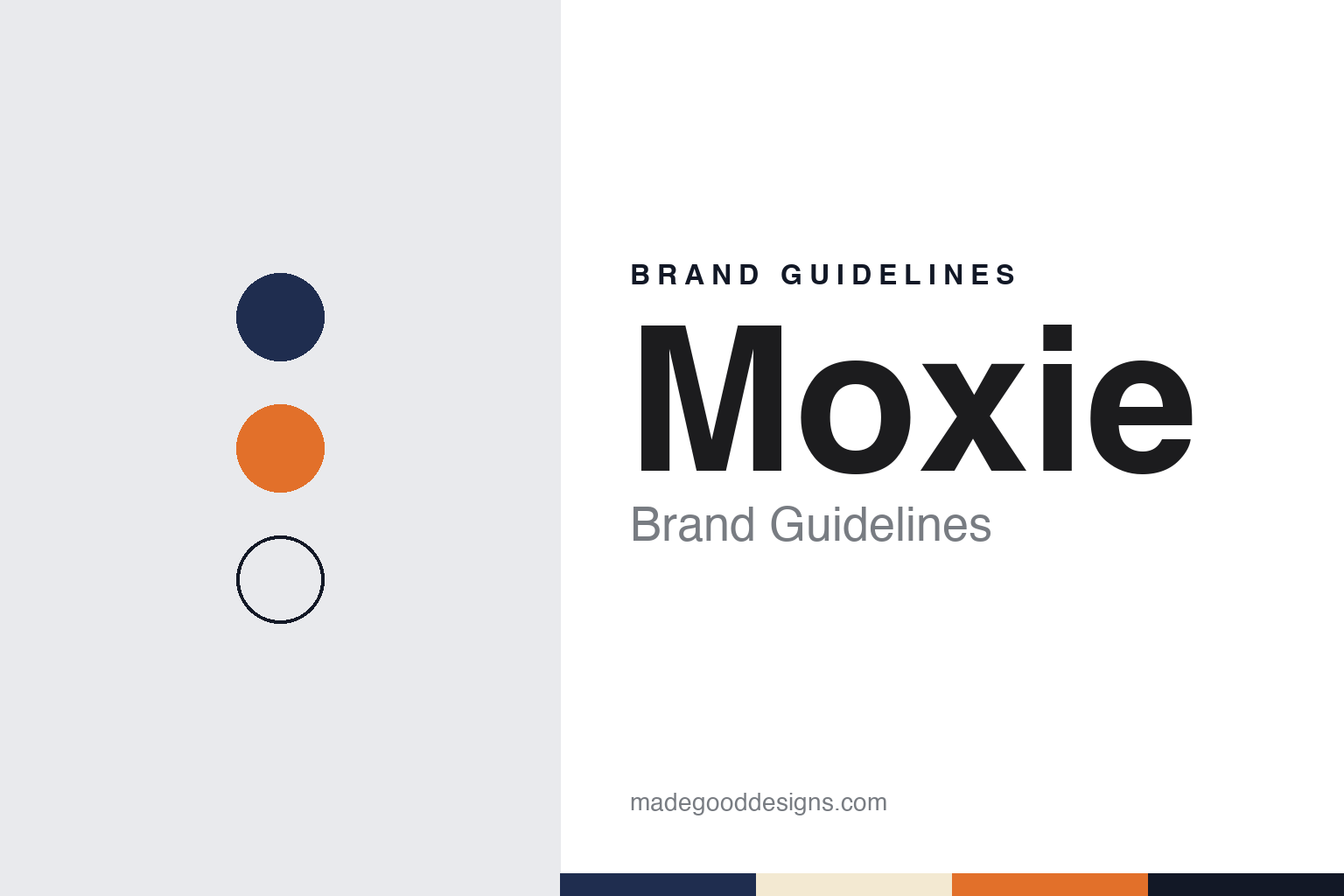
Two constants: a Moxie navy, orange and cream palette and a condensed sans register. Abstract homage — not a Moxie product or mark; no can, bottle, logo or “Moxie Man” is reproduced.
Lowell, c. 1876
A Maine doctor, a bitter root and a new word.
Moxie is one of the oldest branded soft drinks in the United States. Its creator, Augustin Thompson, was a physician born in Union, Maine, who had served as a Union Army captain in the Civil War. Around 1876, English Wikipedia says, citing the historian Mark Pendergrast, he began selling it in Lowell, Massachusetts, as a patent medicine called “Moxie Nerve Food.” Its bitter edge comes from gentian root extract, which Thompson presented as the extract of a rare, unnamed South American plant. Its early advertising, Wikipedia notes, sold it as a health drink and a “nerve food” — the language of the patent-medicine era, recorded here only as history.
Within a few years Thompson added soda water and renamed it “Beverage Moxie Nerve Food.” By 1884 he was selling it in bottles and as a soda-fountain syrup, and in 1885 he obtained a trademark for the name, the historian Anne Cooper Funderburg wrote in Sundae Best (2001). Coca-Cola’s brand page dates the drink from 1884, under the line “Distinctively Different since 1884.” Thompson said he had named it after a Lieutenant Moxie, a friend who had found the plant. The word also appears in Maine place names such as Moxie Falls, and Wikipedia says he likely borrowed it from there. The Online Etymology Dictionary proposes an Abenaki word meaning “dark water,” while the lexicographer Frederic Cassidy argued in 1995 for an Algonquian root meaning “herbal infusion.”
The drink in turn gave American English a word. “Moxie,” meaning energy, determination and nerve, comes from the soft drink’s name, Merriam-Webster says, and English Wikipedia dates that use to about the 1930s. In 2005 Maine made Moxie its official state soft drink. The statute, still in force, describes it as “a registered trademarked soft drink invented by Maine-born Dr. Augustin Thompson of Union that symbolizes spirit and courage.”
Colour
A pointing man, a horse on wheels and a magazine.
Moxie’s advertising was as distinctive as its taste. The brand used “Make Mine Moxie!” jingles and the slogan “Just Make It Moxie for Mine,” English Wikipedia says, and its best-known emblem is the “Moxie Man.” A figure has appeared on its labels in some form since 1906, and the image most associated with the brand, a man pointing straight at the viewer, was introduced in 1911. In a 1922 advertisement in the Boston Herald, F. M. Archer wrote that people in almost every American town believed they knew the original “Moxie Boy.” The collectors’ group the Moxie Congress has since suggested that the model was probably someone who sat for the lithographers, possibly John T. Chamberlain of Revere, Massachusetts.
The company also built the Moxie Horsemobile, a car whose driver sat on a large model horse, patented in February 1917, Wikipedia says; one built on a LaSalle sedan is displayed at Clark’s Trading Post in Lincoln, New Hampshire. Moxie had famous drinkers: President Calvin Coolidge was known to favour it, and the Boston Red Sox hitter Ted Williams endorsed it on radio and in print, according to Wikipedia. From 1959 Mad magazine began placing the Moxie logo in the backgrounds of its pages, and the attention led to a “Mad About Moxie” campaign, which Dun’s Review discussed in 1968. Diet Moxie followed in 1962.
The drink has also found a second life in the kitchen. In 2018 Food & Wine reported on chefs using Moxie in glazes and reductions, and in 2011 the Bangor Daily News described the Moxie recipes that turn up at the drink’s festival in Maine. The lettering on its labels is covered in our separate guide to the Moxie font.
Typography
Design and documentation.
The seven brands in this group are all soft drinks from different regions of the United States: Cheerwine, Moxie, Faygo, Vernors, Big Red, Ale-8-One and Sun Drop. American regional soft-drink brands in general sit at many different points in the trade, from family firms that still carry a founder’s name to names that now belong to much larger drinks groups, and a single brand can be sold everywhere from a corner shop to a supermarket shelf.
A soft-drink brand’s identity is usually carried less by a single product than by a bottle or can, a name and the flavour it promises, because the company behind the name may have changed hands, moved its production or grown far beyond the place where it started. That makes the questions behind each name worth asking plainly: who started it, who owns it now, and where its drinks are actually made and bottled.
Each guide separates what independent sources record from what the company says about itself — its founding story, its owners over time, where its drinks are made and how its packaging has changed — and marks plainly what rests only on the company’s own word.
Aa
A condensed sans — tall, direct and pointing at you. (Specimen set in Oswald, a sans STAND-IN; NOT the Moxie logo.)
Moxie
From Atlanta to New Hampshire to Coca-Cola.
Moxie has changed hands several times. The Monarch Beverage Company of Atlanta bought the brand in 1966, English Wikipedia says. In 2007 Monarch sold it to Cornucopia Beverages of Bedford, New Hampshire, owned by the Coca-Cola Bottling Company of Northern New England, the New Hampshire Union Leader reported in April that year. Cornucopia set out to widen distribution, citing requests from fans around the country: it began pilot sales in Florida in 2007 and appointed a Florida distributor in 2010, the Associated Press reported, and in 2011 it began trading as the Moxie Beverage Company, with a website at drinkmoxie.com.
In August 2018 the Coca-Cola Company announced that it was buying Moxie from Coca-Cola of Northern New England, an independent bottling partner based in Bedford, the Associated Press reported; the price was not disclosed. A Coca-Cola spokeswoman said the goal was to “protect the heritage and regional culture of the brand,” and a spokesman for the bottler said the drink was made at a facility in Londonderry, New Hampshire, which would remain the exclusive manufacturer. Other bottlers have made Moxie over the years, among them Catawissa Bottling in Pennsylvania, which the Boston Globe reported in 2007 had produced it since 1945. Today the drinkmoxie.com address leads to Moxie’s page on Coca-Cola’s US website, which calls it “A New England tradition.”
The drink remains most closely tied to Maine, where the river town of Lisbon holds an annual Moxie Festival, the AP noted in 2018. At the time of the sale the bottler’s spokesman told the AP that he expected Moxie to “primarily remain a regional brand.”
For a design guide, Moxie shows how a pointing figure, a bitter taste and a word in the dictionary can keep a nineteenth-century brand alive. Compare Cheerwine, a family-run Southern cherry soda, and Vernors, Detroit’s ginger ale. For this guide we use a navy, an orange and a cream with a condensed sans, an unofficial interpretation; no product or logo is reproduced.
Explore & save
Keep Moxie’s identity on hand — save it to a board in the Made Good inspiration library.
Moxie identity set
Pin the Moxie navy, orange and cream palette and the condensed sans register to your own board.