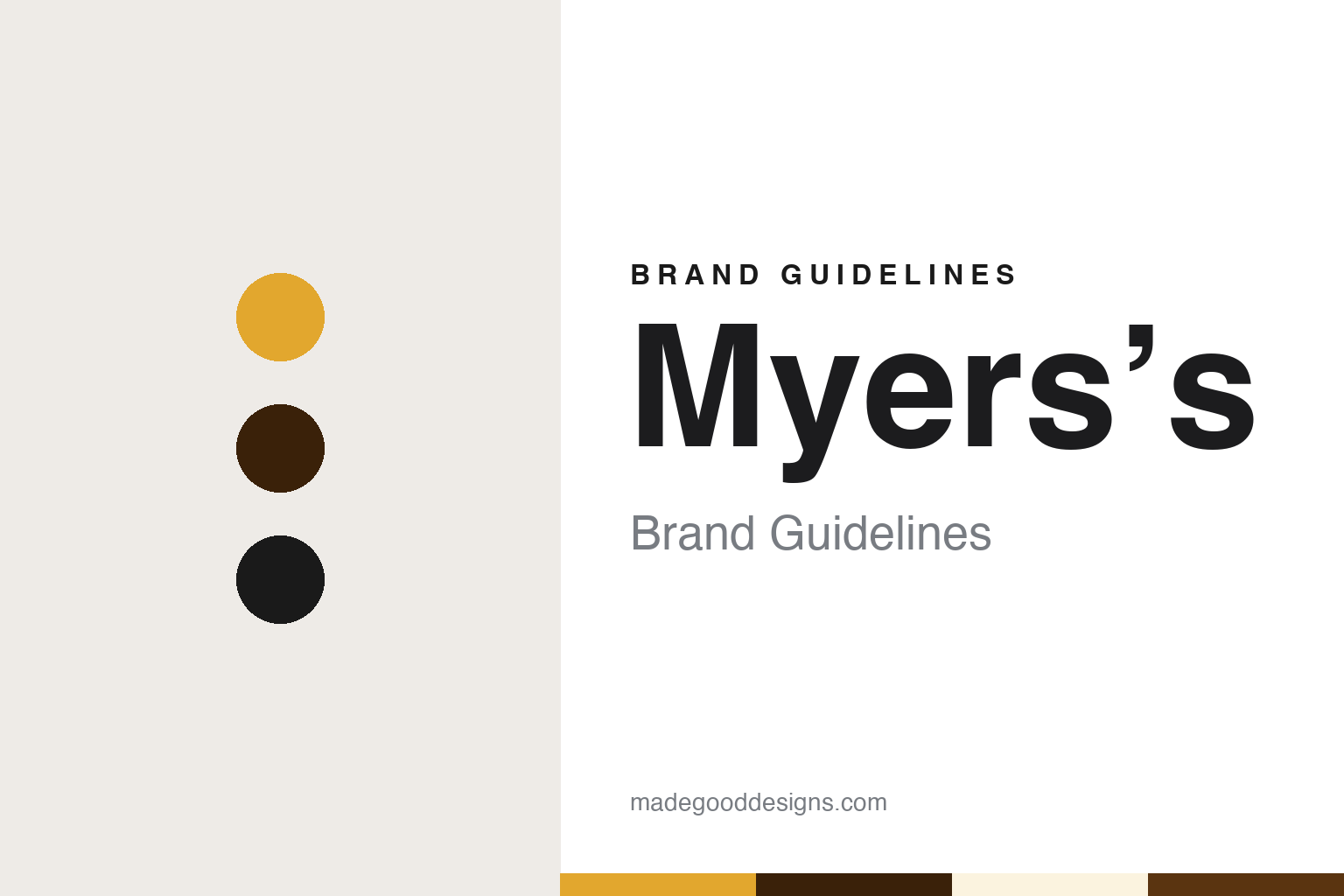
Myers’s Brand Guidelines
The Kingston dark rum of 1879 behind the Planter’s Punch.
Aa
Two constants: a label gold, molasses and cask black palette and a high-contrast serif register. Abstract homage — not a Myers’s product or mark; no label, logo or bottle is reproduced.
A merchant on Sugar Wharf
From a Kingston trading house to a rum with its own name.
Myers’s dates itself to 1879, when Fred L. Myers began trading rum in Kingston, Jamaica. The Oxford Companion to Spirits & Cocktails (2021), in an entry by the bar owner and rum writer Martin Cate, gives 1879 as the founding year and says the brand was long known for two products, Original Dark and a rum made for the Planter’s Punch. English Wikipedia names the founder in full as Frederick Louis Myers and says the blend has been produced since 1879.
Myers was a merchant before he was a brand. Wayne Curtis, writing in his newsletter The Long Bar in May 2025, describes him as an import and export trader whose Sugar Wharf warehouse in Kingston shipped ginger, coffee, sugar, honey and orange oil as well as rum, and cites a 1909 account that called rum the house’s great speciality, sold in grades from white and coloured spirit to rum fifteen years old. The business that bottled it traded as Fred L. Myers & Son, a name that still appears on American retail listings for the rum.
The family kept the brand for two generations, according to the Oxford Companion. The New York Times reported on 28 July 1954 that Seagram was taking over the Myers rum interests; English Wikipedia, citing that report, says the founder’s grandson Eustace Myers sold the brand to Distillers Corporation–Seagrams the day before.
Colour
A punch, a pavilion and a label full of medals.
The drink that made the name is the Planter’s Punch. The Oxford Companion says that in the 1920s Myers’s bottled an eight-year-old black-style rum specifically for the punch, that it was popularised at the West Indies Pavilion of the British Empire Exhibition in London in 1924, and that it helped fix Jamaican rum as the rum for the drink. The punch was already a draw for visitors before then: Curtis cites a New York theatre critic who wrote in 1921 about drinking one at the Myrtle Bank Hotel in Kingston. Curtis wrote in 2025 that the brand called itself “Planter’s Punch Rum” for much of the twentieth century, and that the banner on today’s label reads “Original Dark” instead.
The label itself is crowded with heritage. Curtis describes it as showing four gold medals won at industrial and agricultural shows in 1910, along with casks and a distillery set among tropical plants. The other constant is the name: the double possessive of Myers’s, with its apostrophe and second s, is, the Oxford Companion notes, one of the most frequently misspelled brand names on menus and in print anywhere in the world.
What is in the bottle is a blend. The Oxford Companion says Original Dark is a molasses-based rum sourced primarily from the Clarendon Distillery in Jamaica, blending pot-still and column-still distillates aged up to four years in white oak, and that, as with other traditional black rums, caramel or molasses is added after distillation, so its dark colour comes from more than ageing alone. English Wikipedia links Clarendon with National Rums of Jamaica. The same Oxford Companion entry lists Myers’s Legend, a ten-year-old pot-still rum, and Myers’s Platinum, a white rum, alongside Original Dark.
Typography
Design and documentation.
The seven brands in this group are all rum and bitters names: Diplomático, Gosling’s, Myers’s, Lamb’s, Wray & Nephew, El Dorado and Angostura. Rum and bitters brands in general sit at many different points in the trade, from family houses that still carry a founder’s name to labels that now belong to much larger drinks groups, and a single brand can be sold everywhere from a corner shop to a cocktail bar.
A rum or bitters brand’s identity is usually carried less by a single bottle than by a label, a name and the place it promises, because the company behind the name may have changed hands, moved its production or grown far beyond the place where it started. That makes the questions behind each name worth asking plainly: who started it, who owns it now, and where its rum or bitters is actually made and bottled.
Each guide separates what independent sources record from what the company says about itself — its founding story, its owners over time, where its rum or bitters is made and how its labels have changed — and marks plainly what rests only on the company’s own word.
Aa
A high-contrast serif for a heritage rum label. (Specimen set in Playfair Display, a serif STAND-IN; NOT the Myers’s logo.)
Myers’s
From Seagram to Diageo to Sazerac.
The brand has changed hands twice since Seagram. English Wikipedia says Seagram sold the rum to Diageo in 2000, and the Oxford Companion gives the same year. In November 2018 Bloomberg reported that Diageo was selling 19 brands to the Sazerac Company of New Orleans, Myers’s among them, and The Spirits Business reported in December 2018 that the sale had been completed. Sazerac lists Myers’s among the rums in its portfolio today.
Under Sazerac the brand has started to experiment. In October 2024 the spirits writer Fred Minnick and the drinks site VinePair reported the launch of two limited collections developed by Sazerac’s master blender Drew Mayville. The Signature Legends Collection opened with Legacy Blend #1, a blend of Jamaican and Barbadian rums made with Richard Seale, the master distiller of the Foursquare distillery in Barbados. The Signature Cask Collection took Original Dark and finished it in five kinds of barrel that had held whiskeys from the Buffalo Trace Antique Collection, including George T. Stagg and Eagle Rare 17 Year Old.
Through those changes of ownership the product at the centre has stayed Original Dark. English Wikipedia describes it today as a Jamaican black rum, a molasses-based blend of pot-still and column-still rums, and lists the Planter’s Punch first among the mixed drinks it is used in, along with its use as a cooking ingredient in sweet and savoury dishes. Fred Minnick, announcing the 2024 collections, introduced it in the same terms the label uses: a Jamaican rum brand launched in 1879.
For a design guide, Myers’s shows how a merchant’s name, a single cocktail and a label of medals and casks can carry a rum through three owners and nearly a century and a half. Compare Appleton Estate, the Jamaican estate rum, and Captain Morgan, the rum brand Seagram created. For this guide we use label gold, molasses and cask black with a high-contrast serif, an unofficial interpretation; no product or logo is reproduced.
Explore & save
Keep Myers’s’s identity on hand — save it to a board in the Made Good inspiration library.
Myers’s identity set
Pin the Myers’s label gold, molasses and cask black palette and the high-contrast serif register to your own board.