New Orleans Pelicans Brand Guidelines
A state bird, a fleur-de-lis and three colours borrowed from two flags.
Aa
Two constants: a navy, gold and red palette and a condensed athletic sans register. Abstract homage — not a New Orleans Pelicans mark; no logo, jersey or wordmark is reproduced.
From Hornets to Pelicans
A franchise that arrived with another city’s name and later chose its own.
The New Orleans Pelicans did not begin as the Pelicans. English Wikipedia says the franchise reached New Orleans for the 2002–03 season, when George Shinn, then owner of the Charlotte Hornets, moved the team south. It kept its old nickname and played as the New Orleans Hornets. After Hurricane Katrina in 2005 the team spent two seasons based in Oklahoma City as the New Orleans/Oklahoma City Hornets, returning to New Orleans full-time for the 2007–08 season. Wikipedia says the NBA itself bought the club from Shinn in December 2010.
A new owner arrived in April 2012. Wikipedia says Tom Benson, owner of the NFL’s New Orleans Saints, bought the team from the league and said he would change its name to something that suited the region better. Benson had hoped the Utah Jazz, a club founded in New Orleans in 1974 that moved to Salt Lake City in 1979, might give back the “Jazz” name; Wikipedia says the Jazz were not interested. Writing on CBSSports.com on 4 December 2012, Matt Moore relayed a Yahoo! Sports report that the Hornets were expected to become the Pelicans as early as the 2013–14 season. Moore noted that Benson already owned the rights to the Pelicans name, and that Krewe, after the costumed parading groups of Mardi Gras, and Brass had also been considered.
The name itself had local history. Wikipedia says a minor-league baseball team called the New Orleans Pelicans played in the city from 1901 to 1957. The bird is older still as a civic symbol: the brown pelican is Louisiana’s state bird, and the team said in its January 2013 announcement that the pelican appears on the state’s flag and seal.
The change was confirmed on 24 January 2013. In its release that day, the club said that at the end of the 2012–13 season the team would become the New Orleans Pelicans, and that Benson had introduced the new logos and colour scheme at the announcement. Wikipedia says the name formally changed on 18 April 2013, after the season ended.
Colour
Colours taken from a state flag, a city flag and a bird.
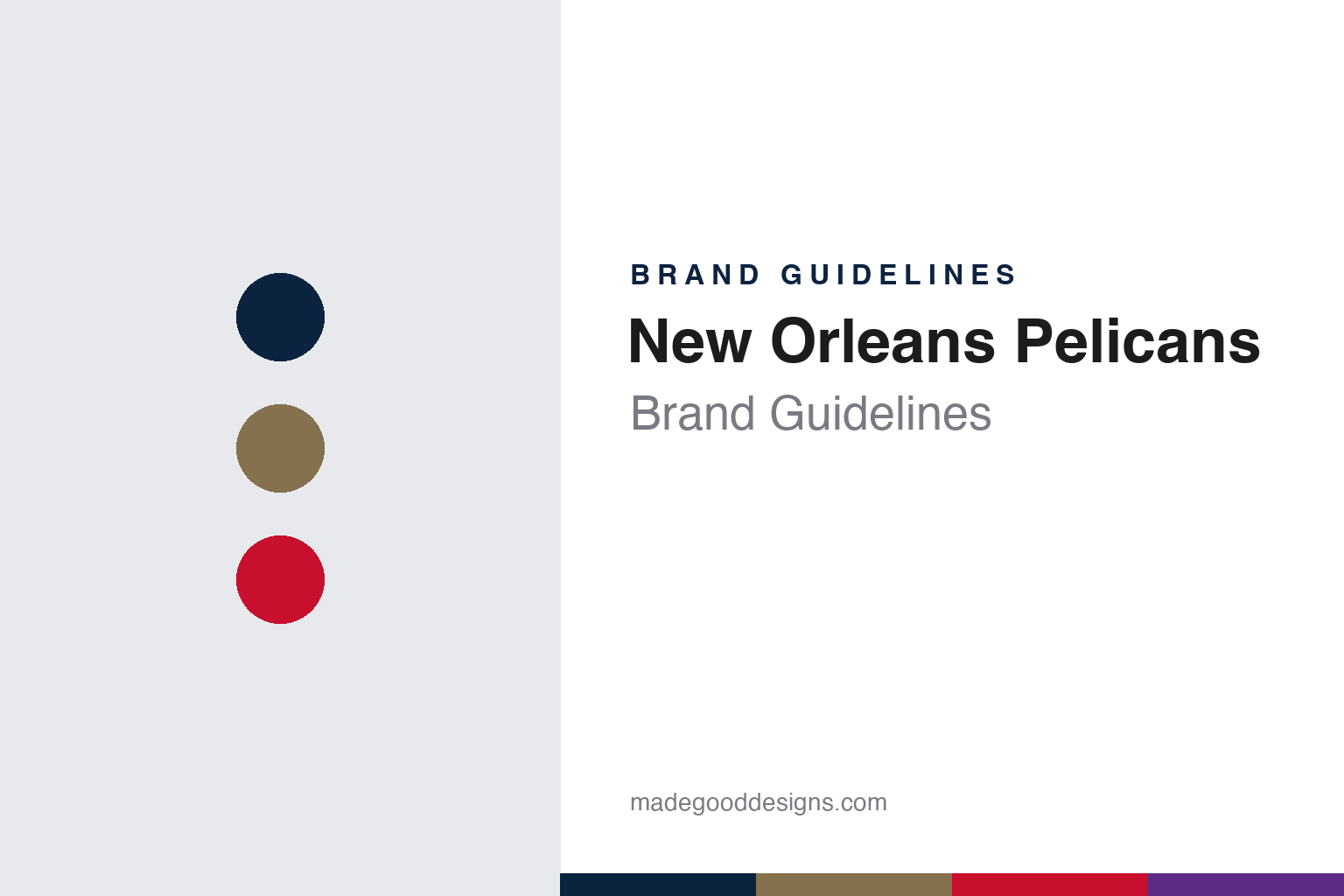
The team explained its palette in unusual detail. According to the club’s 24 January 2013 release, the Pelicans’ colours would be blue, gold and red. The primary blue, the team said, was taken from Louisiana’s state flag. Gold was shared with the Saints, linking the two Benson-owned clubs, and the team added that gold is also found on the “crown” of the pelican. Red, the release said, stands for fraternity and for the mother pelican’s “blood provision,” and echoes the colour beneath the pelican’s throat. The club pointed out that all three colours appear on the flag of the City of New Orleans. Wikipedia describes the finished scheme as navy blue, gold and red.
The same release set out what the bird was meant to carry. The team said the pelican would stand for the culture and resolve of the Gulf Coast, and would front community work on coastal restoration, wildlife conservation and children’s health. Rita Benson LeBlanc, then the team’s owner and vice chair of the board, said in the release that the pelican represented teamwork and regeneration.
The marks followed the same local logic. Wikipedia names a combination mark the club called the “Bird-de-Lis”, which joins a pelican, a fleur-de-lis and a crescent basketball shape. The fleur-de-lis had already appeared under the old name: Wikipedia says the Hornets added a “fleur-de-bee” logo to the right chest in 2007, and in 2008 introduced logos and uniforms with lettering inspired by the city’s wrought iron, swapping teal for “creole blue” alongside purple and Mardi Gras gold.
The Hornets name did not disappear. Wikipedia says the Charlotte Bobcats applied in May 2013 to take the Hornets name for the 2014–15 season, and that at a press conference on 20 May 2014 it was announced that the Pelicans would hand the history of the original 1988–2002 Hornets back to Charlotte. Hugo the Hornet, the New Orleans mascot from 2002 to 2013, went back to Charlotte too.
Typography
Design and documentation.
Professional clubs carry names that can outlast the cities, owners and ballparks attached to them. When a club changes its name, the new identity usually arrives as a complete set rather than a single swap: a wordmark, a cap or helmet insignia, a primary logo, home and road uniforms and a colour palette, all launched together so that signage, merchandise and broadcast graphics can switch on the same date. Leagues often supply design support, and clubs commonly test options with supporters before an announcement.
Relocation works differently. A club that moves may keep its nickname, colours and lettering while the city name on the road jersey changes, so the visual system becomes the thread that links one home to the next. Some clubs play for a period in an interim home, such as a smaller ballpark or a shared stadium, before a permanent building is ready, and their identity then has to read clearly in surroundings designed for another team.
Many clubs also keep a single element through every change: a script wordmark, a letter monogram or an animal mascot. Such elements are often redrawn rather than replaced, with thicker strokes, revised serifs or a simplified outline, so that supporters can recognise them on a cap, a sleeve patch or a scoreboard across several decades.
Aa
A condensed athletic sans — the register of a jersey number and a French Quarter street sign. (Specimen set in Saira Condensed, a condensed sans STAND-IN; NOT the New Orleans Pelicans logo or wordmark.)
New Orleans Pelicans
Street-sign lettering, Mardi Gras uniforms and a pelican called Pierre.
The opening set of Pelicans uniforms was released on 1 August 2013. Wikipedia says the “New Orleans” wordmark across the front was inspired by the street signs of the French Quarter, that a partial logo sat on the sides of the shorts and that the Bird-de-Lis was placed on the back of the neck. When the NBA moved its own logo to the back neck of every team’s jersey in 2014, the league mark took that spot. A red alternate followed on 23 September 2014.
Carnival colours have recurred ever since. Wikipedia says a short-sleeved alternate shown on 17 September 2015 used the Mardi Gras colours of purple, green and gold, with “NOLA” across the chest in the club’s lettering. After Nike became the NBA’s uniform supplier in 2017, the Mardi Gras look continued as the Pelicans’ City edition. The 2020–21 City uniform was modelled on the New Orleans city flag; the 2021–22 version set “NOLA” in lettering shaped like a bird in flight; and later editions returned to dark purple. For 2023–24 the red Statement uniform was updated to read “Crescent City”, and a black City uniform with neon green letters drew on the city’s night life.
The mascot arrived with the new season. Wikipedia says Pierre the Pelican was introduced on 30 October 2013, the team’s home opener, with a name chosen by fans in an online poll; his head was redesigned and shown again on 11 February 2014. The arena was renamed the Smoothie King Center in 2014 under a naming deal with the Metairie-based smoothie chain, and Wikipedia says NewAge Products became the jersey patch partner in 2023.
Ownership passed within the family. David Aldridge reported in his NBA.com Morning Tip column on 19 March 2018 that Tom Benson had died the previous week, leaving control of the Saints and the Pelicans to his wife, Gayle Benson, whom the NBA had already approved as his successor. NOLA.com | The Times-Picayune reported on 17 March 2018 that Benson’s will named Gayle Benson as sole beneficiary. She has controlled the Pelicans since 2018.
For a design guide, the New Orleans Pelicans show how a renamed team can build an identity from a state bird, two flags and the lettering of its own streets. Compare the Charlotte Hornets, the New Orleans Saints and the NBA. For this guide we use navy, gold and red with a condensed sans, an unofficial interpretation; no product or logo is reproduced.
Explore & save
Keep New Orleans Pelicans’s identity on hand — save it to a board in the Made Good inspiration library.
New Orleans Pelicans identity set
Pin the New Orleans Pelicans navy, gold and red palette and the condensed athletic sans register to your own board.