New York Brand Guidelines
A newspaper’s Sunday title that became a city weekly.
Aa
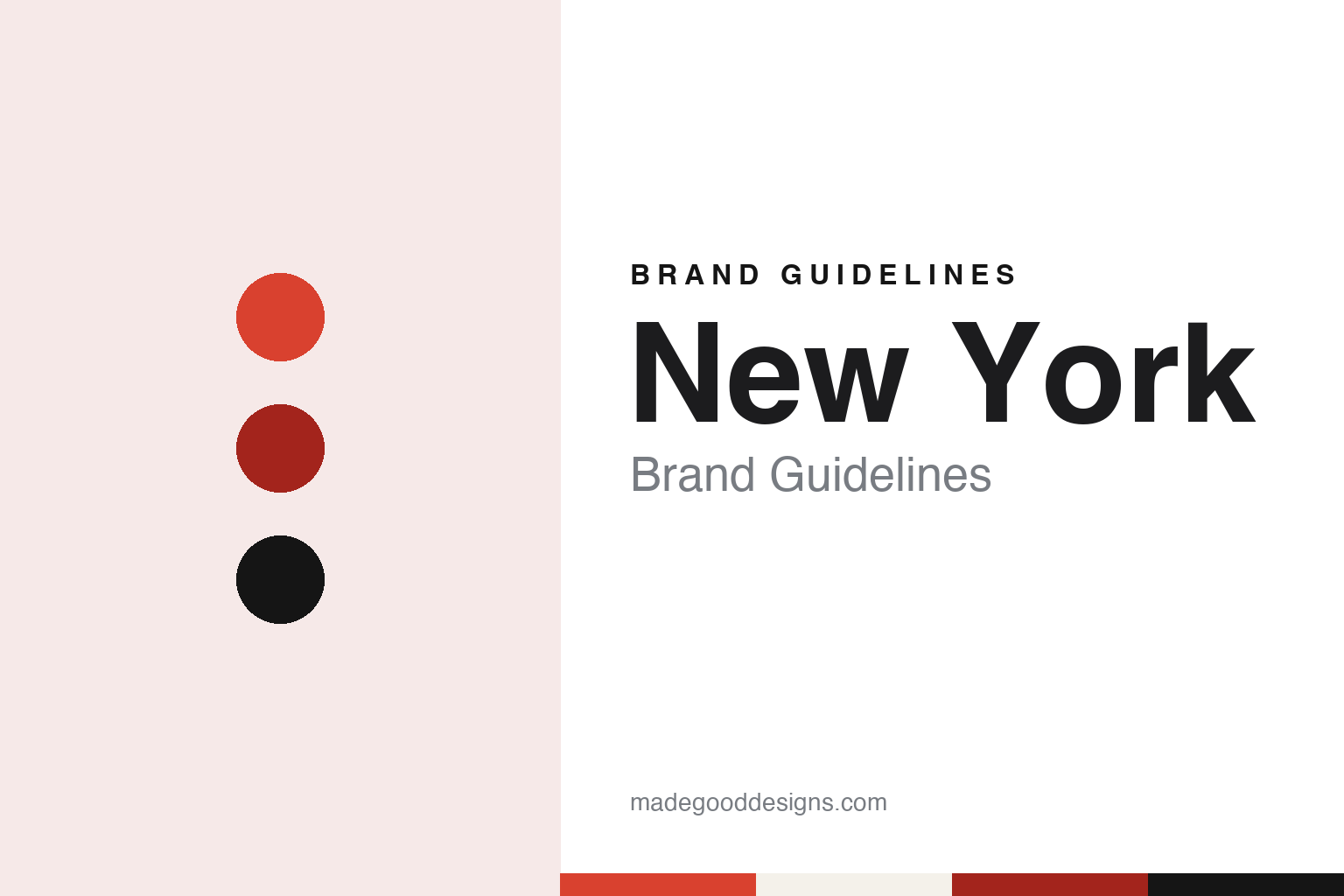
Two constants: a red, brick and subway black palette and a high-contrast serif register. Abstract homage — not a New York magazine asset or mark; no logo, cover or nameplate is reproduced.
From Sunday supplement to city weekly
A newspaper’s magazine, a bought nameplate and an April 1968 issue.
New York began inside a newspaper. English Wikipedia says the magazine was created in 1963 as the Sunday supplement of the New York Herald Tribune, which had recently been sold to John Hay Whitney and was relaunching its Sunday edition. It was edited first by Sheldon Zalaznick and then by Clay Felker. CBS News Sunday Morning, in a report broadcast on 15 September 2019, described the same arrangement: the Herald Tribune had a Sunday magazine called New York, Felker was its editor and Milton Glaser was its art director.
The newspaper did not survive the decade. Wikipedia says the Herald Tribune closed in 1966 and that New York was briefly revived inside a combined paper, the World Journal Tribune, which lasted until May 1967. CBS reported that Felker and Glaser then bought the name New York from the Tribune’s owners, and that in 1968 the magazine as readers now know it was born. Wikipedia adds that the pair bought the rights to the nameplate with backing from investors led by Armand G. Erpf, the magazine’s first chairman, and that the new title was a stand-alone glossy weekly. Its first issue was dated 8 April 1968.
Glaser’s own studio describes the venture in one line: “In 1968, Clay Felker and I founded New York Magazine, where I was president and design director until 1977.” In the CBS interview, Glaser said he had never designed a magazine before he started on this one, and that the plan was simply, as in a film, to make a magazine. Wikipedia says Glaser and his deputy, Walter Bernard, designed and laid out the magazine and hired illustrators including Jim McMullan, Robert Grossman and David Levine to produce covers and illustrations. Writers from the supplement came across with the title, among them Tom Wolfe and Jimmy Breslin, and in its first year the composer Stephen Sondheim set a cryptic crossword for every third issue, Wikipedia says.
Colour
Murdoch, K-III, Wasserstein, Vox Media and Lupa Systems.
Ownership of New York has changed hands several times since its founders left. The Associated Press, in a report by Jocelyn Noveck published by PBS NewsHour on 21 May 2026, noted that Rupert Murdoch owned the magazine from 1976 until 1991. Wikipedia says the 1976 takeover forced Felker and Glaser out, that Edward Kosner became editor in 1980, and that in 1991 Murdoch sold to K-III Communications. Editors in the K-III years included Kurt Andersen, from 1993, and Caroline Miller, from 1996.
A family trust controlled by the financier Bruce Wasserstein took over at the end of 2003, according to Wikipedia, and early in 2004 Adam Moss, who had edited The New York Times Magazine, became editor. That autumn Moss relaunched the magazine with two new sections, The Strategist and The Culture Pages. CBS reported in September 2019 that Moss had just stepped down after fifteen years, and that David Haskell, an editor at the magazine for twelve years, had become editor-in-chief; Wikipedia dates the handover to 1 April 2019.
Later that year the parent company changed hands. TechCrunch, in a report by Anthony Ha on 25 September 2019, said Vox Media had announced the day before that it was acquiring New York Media, making it the new owner of the magazine and its digital offshoots. Variety reported on 24 September 2019 that New York Media’s chief executive, Pamela Wasserstein, would become president of Vox Media and that Haskell would continue to oversee the print issues and the digital titles.
Another change came in 2026. Reuters, in a report carried by Al Jazeera on 20 May 2026, said James Murdoch had agreed to acquire the magazine and the Vox Media Podcast Network through his company Lupa Systems, and the AP report of the following day said the acquired divisions would run as a Lupa subsidiary under the Vox Media name. Lupa Systems announced on 8 July 2026 that the acquisition had closed, with Jim Bankoff as chief executive of the new company and Haskell as editor-in-chief of New York. Lupa Systems has owned the magazine since 2026.
Typography
A masthead, a format and a grid of departments.
A magazine meets its readers on the newsstand and the shelf, so much of its identity sits in three places: the masthead, the cover and the physical format. The masthead is usually a single word or short title in a fixed typeface. English Wikipedia says the Artforum logo is a bold, condensed version of Akzidenz-Grotesk, a German grotesque that was hard for an American publication to obtain in the 1960s, and AIGA Eye on Design reported on 21 December 2021 that The Paris Review replaced its serif nameplate with a bold wordmark in Founders Grotesk from Klim Type Foundry when Matt Willey of Pentagram redesigned it.
Cover conventions and format do the rest. A magazine can give its cover to one image, as Artforum often does with the work of one artist, or to an emblem and a list of contents, as The Paris Review did with the eagle drawn by William Pène du Bois in the top left corner of its 1953 debut. The size and shape of the page can matter as much as the logo: Sotheby’s, in an article dated 26 July 2019, said Artforum had set itself apart with a square format since its first issue in 1962, and Eye on Design said the 2021 Paris Review moved to a smaller trim, recycled paper and a spine carrying the issue number in large type. When reading a magazine’s identity, look at the nameplate, at what the cover is allowed to show, and at the size, paper and spine of the object itself.
Aa
A high-contrast display serif — the register of a glossy city weekly’s cover lines. (Specimen set in Bodoni Moda, a STAND-IN; NOT the New York magazine logo or nameplate and NOT any Glaser lettering.)
New York
Glaser’s nameplate, dated covers and a family of websites.
CBS reported in 2019 that the magazine’s covers have always carried Glaser’s logo for the name Felker and Glaser bought from the newspaper’s owners, and Glaser’s own studio lists the magazine as one of its case studies. CBS also showed a run of dated covers from the archive: “Free Leonard Bernstein!” on 8 June 1970; “Brooklyn Is Finished”, photographed by Adrian Gaut, on 1 October 2012; a ground-meat sculpture by Carl D’Alvia with Victoria Granof, photographed by Bobby Doherty, on 1 June 2015; and “The Single American Woman”, also photographed by Doherty, on 22 February 2016. After Hurricane Sandy in 2012, Moss told CBS, the photographer Iwan Baan shot the city from a helicopter, and only a handful of frames were usable for the cover of a Manhattan half in darkness.
The format has changed with the schedule. Wikipedia says the magazine announced in December 2013 that the print edition would move from weekly to biweekly publication the following March, and CBS confirmed in 2019 that it had gone biweekly in 2014. For the magazine’s 50th anniversary in April 2018, Wikipedia says, it marked the date with a book-length history, Highbrow, Lowbrow, Brilliant, Despicable: 50 Years of New York, published by Simon & Schuster, and a commemorative issue.
Much of the brand now lives online under separate names. Wikipedia dates the website nymag.com to 2006, replacing the earlier nymetro.com, and the launch of Grub Street and Daily Intelligencer, later shortened to Intelligencer, to the same year, followed by Vulture in 2007 and The Cut in 2008; The Cut became a standalone website in 2012. Wikipedia adds that the real-estate site Curbed was merged into New York in May 2020. CBS described the sites as sitting under the umbrella of the magazine, and the AP report of May 2026 listed The Cut, Vulture, Intelligencer, The Strategist, Curbed and Grub Street as the magazine’s verticals.
For a design guide, New York shows how one nameplate can hold a print weekly-turned-biweekly and a family of differently named websites together: the name came from a newspaper supplement, the lettering from a co-founder, and the sub-brands carry their own names under it. Compare it with the cover conventions of The New Yorker, and with Rolling Stone. For this guide we use red, brick and subway black with a high-contrast serif, an unofficial interpretation; no product or logo is reproduced.
Explore & save
Keep New York’s identity on hand — save it to a board in the Made Good inspiration library.
New York magazine identity set
Pin the New York magazine red, brick and subway black palette and the high-contrast serif register to your own board.