Pep Boys Brand Guidelines
The Philadelphia shop whose founders became its sign.
Aa
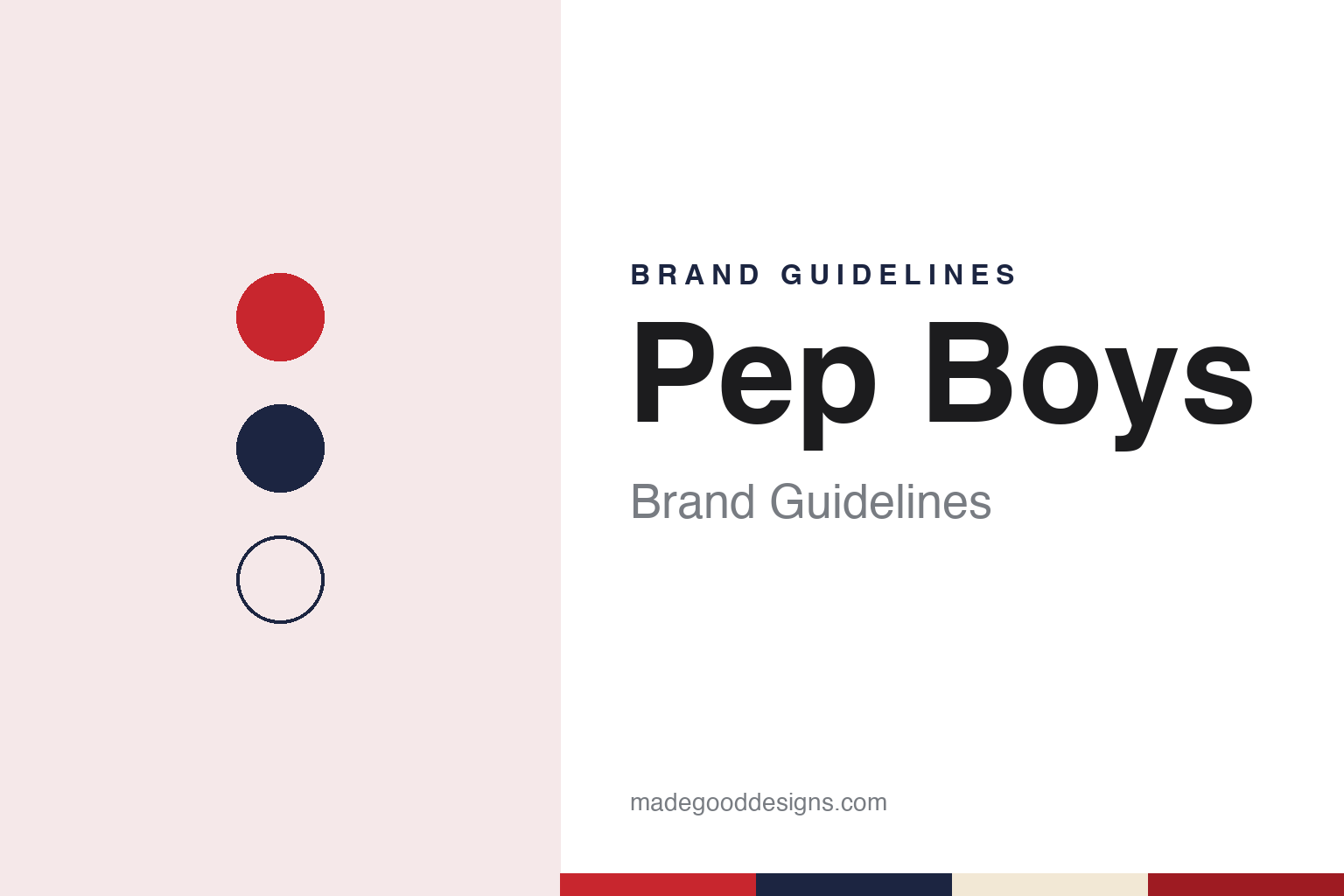
Two constants: a red, navy and cream palette and a slab serif register. Abstract homage — not a Pep Boys mark; no caricature, logo or sign is reproduced.
Pep Auto Supply
A small Philadelphia shop and a borrowed name.
Pep Boys began in Philadelphia in 1921. According to the International Directory of Company Histories (St. James Press, 2001), a group of friends who had served in the First World War opened an auto-supply shop there that year under the name Pep Auto Supply. English Wikipedia names the founders as Emanuel “Manny” Rosenfeld, Maurice “Moe” Strauss, W. Graham “Jack” Jackson and Moe Radavitz, and dates the opening to August 1921.
The name came off the shelves. The Directory retells what it calls corporate folklore: the partners took “Pep” from Pep Valve Grinding Compound, one of the shop’s early product lines, because only a short name would fit on the marquee of their small storefront. The same account says a police officer who worked nearby would send motorists he stopped for equipment faults to “the boys” at Pep for replacement parts. Wikipedia tells the story in the same way, with the officer sending drivers whose lights were out to the shop for a replacement wick.
Radavitz cashed out in the early 1920s, the Directory says, and in 1923 the remaining partners added their own first names, so that the business became The Pep Boys — Manny, Moe & Jack. Wikipedia says Strauss took the idea from a trip to California, where he noticed businesses trading under their owners’ first names, among them a dress shop called “Minnie, Maude and Mabel’s.”
The chain soon looked west. The Directory says Strauss sent Murray Rosenfeld, Manny’s brother, to California in 1932 and that stores opened in Los Angeles in 1933; Wikipedia says the West Coast business was set up as a separate company, The Pep Boys — Manny, Moe & Jack of California. The company went public in 1946, according to the Directory; Wikipedia gives 1945. Its head office is today in Bala Cynwyd, just outside Philadelphia, Wikipedia says.
Colour
The founders became the logo.
The brand’s signature is a set of faces. Shortly after the 1923 renaming, the Directory says, the partners commissioned caricatures of themselves, drawn by Harry Moskovitch. Manny, with a Charlie Chaplin moustache and a cigar, sat on the left; Moe was in the middle; Jack’s grinning face was on the right.
Jack did not stay. Wikipedia says Jackson left the business in 1927 and his caricature was replaced with that of Moe’s brother, Isadore “Izzy” Strauss. The Directory says the company name was kept even though the face changed, because “Manny, Moe and Izzy” did not sound right. Izzy Strauss himself left in 1929 to start his own auto-supply business in Brooklyn, according to Wikipedia. One of the illustrations on Wikipedia’s page is an advertisement for an Allentown store from 1937 that already carries the replacement face.
The faces travelled a long way from the original storefront. The Directory says they were printed on T-shirts and matchbooks and cast in cement as statues outside stores; that Johnny Carson joked about them in his Tonight Show monologue and Saturday Night Live parodied them; and that they came to life in Claymation for television commercials in the late 1980s.
The trio has also outlasted several logos. Wikipedia illustrates a logo used from June 2004 to July 2013 and a logo used since 2023, and says the Manny and Moe faces from the early advertisements of the 1920s are still on the current mark.
The business behind the faces changed as well. Wikipedia says service bays and service managers were added to the stores by 1969, and that larger “supercenter” stores arrived in the 1980s. In April 2019, according to a Business Wire release cited by Wikipedia, the company added smaller fleet vans to its Pep Boys Mobile Crew, which carries out maintenance on location. In December 2023 Pep Boys said it had completed its move away from retail parts sales to concentrate on automotive service and tires.
Typography
Design and documentation.
Car-service and tire brands are read from the road before they are read anywhere else. A fascia over a row of service bays, a pole sign at the curb and the lettering above each bay door are meant to be seen from a moving car or from across a parking lot, which is one reason such names are often short, their colours few and their letterforms heavy. Inside, the same marks can repeat on a smaller scale: on the tire wall, where stacked sidewalls sit under a branded header, on the counter, on the waiting-room wall and on the printed or emailed receipt.
Uniforms carry an identity into the bay itself. A name patch, a coloured shirt or a branded cap marks out the technician, and the same colours can run on to vans, tool chests and the paperwork that leaves the shop with the car. Where a name is franchised, a central owner can set the fascia, the sign and the colours while local operators run the bays.
Each guide below follows one name from its founding through its owners to the signs and stores that carry it today, and notes where an account rests on the company’s own word.
Aa
A sturdy slab serif for a sign above a garage door. (Specimen set in Roboto Slab, a slab-serif STAND-IN; NOT the Pep Boys logo.)
Pep Boys
From family firm to Icahn to Mavis.
For most of its history Pep Boys was run by its founding families. The Directory says the Strauss and Rosenfeld families still controlled a substantial block of the stock into the early 1990s, and that in 1986 Mitchell Leibovitz, from outside the founding families, became the company’s president. Wikipedia says Manny Rosenfeld served as president from the 1945 listing onward and that Moe Strauss followed him in 1960.
Ownership changed hands in the 2010s. In January 2012 the company agreed to be acquired by the private-equity firm The Gores Group, Wikipedia says, and that deal fell through in May 2012. In October 2015 Bridgestone agreed to buy the company, CBS News reported, citing the Associated Press; Wikipedia says Pep Boys ended that agreement in December 2015 and signed instead with Icahn Automotive Group, part of Icahn Enterprises, which completed its purchase in February 2016. Under Icahn, in January 2017, Pep Boys bought the repair chain Just Brakes, Wikipedia says, citing aftermarketNews. Icahn Enterprises owned Pep Boys from 2016 until 2026.
In July 2026 Icahn Enterprises agreed to sell the chain to Mavis Tire. On 21 August 2026 AutoGuide reported that the sale had closed, effective 20 August, as a stock purchase in which Icahn kept the real estate under the Pep Boys stores and its AAMCO and Precision Tune businesses. Mavis Tire has owned Pep Boys since August 2026. According to the joint announcement quoted by AutoGuide, Pep Boys “will retain its brand identity as part of the Mavis family of brands.” AutoGuide quoted Joe Auriemma as Pep Boys’ chief executive; Wikipedia, citing aftermarketNews, dates his appointment to that role to February 2025.
For a design guide, Pep Boys shows how a drawing of a business’s founders can carry a brand through changes in what it sells and who owns it. Compare Bridgestone, which agreed to buy the chain in 2015, and Advance Auto Parts, another auto-parts name with roots on the East Coast. For this guide we use a signal red, a deep navy and a garage cream with a slab serif, an unofficial interpretation; no product or logo is reproduced.
Explore & save
Keep Pep Boys’s identity on hand — save it to a board in the Made Good inspiration library.
Pep Boys identity set
Pin the Pep Boys red, navy and cream palette and the slab-serif register to your own board.