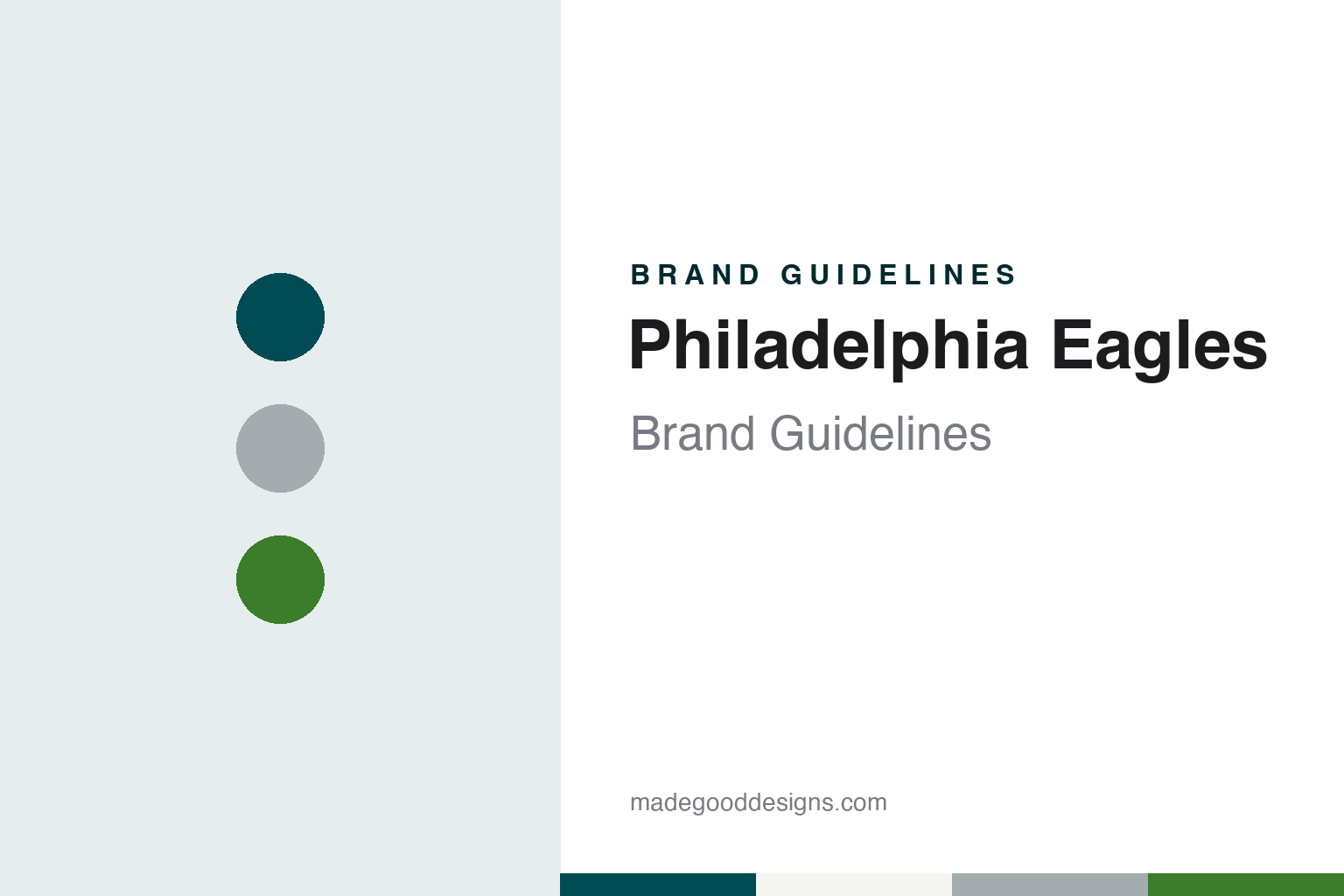
Philadelphia Eagles Brand Guidelines
A New Deal badge, a pair of helmet wings, and a green that changed shade in 1996.
Aa
Two constants: a midnight green, wing silver and kelly green palette and a condensed block sans register. Abstract homage — not a Philadelphia Eagles product or mark; no helmet, uniform or logo is reproduced.
The Blue Eagle
A franchise from the ashes of Frankford and a name from the New Deal.
The Philadelphia Eagles date from 1933, when the National Football League granted a Philadelphia franchise to a group headed by Bert Bell and Lud Wray, two former teammates at the University of Pennsylvania. English Wikipedia says the group also took over the liquidated assets of the Frankford Yellow Jackets, a Philadelphia club that had stopped playing in 1931, but that both the Eagles and the league regard the two as separate organisations. The Pro Football Hall of Fame’s team history describes the 1933 deal as a syndicate headed by Bell and Wray taking over the former Frankford franchise. ESPN’s NFL Nation reporters, in a guide to the origins of all the league’s team names published on 2 February 2022, also say the rights to the financially struggling Yellow Jackets were awarded to Bell and Wray that year.
The name came from Washington. ESPN’s Tim McManus wrote that Bell and Wray chose “Eagles” as a nod to President Franklin D. Roosevelt’s New Deal, because an eagle was the emblem of the National Recovery Administration, a centrepiece of the New Deal. Wikipedia says the club’s choice of an eagle honoured that agency’s insignia, the Blue Eagle.
The early colours were not green. Wikipedia says the Eagles wore light blue and yellow in 1933 and 1934, the same colours as Philadelphia’s city flag and the colours the Frankford club had used, and that green was added in 1935; for several decades after that the team’s colours were kelly green, silver and white. The Philadelphia Inquirer likewise wrote in 2022 that the Eagles have worn green since the mid-1930s.
The early years were unsettled. Wray coached the team at Bell’s urging, Wikipedia says, and home games moved from the Baker Bowl to Municipal Stadium and then to Shibe Park. In 1936 the club was sold at public auction and Bell, the only bidder, became sole owner. During the Second World War, the Hall of Fame notes, the Eagles combined with the Pittsburgh club for the 1943 season, a side called both Phil-Pitt and the “Steagles”.
Colour
Owners from Bell to Lurie, and five home grounds.
Ownership changed hands several times before the present era. The Hall of Fame history says that in 1941 a swap between Philadelphia and Pittsburgh saw the two clubs trade home cities, with Alexis Thompson becoming the Eagles’ owner; Wikipedia calls the arrangement the “Pennsylvania Polka”, in which Bell and Art Rooney exchanged the Eagles roster and Philadelphia territory for Thompson’s Pittsburgh rights. Before the 1949 season Thompson sold the team to a syndicate known as the “Happy Hundred”, led by the Philadelphia businessman James P. Clark. Wikipedia lists later owners as Leonard Tose from 1969, and the Florida car dealers Norman Braman and Ed Leibowitz from 1985.
Jeffrey Lurie bought the Eagles on 6 May 1994, Wikipedia says, and he has owned the club since. The Inquirer’s Cassie Owens, writing on 30 March 2022, described the 1996 rebrand as coming two years after Lurie bought the franchise, and identified him as the team’s chairman and chief executive.
The stadiums trace the city’s sporting map. After the Baker Bowl, Municipal Stadium in South Philadelphia from 1936 and Shibe Park from 1940, the team moved in 1958 to Franklin Field at the University of Pennsylvania, Wikipedia says. In 1971 it moved again, to the new Veterans Stadium, and the team played there until the end of the 2002 season. The current home, Lincoln Financial Field in the South Philadelphia Sports Complex, opened for the 2003 season.
The kit itself has been revised in steps since the 1996 overhaul. Wikipedia says black shadows and silver trim were added to the numbers in 2003, the year black alternate jerseys arrived, and that the team marked its 75th season in 2007 with a patch and a yellow-and-blue throwback modelled on the 1933 uniforms. When Nike became the league’s uniform supplier in 2012 the Eagles kept their design; when they adopted Nike’s newer cut in 2014, Wikipedia says, the midnight green trousers were held back for half a season because the preferred shade of midnight green was hard to produce. A black alternate helmet followed in 2022.
Typography
Design and documentation.
An American football club’s identity has to work at very different scales. The helmet logo is the mark people see first: a single shape on a curved shell, read from the upper deck and on a phone screen, so it is usually a bold silhouette with a clear outline and few colours. A wordmark then carries the name on jerseys, sidelines and broadcasts, often in a custom or heavily modified typeface with its own numerals for the back and shoulders of the jersey.
Alternate uniforms give clubs room to play. Throwback sets bring back earlier helmets and stripes for a game or a season, and all-over single-colour “colour rush” style sets push one team colour across helmet, jersey and trousers. Each alternate has to stay recognisable on television next to the opposing side, which is why contrast between home and away kits matters so much.
Sideline apparel — coaches’ jackets, caps, hoodies and staff polos — extends the same marks into retail, away from the field. In the stadium, the palette moves onto end-zone paint, the midfield logo, ribbon boards, wayfinding and concourse signs, where large flat areas of colour and simple type need to read from a distance and in floodlight.
Aa
A condensed block sans — the register of a sideline number and a stadium concourse sign. (Specimen set in Oswald, a sans-serif STAND-IN; NOT the Philadelphia Eagles logo or wordmark.)
Wings, an eagle head and two greens
From a bird in flight to a head that reads as an E.
For nearly five decades the club’s logo was a full bird. Wikipedia says that from 1948 to 1995 the Eagles’ mark was an eagle in flight carrying a football in its claws, drawn in a more stylised way from 1969 to 1972 before the team name returned beneath it in 1973. The helmet carried a separate idea: in 1954 the Eagles put silver wings on a kelly green helmet. In 1969 the team used two helmets, kelly green with white wings on the road and white with green wings at home, and wore the white version alone from 1970 to 1973. By 1974, Wikipedia says, Joseph A. Scirrotto Jr. had designed silver wings within a white outline, and that style on a kelly green helmet stayed standard for more than two decades.
The 1996 rebrand changed almost everything at once. Wikipedia says the primary kelly green gave way to a darker shade the club officially called midnight green, silver largely disappeared, the helmet wings became mostly white with silver and black accents, and the eagle was cut down to a white bald-eagle head in a less realistic, more cartoon-like style, with the lettering changed from calligraphic to block letters. The head faces left, Wikipedia notes, so that the feathers on its right side form a stylised “E”. Owens wrote in the Inquirer in 2022 that, according to the paper’s reporting at the time, Lurie said at the 1996 unveiling that the “stronger” look reflected a “new spirit for a new era”, and that the change followed a focus group run by NFL Properties, the league’s licensing arm, with local fans who disliked the kelly green and wanted more distance from the New York Jets’ green.
The older green came back as an alternate. On 29 March 2022 Lurie announced that kelly green uniforms would return in 2023; the Inquirer quoted him saying, “It’s what our fans have wanted, it’s what we’ve wanted.” Wikipedia says the release had been planned for 2022 and was delayed by production supply issues, and that the kelly green set debuted in a 2023 home game against the Miami Dolphins, with the kelly green helmet becoming the club’s alternate shell.
For a design guide, the Philadelphia Eagles show how a team name borrowed from a government programme can outlive the programme, and how a club can run two greens side by side, a bright historic one and a darker one chosen through market research. Compare it with NFL, whose licensing arm ran the 1996 research, and Pittsburgh Steelers, the club the Eagles merged with in 1943. For this guide we use midnight green, wing silver and kelly green with a condensed sans, an unofficial interpretation; no product or logo is reproduced.
Explore & save
Keep Philadelphia Eagles’s identity on hand — save it to a board in the Made Good inspiration library.
Philadelphia Eagles identity set
Pin the Philadelphia Eagles midnight green, wing silver and kelly green palette and the condensed block sans register to your own board.