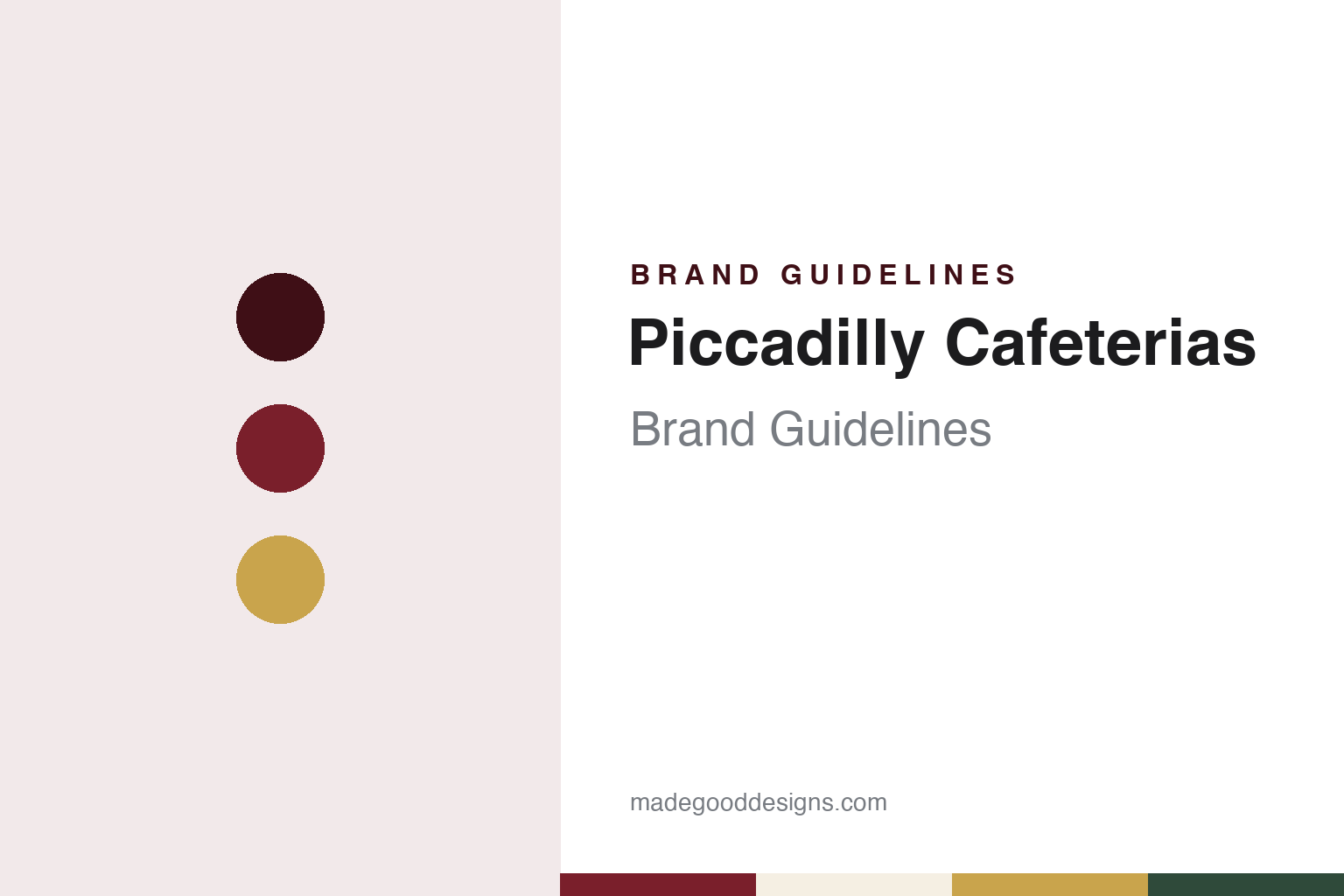
Piccadilly Cafeterias Brand Guidelines
The Baton Rouge cafeteria line named for picking a dilly of a meal.
Aa
Two constants: a line burgundy, brass and magnolia green palette and a high-contrast dining serif register. Abstract homage — not a Piccadilly product or mark; no sign, tray or logo is reproduced.
Pick a dilly
A 1932 coffee shop, a 1944 purchase and a pun.
Piccadilly’s story begins with a business that was already trading under the name. The Advocate of Baton Rouge, in a profile by Timothy Boone published on 3 February 2019, says the company was founded by T.H. Hamilton in 1944, when he acquired the Piccadilly Cafeteria and Coffee Shop, which had operated in downtown Baton Rouge, Louisiana, since 1932. English Wikipedia names the earlier proprietor as Thomas J. Costas, who it says opened the cafeteria in 1932, and gives the buyer’s full name as Tandy Hannibal Hamilton. The Orlando Sentinel, reporting on 24 April 1998, likewise dated Tandy Hamilton’s purchase of a Baton Rouge restaurant to 1944.
The name has a story of its own. Despite its British sound, the Orlando Sentinel reported in 1998, the chain’s name stemmed from Hamilton’s idea that customers could go through the serving line and “pick a dilly” of a meal.
The business grew as a Louisiana company. The Advocate says it was incorporated in Louisiana as Piccadilly Cafeterias Inc. in 1965, and that by 1971 it had reached its original growth target. By the late 1990s, the Sentinel reported, Piccadilly had restaurants well beyond Louisiana, including in the Orlando area, and its chief financial officer, Fred Johnson, described Piccadilly and its rival Morrison’s as “two peas out of the same pod”, saying the two companies’ cultures and customers were very similar. The paper said both chains had older, loyal customers and had found ways to appeal to younger diners looking for home-style dishes such as meat loaf, fried chicken and mashed potatoes.
Wikipedia describes Piccadilly today as a chain of cafeteria-style, casual dining restaurants mainly in the south-eastern United States, with most of its restaurants in the Gulf Coast region, and says it also offers family dining, meals to go and catering.
Colour
Morrison’s, two reorganisations and a return to growth.
The defining acquisition came in the late 1990s. The Orlando Sentinel reported on 24 April 1998 that Piccadilly had agreed a friendly buyout of Morrison’s, a cafeteria company the paper said got its start in Mobile, Alabama, in the 1920s, and that Morrison’s cafeterias would be converted to Piccadillys within about a year. The Advocate’s 2019 profile says the purchase of Morrison Restaurants Inc. doubled the size of the business, and that Piccadilly quickly had to shed poorly performing locations.
Two reorganisations followed. Piccadilly filed for Chapter 11 in 2003, and in 2004 the Los Angeles firm Yucaipa Companies and Diversified Investment Management Group bought the company and took it private, the Associated Press reported in a story carried by The Times-Picayune on 14 September 2012; Wikipedia dates the Yucaipa purchase to 2003. The same AP report said the Baton Rouge-based chain had filed for Chapter 11 again that week in Lafayette, citing a dispute with a lender.
Falcon Holdings took control of the chain in 2014, The Advocate reported in 2019, and Azam Malik, who had been Piccadilly’s president and chief executive in the early 2000s, came back to the company that year; Wikipedia says Falcon Holdings was led by Malik and names the present owner as Piccadilly Holdings LLC. Under Malik the company turned towards takeout. The Advocate described a Piccadilly To Go restaurant on Lee Drive in Baton Rouge with a drive-through lane and no inside seating, where customers ordered in the lobby or collected meals ordered online. Business Report, in 225 magazine, reported on 19 November 2019 that this to-go restaurant had closed.
The same 225 report said Piccadilly would open a new full-service restaurant at Juban Crossing in Denham Springs on 11 December 2019, as a prototype for future restaurants that blended Piccadilly’s classic elements with modern conveniences, an updated menu, takeout and an open kitchen, in a building much smaller than the company’s existing Baton Rouge restaurants. Wikipedia says K&W Cafeterias president Dax Allred announced on 16 August 2022 that the North Carolina chain was being sold to Piccadilly. In October 2026 the company website, piccadilly.com, offers online ordering, a rewards programme, catering, group dining and food services.
Typography
Design and documentation.
The family-restaurant brands in this part of the group grew up beside the road. Their names were made to be read from a moving car, so the sign out front — a tall pylon, a lit cabinet, a roofline shape or a wordmark across the building — often did more work than any printed advertisement. A traveller who recognised the sign knew roughly what kind of room, menu and welcome waited inside before parking.
Inside, the identity carries on in ordinary objects: a laminated or folded menu with the name across its cover, a pie case or bakery counter near the entrance, booths and counter stools, printed placemats, coffee mugs and the uniforms of the staff. Many of these chains also changed hands more than once, so the wordmark, colours and building style can shift with each new owner while the name stays the same.
Each guide in this part sets out who started the brand and where, who has owned it since, and how its sign, logo and dining room are documented — separating what independent sources record from what the company says about itself.
Aa
A high-contrast dining serif — the register of a cafeteria sign and a printed menu card. (Specimen set in Playfair Display, a serif STAND-IN; NOT the Piccadilly logo.)
Piccadilly Cafeterias
A borrowed name, a pun and a name kept in Mobile.
Piccadilly’s identity starts with a name its founder did not coin. The Piccadilly Cafeteria and Coffee Shop was already trading in downtown Baton Rouge when T.H. Hamilton bought it in 1944, The Advocate says, and the name stayed with the business through incorporation as Piccadilly Cafeterias Inc. in 1965 and through every later change of owner. The Orlando Sentinel’s 1998 account of the name, that customers could “pick a dilly” of a meal on the line, is the one the newspaper printed when Piccadilly was about to put its name on a rival’s restaurants.
The Morrison’s purchase tested how far one cafeteria name could stretch over another. The Sentinel reported in 1998 that Morrison’s restaurants were to be converted to Piccadillys, and quoted a regular at an Orlando Morrison’s who said she preferred the older name’s cooking. Wikipedia says one restaurant in Mobile, Alabama, still carries the Morrison’s Cafeteria name as an homage to that chain’s former hometown, while serving the same menu as the rest of the Piccadilly chain, so a second cafeteria name survives inside the group.
The name has also been extended beyond the dining room. Wikipedia lists Piccadilly Emergency Services, which provides meals in emergency and disaster settings, and Piccadilly Food Service, which supplies meals to schools, hospitals and government organisations. The 2019 prototype at Juban Crossing, with its open kitchen and smaller footprint, and the drive-through Piccadilly To Go on Lee Drive show the company testing new building formats under the same name, as reported by 225 and The Advocate. The Advocate’s 2019 profile was illustrated with a rendering of the Juban Crossing restaurant supplied by Piccadilly.
For a design guide, Piccadilly shows how a name bought with a single Baton Rouge coffee shop, and explained by its owners as a pun on choosing a meal, can carry a regional cafeteria chain through a large merger, two reorganisations and a change of owner. Compare it with Luby’s, the Texas cafeteria chain founded in San Antonio in 1947, and Friendly’s, a family-dining name that began in Springfield, Massachusetts, in 1935. For this guide we use line burgundy, brass and magnolia green with a serif, an unofficial interpretation; no product or logo is reproduced.
Explore & save
Keep Piccadilly Cafeterias’s identity on hand — save it to a board in the Made Good inspiration library.
Piccadilly identity set
Pin the Piccadilly line burgundy, brass and magnolia green palette and the high-contrast dining serif register to your own board.


