Polaris Brand Guidelines
The Roseau snowmobile maker that grew into an off-road company.
Aa
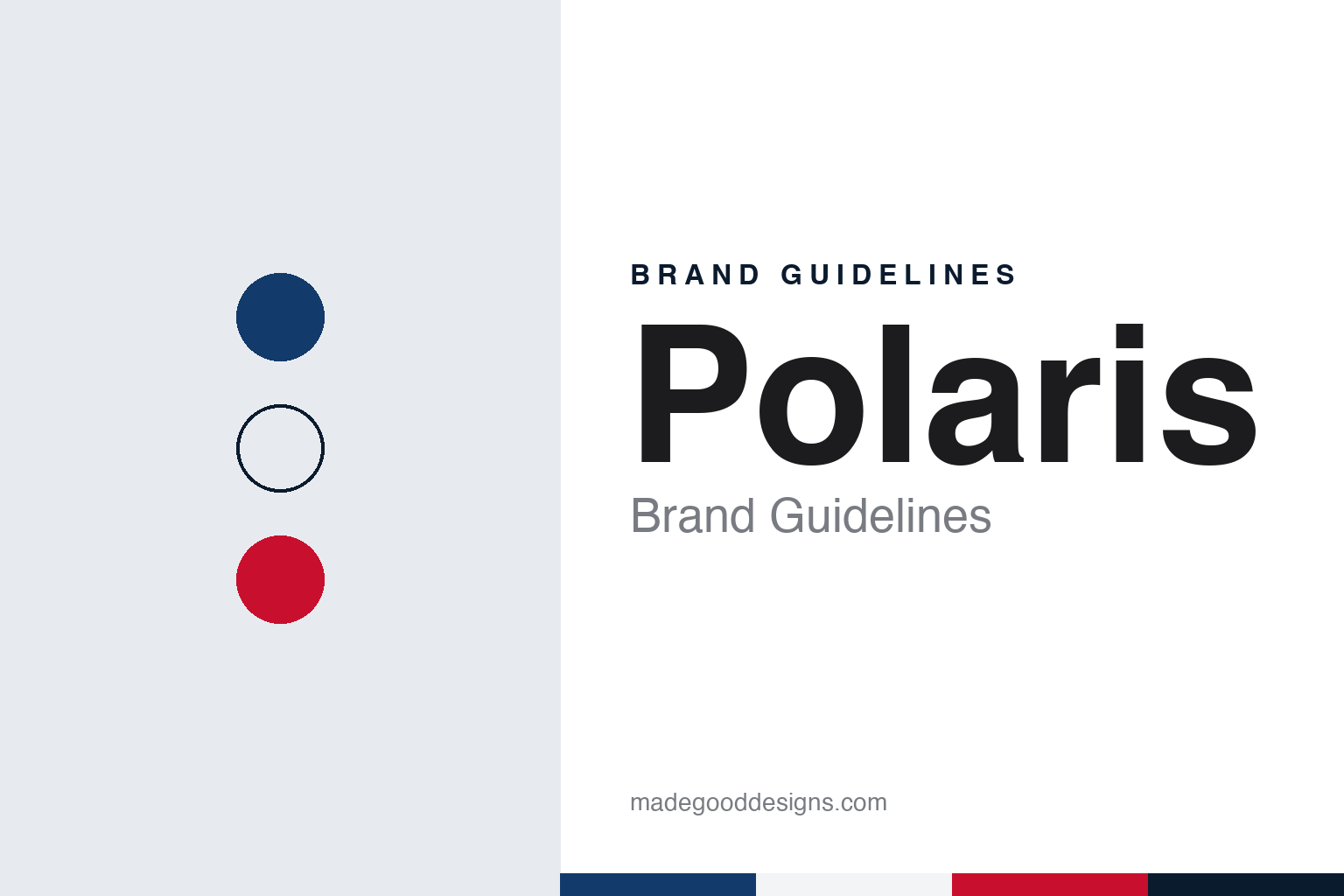
Two constants: a blue, white and red palette and an industrial grotesque register. Abstract homage — not a Polaris product or mark; no vehicle, logo or decal is reproduced.
Hetteen Hoist & Derrick
A machine shop in Roseau and a sled built on the side.
Polaris began in Roseau, a town in the far north-west of Minnesota, close to the Canadian border. According to MNopedia, the Minnesota Historical Society’s online encyclopedia, the local firm Hetteen Hoist & Derrick, which made straw cutters and other equipment, was renamed Polaris Industries in 1954. Its founders were Edgar Hetteen, his brother Allan Hetteen and David Johnson.
English Wikipedia tells the story of the first machine. In 1954 David Johnson and several employees built a prototype snow vehicle while Edgar Hetteen was away on business, using a grain-elevator conveyor belt for a track, a Briggs & Stratton motor and an old Chevrolet bumper for skis. Edgar, the article says, was unhappy that company time had gone into it, and the first sled was sold to a Roseau lumberyard owner to help meet the payroll. A second design, led by Allan Hetteen, became the Sno-Traveler; MNopedia says the founders built several versions of their first snowmobile in 1956 and had settled on that name by the end of the year.
Edgar Hetteen became the machine’s promoter. In 1960, English Wikipedia says, he led a three-sled journey across the Alaskan wilderness from Bethel. He left the company that June and started a rival, Polar Manufacturing, in Thief River Falls, Minnesota; it later became Arctic Enterprises, and its snowmobile business continues as Arctic Cat. Allan Hetteen and David Johnson led Polaris from 1960 to 1980, according to the same article.
The company’s next small sled, the Comet of 1964, was recalled, English Wikipedia says, and was followed in 1965 by the Mustang, a front-engine family snowmobile.
Colour
From Textron to Polaris Inc.
In 1968 the Rhode Island conglomerate Textron bought Polaris, MNopedia says. Production stayed in Roseau. In 1981 a group of Polaris managers bought the company back from Textron in a leveraged buyout; English Wikipedia lists W. Hall Wendel Jr. as the company’s leader from 1980 to 2008.
The product range widened after the buyout. In the early 1980s Polaris introduced its Indy-style snowmobiles, and in 1985 it began making all-terrain vehicles, MNopedia says; English Wikipedia names the first models as the Scrambler and the Trail Boss. The Rocky Mountain King, or RMK, a snowmobile for mountain riding, followed in the early 1990s, and the Indy name returned to the snowmobile range in 2012 for the 2013 model year. Polaris made personal watercraft from 1994 to 2004 and motorcycles under the Victory name until January 2017, according to English Wikipedia.
Engines came first from Robin, a Subaru subsidiary. English Wikipedia says that from the mid-1990s Polaris began designing and building its own engines, starting with the Magnum 425 four-stroke ATV of 1995 and the “twin 700” snowmobile engine of 1997, under the Liberty name.
Acquisitions added further brands. Polaris bought Indian Motorcycle in April 2011, the French quadricycle maker Aixam-Mega in April 2013 and the industrial-vehicle maker Taylor-Dunn in March 2016, and in May 2018 it returned to boats by buying Boat Holdings of Indiana, English Wikipedia says. The Slingshot, a three-wheeled road vehicle, also carries the Polaris name. On 29 July 2019 the company changed its name from Polaris Industries Inc. to Polaris Inc.
Indian did not stay. Polaris announced in October 2025 that it would sell Indian Motorcycle to the private-equity firm Carolwood LP while keeping a minority stake, English Wikipedia says, and Australian Motorcycle News reported on 3 February 2026 that Carolwood had closed its agreement with Polaris.
Other moves pointed toward electric power and racing. English Wikipedia says Polaris bought the electric-motorcycle business of Brammo of Ashland, Oregon, in January 2015, acquired the Marquis-Larson Boat Group in January 2019, bought Walker Evans Racing in July 2023 and launched the all-electric Ranger XP Kinetic in 2023. Scott Wine led the company from 2008 to 2020, and Mike Speetzen has been chief executive since 2021, according to the same article.
Typography
Design and documentation.
The brands in this group all make powersports machines: motorcycles, snowmobiles, all-terrain vehicles, side-by-sides and personal watercraft. Some grew out of larger industrial groups and only later attached their names to leisure machines; others were set up from the start to build engines and the vehicles around them, and a few now build machines under more than one name.
A powersports brand’s identity is usually carried less by a single badge than by a set of habits: a livery colour repeated across a range, model names and number codes on side panels, decals that change from season to season, and race teams that put the same colours in front of a crowd. Because the company behind a name may have been sold, spun off from a larger group or folded into a new owner, the questions worth asking are plain ones: who started it, who owns it now, and where its vehicles are actually built.
Each guide separates what independent sources record from what the company says about itself, and marks plainly what rests only on the company’s own word.
Aa
An industrial grotesque — a working-machine register. (Specimen set in Archivo, a sans STAND-IN; NOT the Polaris logo.)
Polaris
Roseau still at the centre.
Polaris Inc. is now based in Medina, Minnesota, west of Minneapolis, but English Wikipedia says it still has engineering and manufacturing facilities in Roseau, where off-road vehicles are assembled. The same article says components are made in Osceola, Wisconsin; that motorcycles were built at Spirit Lake, Iowa; that in May 2010 Polaris announced a plant in Monterrey, Mexico, with lines for Ranger side-by-sides; and that in January 2015 it announced a factory in Huntsville, Alabama, covering vehicle assembly, painting, welding, fabrication and injection moulding.
The model names carry much of the brand. Ranger, RZR, Indy and RMK appear across the off-road and snowmobile ranges, and the company’s founding sled survives as a reference point: MNopedia describes a 1961 Sno-Traveler as originally painted red, with white stencilling, decals and pinstripes. English Wikipedia notes that the Rush snowmobile of 2010 was offered with retro graphics.
For a design guide, Polaris shows how a regional machine shop can become a multi-brand vehicle company while keeping its home town at the centre of its story. Compare Arctic Cat, the Thief River Falls snowmobile maker founded by Edgar Hetteen after he left, and Indian Motorcycle, which Polaris owned from 2011. For this guide we use a deep blue, white and a red with a sans, an unofficial interpretation; no product or logo is reproduced.
Explore & save
Keep Polaris’s identity on hand — save it to a board in the Made Good inspiration library.
Polaris identity set
Pin the Polaris blue, white and red palette and the industrial grotesque register to your own board.