Portland Trail Blazers Brand Guidelines
Ten players turning around a centre circle, drawn in red and black.
Aa
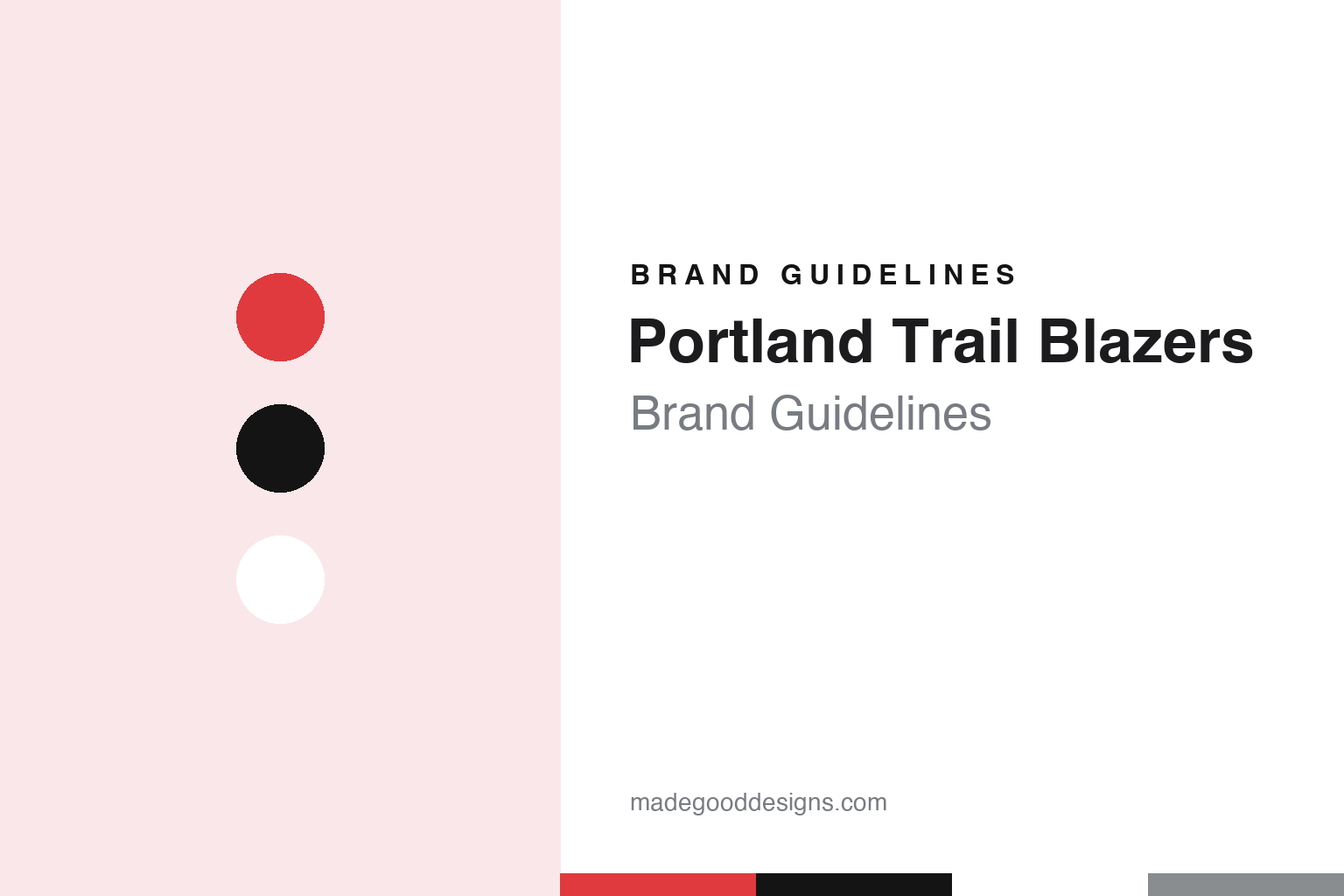
Two constants: a red, black and white palette and a condensed athletic lettering register. Abstract homage — not a Portland Trail Blazers mark; no pinwheel logo, jersey or wordmark is reproduced.
A contest, a coliseum and a cousin’s drawing
How an expansion club in Oregon picked its name.
The Portland Trail Blazers began with one promoter’s long campaign. English Wikipedia, drawing on the team’s own media guide, says sports promoter Harry Glickman had sought a National Basketball Association franchise for Portland since the mid-1950s, and saw the new Memorial Coliseum, opened in 1960, as a possible home for professional basketball. The league’s board of governors granted him the rights to a Portland franchise on 6 February 1970. To meet the league’s entry costs, Wikipedia says, Glickman joined forces with three real estate investors: Robert Schmertz of New Jersey, Larry Weinberg of Los Angeles and Herman Sarkowsky of Seattle.
The name came from the public. Two weeks after the franchise was granted, on 24 February 1970, team management opened a contest to name the club. The suggestion “Pioneers” was set aside because sports teams at Portland’s Lewis & Clark College already used it. A judging panel chose “Trail Blazers”, and the name was revealed on 13 March 1970, at halftime of a SuperSonics game at the Memorial Coliseum. Wikipedia says the name refers to the work of explorers cutting paths through forests, and quotes Glickman as saying it could reflect both the ruggedness of the Pacific Northwest and the start of a major league era in Oregon. The response was mixed at first, but the shortened form, “Blazers”, caught on.
The club entered the league in the 1970–71 season as an expansion team, alongside the Cleveland Cavaliers and the Buffalo Braves. It played at the Memorial Coliseum until 1995, when it moved next door to a new arena, the Rose Garden. In August 2013 the building was renamed the Moda Center under a naming deal with the insurer Moda Health; Wikipedia records that the change drew criticism from fans. The coliseum, renamed the Veterans Memorial Coliseum in 2011, still stands beside it.
The mark that came with the name is the pinwheel. Wikipedia, citing the team, says it was originally designed by a cousin of founder Harry Glickman, and describes it as a graphic interpretation of two five-man basketball teams lined up against each other. One side of the pinwheel is red; the other is black or white. Writing about the design in May 2017, The Oregonian described the concept as five players from one side against five from the opposing side, rotating around a centre circle in a pinwheel-like motion. The logo was drawn upright at first; from the 1991 season it was set on a slant, which gave it a straight edge along the top.
Colour
From Glickman’s partners to Paul Allen, his estate and the Dundon group.
The club’s ownership has passed through three broad eras. The founding partnership of Glickman, Schmertz, Weinberg and Sarkowsky ran the team in its first years. In 1988, Wikipedia records, the Microsoft co-founder Paul Allen bought the Blazers. Under Allen, the team became part of a group of sports properties managed by Vulcan Sports and Entertainment, a unit of his company Vulcan, which also looked after the Seattle Seahawks of the NFL and the Moda Center.
The Associated Press, in a report published by ESPN on 30 March 2026, explained what happened next. After Allen’s death in 2018, his sister Jody Allen served as chair of both the Blazers and the Seahawks and as a trustee of the Paul G. Allen Trust. Allen had stipulated in his will that his teams should eventually be sold, with the proceeds going to philanthropy, and his estate later announced that it had begun the process of selling the Blazers. On 30 March 2026 the NBA board of governors approved the sale of a controlling interest to a group led by investor Tom Dundon, the owner of the NHL’s Carolina Hurricanes and chairman of the Dallas-based firm Dundon Capital Partners. The AP named three other members of the group: Portland-based investor Sheel Tyle, Blue Owl Capital co-president Marc Zahr, and the Cherng Family Trust, the family office of the co-founders of Panda Express.
The same AP report tied the sale to the building. Earlier in March 2026 the Oregon Legislature had approved funding for a renovation of the Moda Center, giving the state joint ownership of the arena with the city; the AP said the measure also eased fears that new owners might move the team. Wikipedia says the purchase was completed on 3 April 2026 by an investor group called “Rip City Rising”, and the group led by Tom Dundon has owned the Trail Blazers since 2026.
That group name borrows a phrase the club has long worn. Wikipedia calls “Rip City” the team’s nickname, and the Blazers have put it on uniforms since an alternate introduced in the 2009–10 season. It also runs through the club’s retail and fan identity: in 2017, The Oregonian reported, the team sold its first merchandise with the updated logo exclusively at its Rip City Clothing Company store inside the Moda Center.
The mascot has changed with the eras too. Wikipedia says the official mascot since 2002 has been Blaze the Trail Cat, a two-tone silver mountain lion. From 1987 to 1989 the team used a Bigfoot character, which was dropped after a 1989 timeout skit in which it crushed a model of the Golden Gate Bridge during a game against Golden State. A new Bigfoot, nicknamed Douglas Fur, joined Blaze as a secondary mascot in March 2023.
Typography
Design and documentation.
Team names travel more easily than teams do. When a club changes city, the name sometimes goes with it, sometimes stays behind for a later team to claim, and sometimes returns years afterwards with its old colours and records attached. Each path leaves a design problem: a nickname chosen for one place has to make sense in another, and a revived name has to look familiar without looking dated.
Uniforms are a second thread. Clubs have occasionally hired fashion designers rather than sports outfitters to set a palette and a jersey, and those choices can outlast the people who made them, coming back as throwback or anniversary editions once the original fans have grown up.
Colour revivals follow a recognisable pattern. A team retires a shade, fans keep buying the old merchandise, and the shade returns first on an alternate jersey, then on the court, then on the primary mark. Arena graphics then carry the identity at full scale: floor paint, baseline lettering, banners, scoreboards and concourse signage all have to work with the same few colours under bright light and on television. For a designer, the useful lesson is how a small set of marks and tones is stretched across a building as well as a shirt.
Aa
A condensed athletic letter — the register of a jersey wordmark and an arena scoreboard. (Specimen set in Oswald, a condensed sans STAND-IN; NOT the Portland Trail Blazers logo or wordmark.)
Portland Trail Blazers
A diagonal sash, a slanted pinwheel and plaid for a coach.
The uniforms have changed more often than the logo. Wikipedia says the first Blazers uniforms were white at home and red on the road, and that the 1970–1975 design carried a swooping tail on the last letter of “blazers” at home and “Portland” on the road. From 1975 to 1977 the team name ran vertically down the right side of the jersey. After that came the element the team still uses: a red, black or white sash running diagonally down the uniform. The road uniforms switched to black from 1977 to 1979 and again from 1985 to 1991, with red in between, and all of them carried a lowercase “blazers”. A 1991–92 redesign moved to uppercase letters, and a 2002–03 rebrand added silver accents and a red alternate.
The pinwheel was refreshed along the way. The Oregonian reported in May 2017 that the club was updating the logo for the first time since 2002, after a first modernisation in the mid-1990s. Team president Chris McGowan said the club had gathered fan feedback and “landed on subtle changes that provide a nod to our past while allowing us to modernize other aspects of our creative assets.” The paper noted that the timing matched Nike becoming the supplier of all NBA uniforms from the 2017–18 season, and quoted chief marketing officer Dewayne Hankins on adding contemporary touches with Nike’s design staff. Wikipedia says that for 2017–18 the city and team names were straightened from italic to upright, and “Rip City” was added to the waistband. In 2022–23 the Statement uniform, developed with guard Damian Lillard, carried the pinwheel in black with side striping drawn from the logo, and in 2025–26 the Association and Icon uniforms dropped their silver accents.
The City editions have been the place for local references. Wikipedia lists a black 2017–18 uniform with a grayscale plaid pattern in homage to former coach Jack Ramsay and a silhouette of the Portland city flag; a 2020–21 brown uniform with a wood-grain texture and the “Oregon” lettering from the White Stag sign; a 2022–23 black uniform with teal and silver accents and a pattern based on the carpet at Portland International Airport, under the letters “PDX”; and 2023–24 and 2024–25 editions that returned to plaid, with a salute to Mount Hood on the shorts.
For a design guide, the Portland Trail Blazers show how one abstract mark, drawn by a founder’s relative and only nudged in later decades, can carry a club through owners, arenas and kit suppliers while the uniforms do the experimenting. Compare it with the NBA, whose uniform programme frames every Blazers kit, and the Seattle Seahawks, the NFL club Paul Allen owned alongside the Blazers. For this guide we use red, black and white with a condensed sans, an unofficial interpretation; no product or logo is reproduced.
Explore & save
Keep Portland Trail Blazers’s identity on hand — save it to a board in the Made Good inspiration library.
Portland Trail Blazers identity set
Pin the Portland Trail Blazers red, black and white palette and the condensed athletic lettering register to your own board.