Colorado Rockies Brand Guidelines
A name taken from the skyline, a purple taken from a hymn, and one row of seats painted to mark the altitude.
Aa
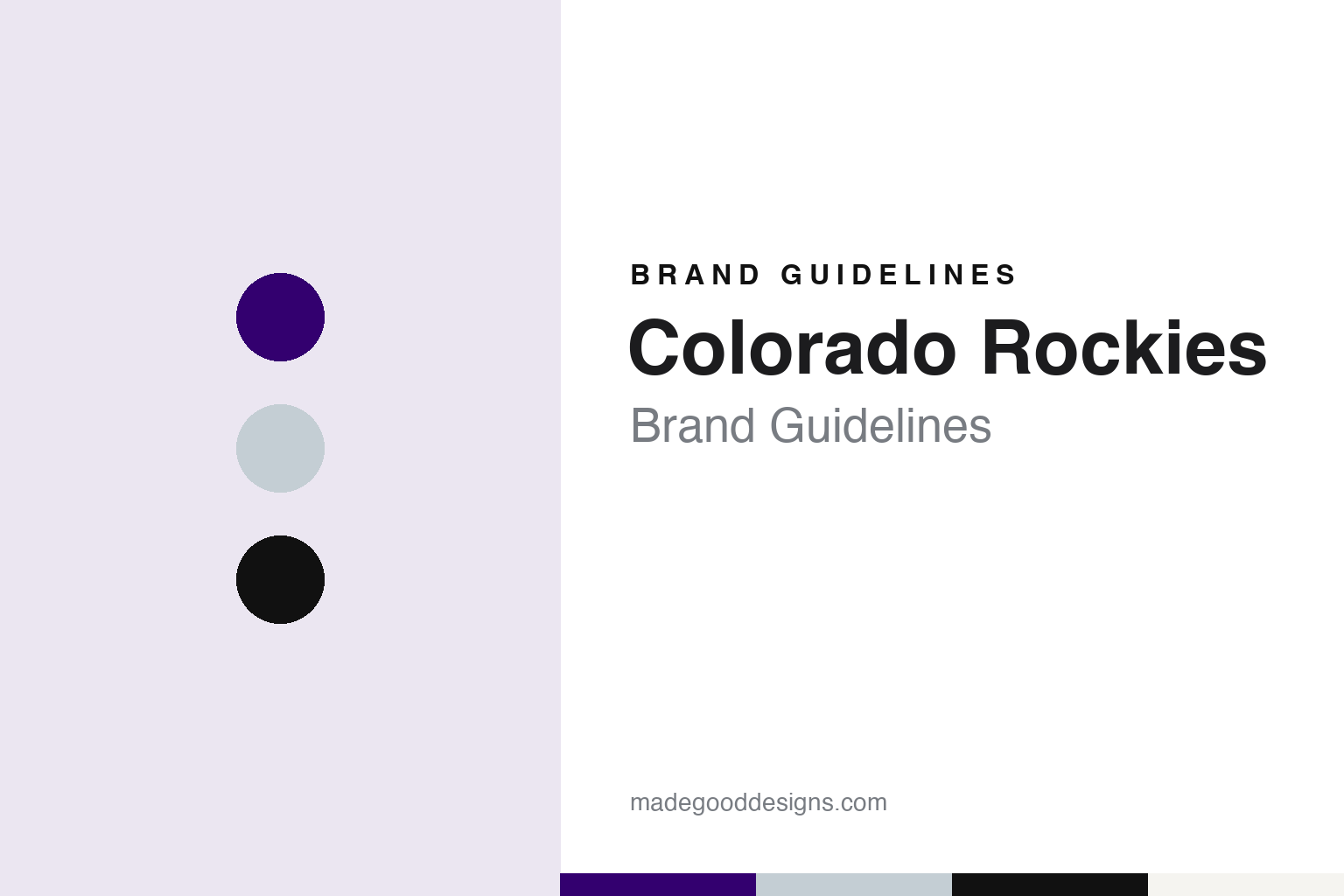
Two constants: a mountain purple, peak silver and night black palette and an interlocking CR and a mountain wordmark register. Abstract homage — not a Colorado Rockies mark; no cap logo, script or wordmark is reproduced.
A name from the skyline
A long wait for a major-league club, an expansion award and a borrowed name.
Denver waited a long time for a major-league baseball club. English Wikipedia says the city had minor-league teams from the late nineteenth century, and that a Denver entry in the proposed Continental League of 1960 never played a game when the league collapsed. In January 1990, it says, the Coors Brewing Company became a limited partner in the city’s Triple-A club, the Denver Zephyrs, which Wikipedia says improved Colorado’s chances.
A ballpark plan was part of the bid. In a SABR ballpark history posted on 27 March 2018, Thomas J. Brown Jr. writes that the National League agreed in 1985 to expand by two teams, that a plan for a new ballpark was a condition of being considered, and that Denver and Colorado formed the Denver Metropolitan Major League Baseball Stadium District in 1989; voters in the six metropolitan counties approved a sales tax to fund it in 1990. In June 1991, Brown writes, franchises were awarded to Denver and Miami. A SABR biography of the trucking owner Jerry McMorris, posted the same day, says team owners approved the Denver franchise on 5 July 1991 for a group led by the Ohio businessmen Michael Monus and John Antonucci, with Steve Ehrhart.
The name came from the view. Wikipedia says the club took the name “Rockies” from Denver’s closeness to the Rocky Mountains, which the logo reflects, and that the name had been used before by the city’s National Hockey League team, the Colorado Rockies, which later moved and became the New Jersey Devils.
The original owners did not last. The McMorris biography says that a year after the award Monus was forced out as president of the drugstore chain Phar-Mor amid charges of embezzlement and had to leave the Rockies. McMorris, who had built a trucking business that hauled beer for Coors from Golden to Denver, stepped in with new partners: Charles Monfort, from a Greeley meatpacking family, the entrepreneur Oren Benton, and the Coors Brewing Company. Wikipedia’s article on the brothers dates that purchase of a controlling interest to 2 September 1992. The club began play in 1993, sharing Mile High Stadium with the Denver Broncos for two seasons while its own ballpark was built.
Colour
A brick ballpark by the rail yards, a purple row and a dinosaur.
Brown writes that construction of Coors Field began on 16 October 1992 and that it opened on 26 April 1995, against the New York Mets. It was designed by HOK Sports, later known as Populous, the firm behind Oriole Park at Camden Yards, and it borrows that park’s retro manner: a steel and red-brick structure with a hand-laid brick façade, a clock tower above the main entrance, asymmetrical outfield walls and a site beside the Union Pacific railroad tracks, with views of the mountains beyond. The playing field sits below street level so the building blends with the surrounding neighbourhood.
The seating carries the club’s main idea. The seats are mainly green, Brown writes, but a band of purple seats along the 20th row of the upper deck marks the point one mile above sea level. Deep in centre field sits the Rockpile, a section named to recall the Rocky Mountains; Mile High Stadium had one too. While the ballpark was being built, workers found bones similar in size to those of plant-eating dinosaurs such as Triceratops, and a year later the club revealed its mascot, Dinger, a Triceratops.
Control passed to the Monforts in stages. Wikipedia’s article on the brothers says Dick Monfort, Charlie’s brother, later replaced Benton in the group and became vice chairman on 8 December 1997. In 2002 McMorris handed the titles of chairman and chief executive to Charlie Monfort; in November 2004 the brothers removed him as vice chairman, and in December 2005 they bought out his share. The Monfort brothers have controlled the club since 2005. Wikipedia says that in June 2025 the club named Walker Monfort, son of owner Dick Monfort, as team president.
Typography
Design and documentation.
A baseball club’s identity can predate its arrival in its current city. When a franchise moves, the name, the colours and the lettering may travel with it, be quietly adapted, or be replaced outright, and the choice tells you a good deal about how the owners want the club to be read in its new home. A relocated team’s visual history often comes in layers, with earlier marks surviving as throwback uniforms, museum pieces and merchandise long after they leave the field.
The cap logo carries an unusual amount of weight in this system. It has to work at a small size, stitched in thread, seen from the stands and on television, so clubs tend to settle on a single letter, a monogram or a compact symbol, and to change it far less often than the wordmark or the uniform trim. Colour choices frequently borrow from local symbolism, such as a state bird, a regional landscape or a civic flag, which gives a palette a story beyond the field.
The ballpark completes the picture. Signage, scoreboards, concourse graphics and distinctive architectural features all repeat the club’s colours and marks at architectural scale, turning the stadium itself into part of the brand.
Rr
A tall, compressed sans — the register of a club whose wordmark is set in strong upright capitals over a mountain range. (Specimen set in Anton, a condensed STAND-IN; NOT the Colorado Rockies logo, script or wordmark.)
Colorado Rockies
Purple from a song, black and silver for contrast, and an official shade from 2017.
The colour has a literary source. Wikipedia says the Rockies’ purple was inspired by the line “for purple mountain majesties” in the song “America the Beautiful.” The shades the club used lacked uniformity, it says, until PMS 2685 was set as the official purple from the 2017 season. Black and silver complete the scheme.
The uniforms have kept a pinstripe base. Wikipedia says the home uniform is white with purple pinstripes, with “Rockies” in silver trimmed in black. Names were missing from the backs of the home shirts in 1993 and added the following year; chest numbers arrived in 2000. The road uniform is grey; it began with purple piping, switched in 2000 to pinstripes with “Colorado” across the front, and brought the piping back before the 2012 season. A black alternate was worn for a few games in 1993; a black sleeveless alternate followed in 2005 and was retired in 2022. A purple alternate arrived in 2000, and from 2012 the club wore it for “Purple Mondays.” The cap today is all black with an interlocking “CR” in purple trimmed in silver; an all-purple cap came before it, and for the 2018 season, the club’s 25th, the “CR” was silver.
The City Connect uniforms looked outward to the state. The earlier one, from 2022, was green and white with a printed mountain range across the chest, lettering taken from Colorado licence plates, and a yellow sleeve patch with “ROX,” the “5280” of Denver’s altitude in feet, two black diamonds from ski-trail grading and the coordinates of Coors Field, with purple piping for the purple seats; it was worn until the end of 2024. The second splits light blue and purple to show the change from day to night over the mountains, with the red, yellow and blue of the Colorado state flag as accents and the Denver city flag inside the cap, Wikipedia says.
For a design guide, Colorado Rockies shows how a name, a colour and a ballpark detail can all come from one landscape, and how setting a single Pantone reference can tidy years of drifting shades. Compare the city’s football club in our Denver Broncos guide, and the league-wide marks in the MLB guide. For this guide we use mountain purple, peak silver and night black with a condensed sans, an unofficial interpretation; no product or logo is reproduced.
Explore & save
Keep Colorado Rockies’s identity on hand — save it to a board in the Made Good inspiration library.
Colorado Rockies identity set
Pin the Colorado Rockies mountain purple, peak silver and night black palette and the interlocking CR and mountain wordmark register to your own board.