Arizona Diamondbacks Brand Guidelines
A snake named by newspaper readers, dressed first in purple and then in the colour of red rock.
Aa
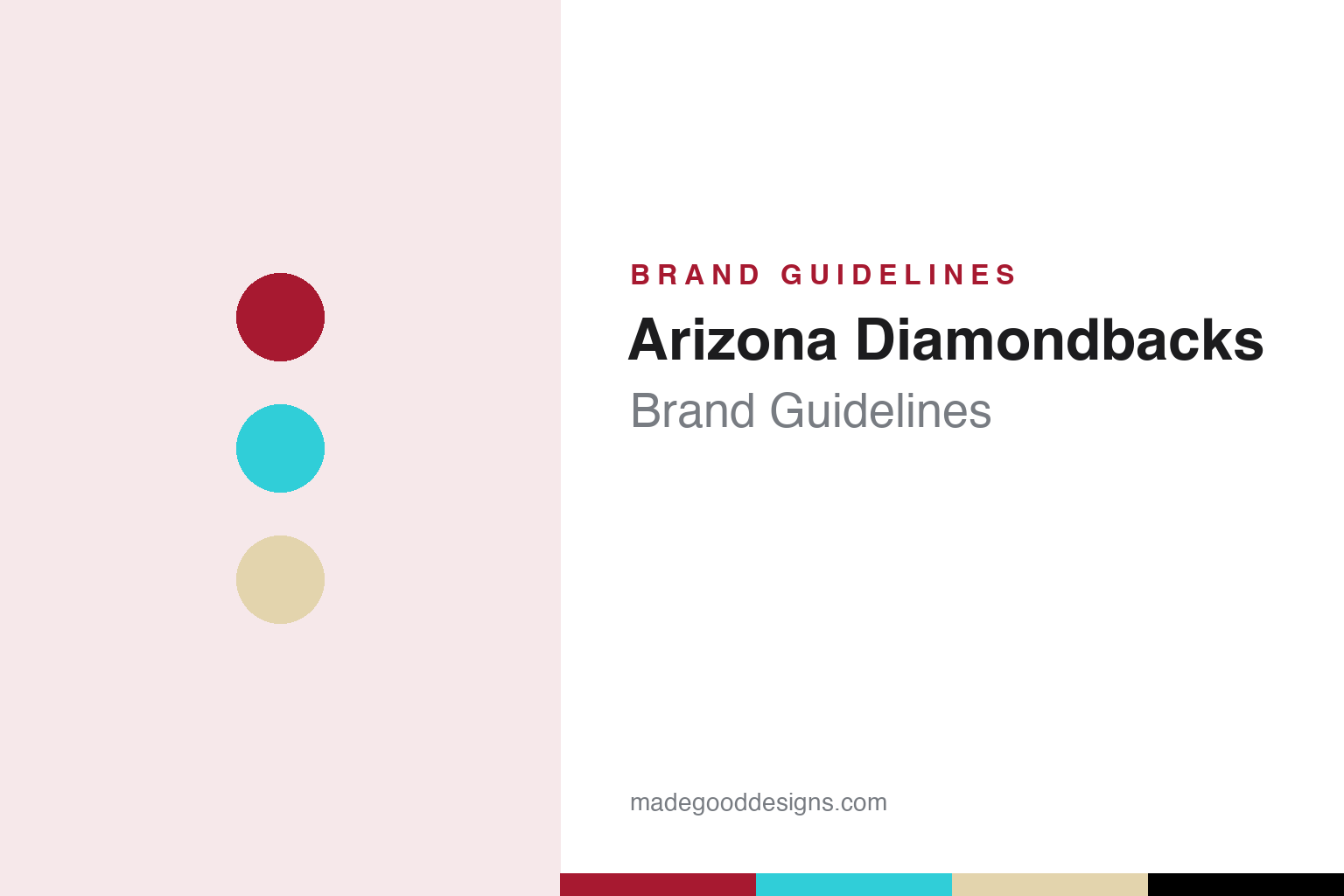
Two constants: a Sedona red, desert teal and Sonoran sand palette and a block initial and snake-head monogram register. Abstract homage — not an Arizona Diamondbacks mark; no cap logo, script or wordmark is reproduced.
A name from the newspaper
A basketball executive, a statewide name and a reader contest.
The Arizona Diamondbacks were built from scratch. English Wikipedia records that Phoenix was awarded an expansion franchise on 9 March 1995, that existing club owners voted on 16 January 1997 to place the new team in the National League, and that the club began play on 31 March 1998 against the Colorado Rockies at Bank One Ballpark. The same expansion round created a club in Tampa Bay.
The bid behind it belonged to a basketball man. In the Society for American Baseball Research’s team ownership history, published on 19 January 2017, the historian Clayton Trutor writes that Jerry Colangelo, the executive who ran the Phoenix Suns, announced the formation of Arizona Baseball Inc. in September 1993 to bring a major-league team to the city, and that dozens of investors backed his group when the franchise was granted in 1995. Trutor describes Colangelo and Ken Kendrick as the only two managing general partners the club has had, Colangelo from 1995 to 2004 and Kendrick from 2004.
The name came from readers. Trutor writes that the nickname Diamondbacks was chosen after a 1995 “name the team” contest conducted by The Arizona Republic, the Phoenix daily, and that Colangelo persuaded his partners to call the club the Arizona Diamondbacks rather than the Phoenix Diamondbacks, to build a sense of ownership across the whole state. The diamondback is a rattlesnake of the desert Southwest, and the snake has shaped the club’s marks ever since; Wikipedia says the team is often called the D-backs and lists “Los Serpientes” among its nicknames.
The first palette was of its moment. Trutor writes that the club adopted purple, turquoise, black and copper, colours that were marketed as evocative of the region’s cultural heritage and that looked similar to those of the Suns, Colangelo’s other team. Wikipedia describes the original logo as an italicised block letter “A” filled with a diamond pattern, its crossbar drawn as a snake’s tongue.
Colour
From Jerry Colangelo to Ken Kendrick, and from the BOB to Chase Field.
The ballpark was part of the pitch. Trutor’s SABR history says that Bank One Ballpark, nicknamed the BOB, offered an array of attractions for spectators who were not especially interested in baseball: playgrounds, a picnic pavilion, a day spa and a swimming-pool party area beyond the outfield wall. Its retractable roof let fans see the sun while sitting in air-conditioned comfort. Wikipedia records that the building was renamed Chase Field in 2005, after Bank One merged with JPMorgan Chase.
Leadership changed hands in 2004. Trutor writes that, unhappy with the direction of the franchise, the other general partners of Arizona Baseball Inc. ousted Colangelo as managing general partner in August 2004, and that Ken Kendrick, who had been a partner since the franchise’s origins, took over. Trutor notes that Kendrick founded Datatel, a software company serving colleges and universities. As of 2016, Trutor names Jeffrey Royer, Michael Chipman and Dale Jensen as the other general partners, all of whom had owned part of the club since its beginning. Wikipedia lists Kendrick as the club’s owner today, with Derrick Hall as president. Kendrick has led the club since 2004.
The club also built a spring home. Trutor writes that since Kendrick took charge the Diamondbacks have moved into Salt River Fields at Talking Stick, a spring-training ground in Scottsdale shared with the Colorado Rockies, which opened in 2011 on land owned by the Salt River Pima-Maricopa Indian Community.
The mascot follows the desert theme too. Wikipedia names D. Baxter the Bobcat as the club’s mascot.
Typography
Design and documentation.
A baseball club’s identity can predate its arrival in its current city. When a franchise moves, the name, the colours and the lettering may travel with it, be quietly adapted, or be replaced outright, and the choice tells you a good deal about how the owners want the club to be read in its new home. A relocated team’s visual history often comes in layers, with earlier marks surviving as throwback uniforms, museum pieces and merchandise long after they leave the field.
The cap logo carries an unusual amount of weight in this system. It has to work at a small size, stitched in thread, seen from the stands and on television, so clubs tend to settle on a single letter, a monogram or a compact symbol, and to change it far less often than the wordmark or the uniform trim. Colour choices frequently borrow from local symbolism, such as a state bird, a regional landscape or a civic flag, which gives a palette a story beyond the field.
The ballpark completes the picture. Signage, scoreboards, concourse graphics and distinctive architectural features all repeat the club’s colours and marks at architectural scale, turning the stadium itself into part of the brand.
Aa
A squared, collegiate slab — the register of a club whose uniforms lean on block capitals and a bold initial. (Specimen set in Graduate, a STAND-IN; NOT the Arizona Diamondbacks logo, script or wordmark.)
Arizona Diamondbacks
Purple pinstripes, red rock, snakeskin and a return to teal.
The original uniforms leaned on pattern. Wikipedia says the home set of 1998 was cream with purple pinstripes, with “Diamond” and “Backs” stacked across the chest, while the road grey also carried purple pinstripes and “Arizona.” Teal and copper appeared as trim on names and numbers. The club wore four cap versions at first; from 1999 the road cap was all black and carried an alternate “D-snake” logo in copper.
The colours changed on 8 November 2006, when the club unveiled new uniforms in Sedona red, Sonoran sand and black. Wikipedia says the red takes its name from the sandstone canyon at Red Rock State Park near Sedona and the sand from the Sonoran Desert. A sleeve patch added a lowercase “d” and “b” arranged to look like a snake’s head, and the “D” logo moved, slightly altered, to an all-red game cap. Home jerseys read “D-Backs,” road jerseys “Arizona.”
Teal came back in stages. Before the 2016 season the club reintroduced teal beside red, sand and black and added a snakeskin pattern to the shoulders or backs of its jerseys; the snakeskin was removed in 2020. In 2021 the club’s City Connect uniform, in sand, spelled “Serpientes” in black script, with the first “S” shaped like a rattlesnake and a recoloured Arizona state flag on one sleeve. A 2024 refresh returned turquoise to every uniform, set a cream home jersey with the “A” on the left chest, and brought back the D-snake on the road cap. In 2025 a second City Connect revived the original purple and teal, mixing pinstripes with snakeskin and adding a “48” for Arizona’s place in the order of statehood.
For a design guide, Arizona Diamondbacks shows how an expansion club can tie a whole identity to one animal and one landscape, then swap palettes without losing the snake. Compare its neighbour in our Phoenix Suns guide and the league marks in the MLB guide. For this guide we use Sedona red, desert teal and Sonoran sand with a slab serif, an unofficial interpretation; no product or logo is reproduced.
Explore & save
Keep Arizona Diamondbacks’s identity on hand — save it to a board in the Made Good inspiration library.
Arizona Diamondbacks identity set
Pin the Arizona Diamondbacks Sedona red, desert teal and Sonoran sand palette and the block initial and snake-head monogram register to your own board.