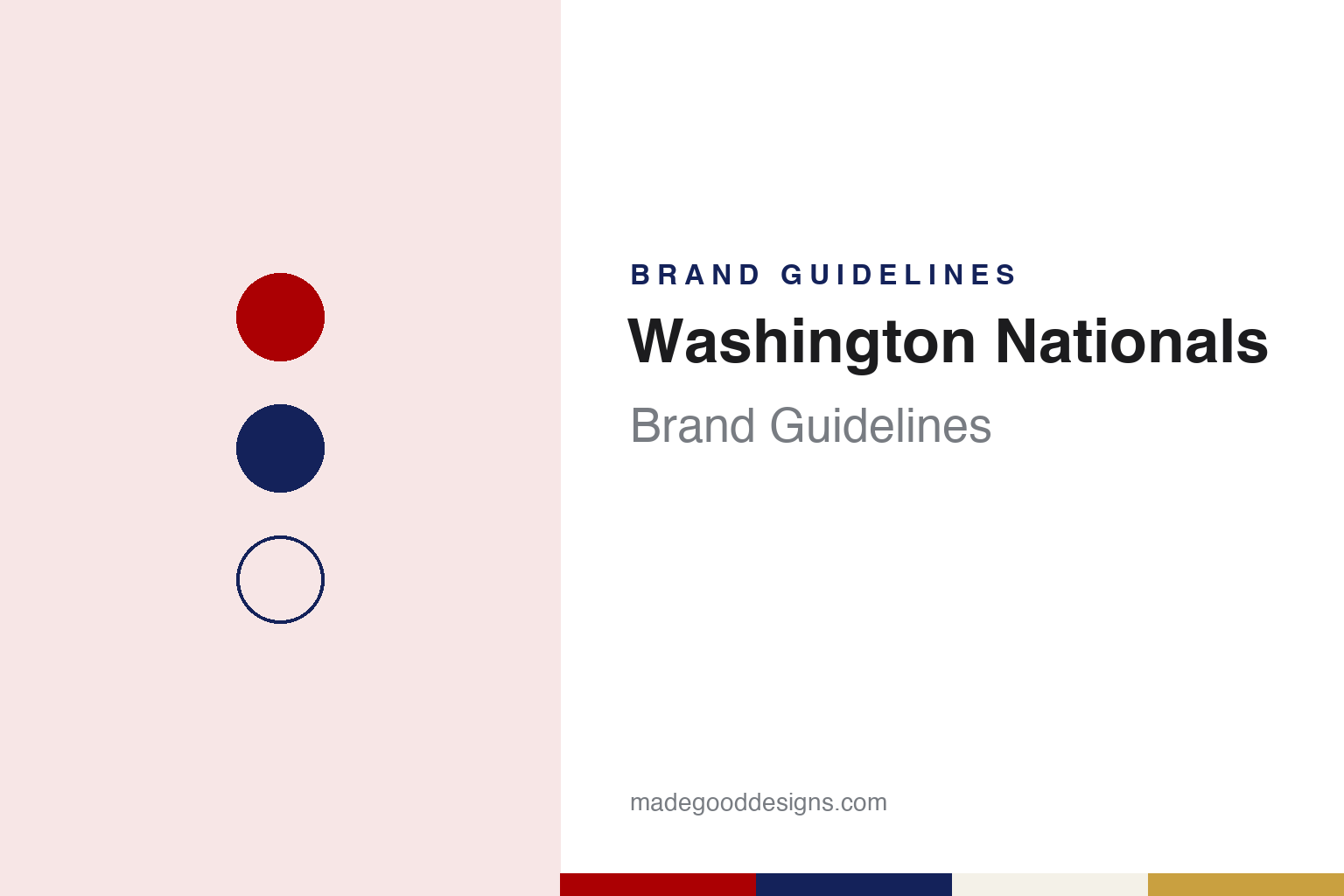
Washington Nationals Brand Guidelines
A club that crossed a border, took an old Washington name and wrote it as a single curling letter.
Aa
Two constants: a curly W red, Capitol navy and monument white palette and a script initial and capital wordmark register. Abstract homage — not a Washington Nationals mark; no cap logo, script or wordmark is reproduced.
From Montreal to the capital
An expansion club in Montreal, a decade of uncertainty and a move south.
The Washington Nationals began life in another country. English Wikipedia records that the franchise was founded in 1969 as the Montreal Expos, part of a four-team expansion of the major leagues. In the Society for American Baseball Research’s ownership history of the Expos, published on 5 February 2019, Joe Marren describes the club’s owners in Montreal: Charles Bronfman from 1968 to 1991, Claude Brochu from 1991 to 1999, Jeffrey Loria from 1999 to 2002, and then Major League Baseball itself from 2002 to 2004, a period in which the league scheduled some of the club’s home games in San Juan, Puerto Rico. Marren writes that the team played first at Jarry Park and later at the Olympic Stadium; Wikipedia dates the move to Olympic Stadium to 1977.
The move to Washington came out of that league ownership. Wikipedia says that after a failed plan to contract the league, MLB bought the Expos intending to move them, and that the owners chose Washington, D.C., in 2004. Marren describes the franchise’s move to Washington under MLB care in 2004. The new club played its debut season in 2005; Washington had been without a major-league team since 1971, when the second club called the Washington Senators left for Texas to become the Texas Rangers.
The name looked backwards. Wikipedia records that several short-lived Washington clubs of the 1870s, and a National League club from 1886 to 1889, had already been called the Nationals. The city’s mayor, Anthony A. Williams, backed “Washington Grays,” in honour of the Homestead Grays of the Negro leagues, who had played many home games at Washington’s Griffith Stadium in the 1940s. On 21 November 2004, Wikipedia says, team management chose “Washington Nationals” instead, and the club’s official colours of red, white and blue were revealed the next day. Wikipedia lists Nats as the club’s nickname.
Colour
From league ownership to the Lerner family, and from RFK to the Navy Yard.
The club spent its opening seasons in an older stadium. Wikipedia lists Robert F. Kennedy Memorial Stadium as its home from 2005 to 2007, while a new park was built for it. That park, Nationals Park, opened in 2008 on South Capitol Street in the Navy Yard neighbourhood of south-east Washington, beside the Anacostia River.
A private owner arrived in 2006. Marren’s SABR history says that MLB announced the new owners in July 2006: a group from Lerner Enterprises, led by the real-estate developer Theodore N. Lerner, chosen over three other bidders. The sale became official on 24 July 2006, and one of Lerner’s early moves was to hire Stan Kasten as team president. Wikipedia records that Ted Lerner’s son Mark Lerner became the public-facing principal owner in 2018, and lists Mark Lerner as the club’s owner today. The Lerner family has owned the Nationals since 2006.
Washington’s baseball past is part of the brand. The club’s Ring of Honor, Wikipedia records, includes players from the old Washington Senators and the Homestead Grays as well as from the Nationals, so its honours reach back to clubs that wore other uniforms in the same city.
The city’s seasons and streets have become uniforms. Wikipedia records that the club’s first City Connect uniform, unveiled in 2022, paid homage to the cherry blossoms that flower in Washington each spring, with a dark grey base, pink trim and printed blossoms; it was retired after 2024. A second City Connect, unveiled in 2025, is light blue with a white outline of the District’s street grid and an interlocking “DC” meant to resemble the block “W” worn by the Washington Senators in 1956; its cap and shoulder patch put the block W with the outline of the Capitol dome beside two cherry blossoms. Wikipedia names Screech as the club’s mascot.
Typography
Design and documentation.
A baseball club’s identity can predate its arrival in its current city. When a franchise moves, the name, the colours and the lettering may travel with it, be quietly adapted, or be replaced outright, and the choice tells you a good deal about how the owners want the club to be read in its new home. A relocated team’s visual history often comes in layers, with earlier marks surviving as throwback uniforms, museum pieces and merchandise long after they leave the field.
The cap logo carries an unusual amount of weight in this system. It has to work at a small size, stitched in thread, seen from the stands and on television, so clubs tend to settle on a single letter, a monogram or a compact symbol, and to change it far less often than the wordmark or the uniform trim. Colour choices frequently borrow from local symbolism, such as a state bird, a regional landscape or a civic flag, which gives a palette a story beyond the field.
The ballpark completes the picture. Signage, scoreboards, concourse graphics and distinctive architectural features all repeat the club’s colours and marks at architectural scale, turning the stadium itself into part of the brand.
Ww
A looping brush script — the register of a club whose cap carries a single curling letter and whose jerseys use a flowing “Nationals.” (Specimen set in Yellowtail, a script STAND-IN; NOT the Washington Nationals logo, script or wordmark.)
Washington Nationals
Gold bevels, a curly W, a Capitol dome and a script that moved to the home jersey.
The first uniforms carried gold. Wikipedia says the original home set of 2005 showed the team name and numbers in red with gold bevels and navy trim, worn with an all-red “curly W” cap; the road set was navy with gold bevels, with an all-navy curly W cap. The front lettering on both formed a distinctive bridge-like arch. A red alternate in 2006 used an interlocking “DC” and its own red DC cap, and the sleeve roundel carried gold stars, two in the first season and nine in the next.
Gold went in 2011. Wikipedia records that a new set that year dropped gold entirely and put the emphasis on the curly W, which became the centrepiece of both the home and the red alternate jerseys; the road cap became navy with a red brim. A navy alternate in 2018 introduced a script “Nationals”, and a white version followed in 2020.
Monuments entered the mark set in 2020. Wikipedia says the club unveiled a navy cap showing the United States Capitol dome over a white block “W,” an homage to the two earlier Washington Senators clubs. The white script uniform became the primary home jersey in 2022. In 2024 the road uniform switched to block “Washington” lettering, and a white pullover alternate with navy sleeves carried the “Capitol W” crest and a sleeve patch placing the interlocking DC inside the outline of the District. For 2025 the red curly W alternate returned without piping, and the Capitol W pullover was retired under Nike’s limit on regular uniforms.
For a design guide, Washington Nationals shows how a relocated club can borrow a city’s older names and monuments while keeping one compact letter at the centre. Compare the capital’s hockey club in our Washington Capitals guide, and the league marks in the MLB guide. For this guide we use curly W red, Capitol navy and monument white with a script, an unofficial interpretation; no product or logo is reproduced.
Explore & save
Keep Washington Nationals’s identity on hand — save it to a board in the Made Good inspiration library.
Washington Nationals identity set
Pin the Washington Nationals curly W red, Capitol navy and monument white palette and the script initial and capital wordmark register to your own board.