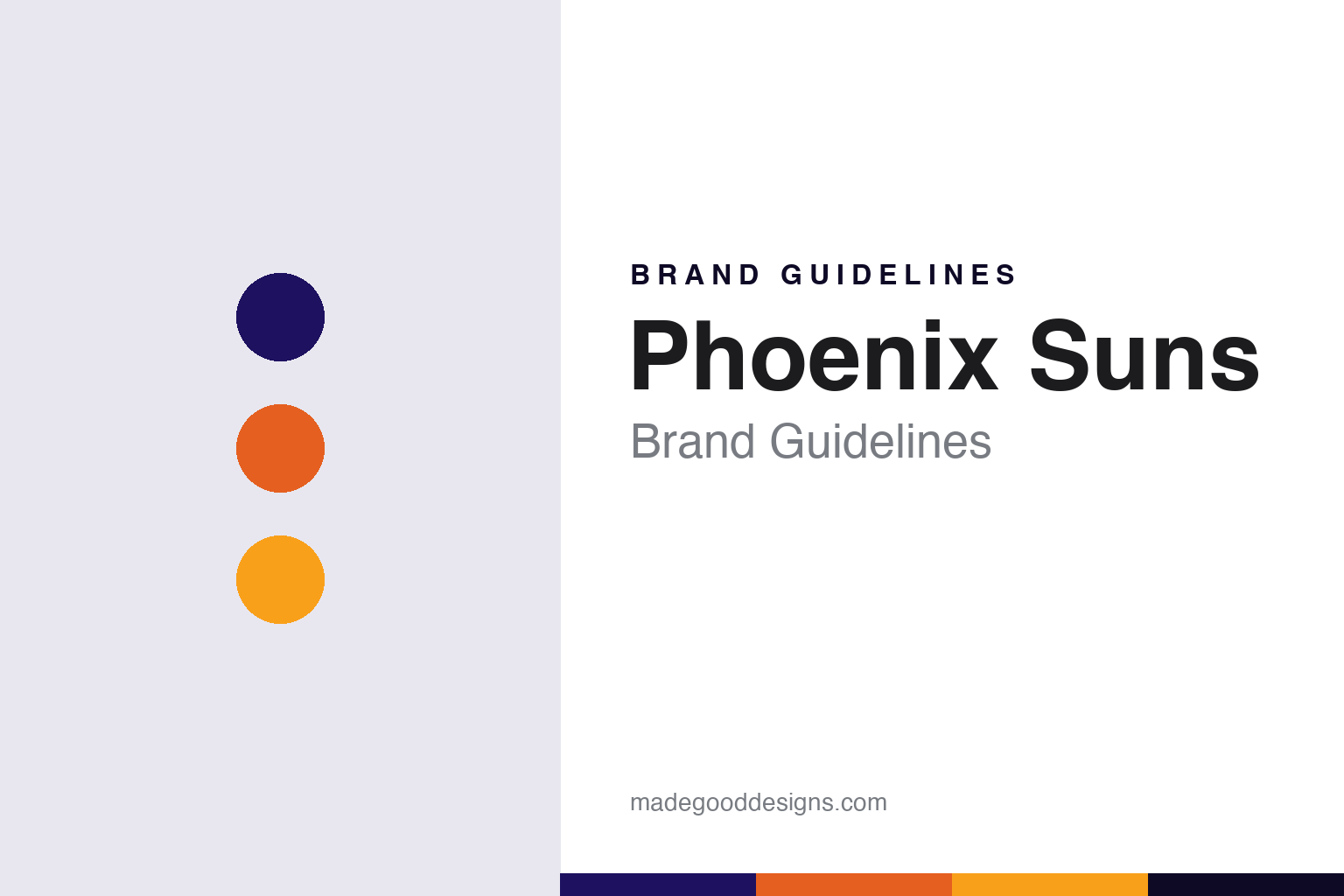
Phoenix Suns Brand Guidelines
A desert city, a name picked by newspaper readers and a sun that never sets on the jersey.
Aa
Two constants: a valley purple, sunburst orange and desert gold palette and a Western-style display lettering register. Abstract homage — not a Phoenix Suns mark; no sun logo, jersey or wordmark is reproduced.
Too hot, too small, too far away
Two Tucson partners, a league that hesitated, and a contest.
The Phoenix Suns began with a phone call about a football team. In a piece for The Arizona Republic dated 22 January 2018, Scott Bordow told how the Tucson lawyer Donald Pitt was invited in 1966 by his friend and business partner Richard Bloch to buy a small stake in the San Diego Chargers. Pitt suggested basketball instead, wondering aloud what an NBA franchise might cost. The league office was not keen. Bordow quoted the then commissioner J. Walter Kennedy as saying Phoenix was “too hot, too small and too far away” to support a team.
Pitt and Bloch pressed on. Bordow wrote that they agreed to the league’s entry terms and assembled an ownership group that at first included the businessman Karl Eller, who later dropped out, along with several entertainers through Bloch’s Los Angeles connections, among them Andy Williams, Bobbie Gentry, Tony Curtis and Henry Mancini. Phoenix was chosen partly because the new Arizona Veterans Memorial Coliseum was available. On 22 January 1968 the NBA Board of Governors awarded franchises to Phoenix and Milwaukee, and the two clubs entered the league together for the 1968–69 season. English Wikipedia says Bloch became the club’s president and that the Suns played at the Coliseum until 1992.
The name came from the public. Bordow reported that the nickname was picked through a “Name the Team” contest sponsored by The Arizona Republic, and that the other names in the running included Scorpions, Rattlers, Thunderbirds, Wranglers, Mavericks, Tumbleweeds, Mustangs and Cougars. The first logo was drawn by Stan Fabe, a commercial printer from Tucson. Less than a month after the franchise was awarded, the club hired Jerry Colangelo, then a scout with the Chicago Bulls, as its general manager.
Wikipedia says local designers chose purple and orange as the club’s main colours. The first uniforms carried a futuristic “Phoenix” wordmark across the chest, block numbers and letters in orange with purple and white trim, and an orange sunburst on the sides of the shorts. For the 1973–74 season the wordmark and numbers changed to a Western-style typeface, a look the team kept until 1992.
Colour
From Colangelo and Sarver to the Ishbia brothers.
Colangelo moved from the front office into ownership. Wikipedia says that in 2004 he announced the sale of the Suns to an investment group headed by the San Diego business executive Robert Sarver, a Tucson native. Bordow’s 2018 piece added a small coda: one of Pitt’s clients in the first season was a Tucson businessman named Jack Sarver, who often took his son, Robert, to games on seats Pitt gave him.
Sarver’s tenure ended in the autumn of 2022: Wikipedia records that on 21 September he said he would begin selling the Suns and the WNBA’s Phoenix Mercury. The Detroit Free Press reported on 20 December 2022 that Mat Ishbia, chief executive of the Pontiac, Michigan, lender United Wholesale Mortgage and a former Michigan State basketball player, had confirmed in a statement that he was finalising a purchase of the Suns, with the Mercury included. The paper said the deal still needed NBA vetting and Board of Governors approval, and, citing The Athletic, that his brother Justin Ishbia would join as a significant investor. Wikipedia says the sale became official on 7 February 2023. Mat and Justin Ishbia have owned the Suns since 2023.
The arena has shaped the brand as much as the owners. In 1992 the Suns moved downtown to the new America West Arena, which Wikipedia says was nicknamed the “Purple Palace” for its purple seats. The move brought an overhaul of the look. The home white and road purple uniforms now carried the “Streaking Sun” logo on the chest, with “Suns” above it and the number below, and the word “Phoenix” ran diagonally in orange letters down the left leg of the shorts. A black alternate followed for 1994–95.
Wikipedia traces the later changes in some detail. Before the 2000–01 season the team switched to a simpler set, with “Suns” on the home jersey and “Phoenix” on the road, and an orange alternate with the abbreviation “PHX” arrived in 2003–04. In 2013–14 a new set brought back orange streaks and grey and orange sunbursts, and a grey-sleeved alternate in 2014–15 revived the Western-style “Phoenix” lettering of the 1970s and 1980s.
Typography
Design and documentation.
A professional basketball logo has to work at very different sizes: as a centre-court graphic seen from the rafters, as a small patch on a shorts leg and as a square icon on a phone. Clubs often keep a family of marks rather than a single emblem, pairing a primary logo with a wordmark, a monogram and a secondary badge that can stand in where space is tight. Redesigns usually adjust that family together, simplifying outlines, thickening strokes and limiting the colour list so the marks print cleanly on fabric and wood.
Uniform patterns carry much of a team’s personality. Pinstripes, side panels, gradient fills and skyline or landscape motifs give a jersey a recognisable silhouette even when the lettering cannot be read. Throwback or “classic” editions revive an older set for a season, often with its original typeface and trim, and they let a club test how fondly a past look is remembered before deciding whether to bring parts of it back permanently. Mascots add a third layer: a costumed character with its own colours and personality gives the identity a playful voice for younger audiences, community events and arena entertainment.
Aa
A Western-style display letter — the register of the 1970s and 1980s jersey wordmark. (Specimen set in Rye, a decorative display STAND-IN; NOT the Phoenix Suns logo or wordmark.)
Phoenix Suns
Los Suns, The Valley, and a gorilla who came to deliver a telegram.
The Nike years began with a reset. When the league switched suppliers for 2017–18, Wikipedia says, the Suns dropped the modernised Streaking Sun and the sunbursts, simplified the uniforms and made purple prominent again, with the Streaking Sun kept on the beltline. An orange Statement uniform with the sun on the front followed in 2019–20. For 2023–24 the purple and white uniforms went back to the 1990s look, now with “Suns” set inside the Streaking Sun rather than above it. Wikipedia lists the club colours as purple, orange, black, grey and yellow.
The alternate uniforms have carried the city’s own words. From 2007 the Suns wore special “Noche Latina” uniforms for the region’s Latin American fans, and from 2008 a modified orange set reading “Los Suns”, which Wikipedia says the team wore in a 2010 playoff game on Cinco de Mayo. Later versions appeared in black, purple and, as a Nike City edition in 2018, purple, grey and white.
One City edition the team has come back to again and again is “The Valley”. Wikipedia describes the 2020–21 City uniform as a black base with a pixelated sunset in yellow, orange, red and purple over Camelback Mountain, a landmark of the Phoenix area, which has long been called the Valley; the words “The Valley” run across the chest in custom script. The team kept it for a second season, brought it back in Spanish as “El Valle” in 2023–24, and returned to the theme in 2024–25 with the Western lettering of 1973 to 1992. A 2022–23 City uniform used a turquoise base with Native American art in the striping.
The mascot arrived by accident. Wikipedia says that after an early attempt with a sunflower costume, the Suns had no official mascot until a messenger from the Eastern Onion singing-telegram service, Henry Rojas, delivered a telegram at the Coliseum dressed as a gorilla and was invited by security to dance during a timeout. He kept coming back, and the Gorilla, nicknamed “Go”, became part of the team.
For a design guide, the Phoenix Suns show how a club can build an identity from its weather and its landscape: a sun, a desert palette, Western lettering and a mountain at dusk. Compare it with the NBA, which sets the rules for every Suns uniform, and the Golden State Warriors, another Western club that draws its landmarks onto its jerseys. For this guide we use valley purple, sunburst orange and desert gold with a Western display face, an unofficial interpretation; no product or logo is reproduced.
Explore & save
Keep Phoenix Suns’s identity on hand — save it to a board in the Made Good inspiration library.
Phoenix Suns identity set
Pin the Phoenix Suns valley purple, sunburst orange and desert gold palette and the Western-style display lettering register to your own board.