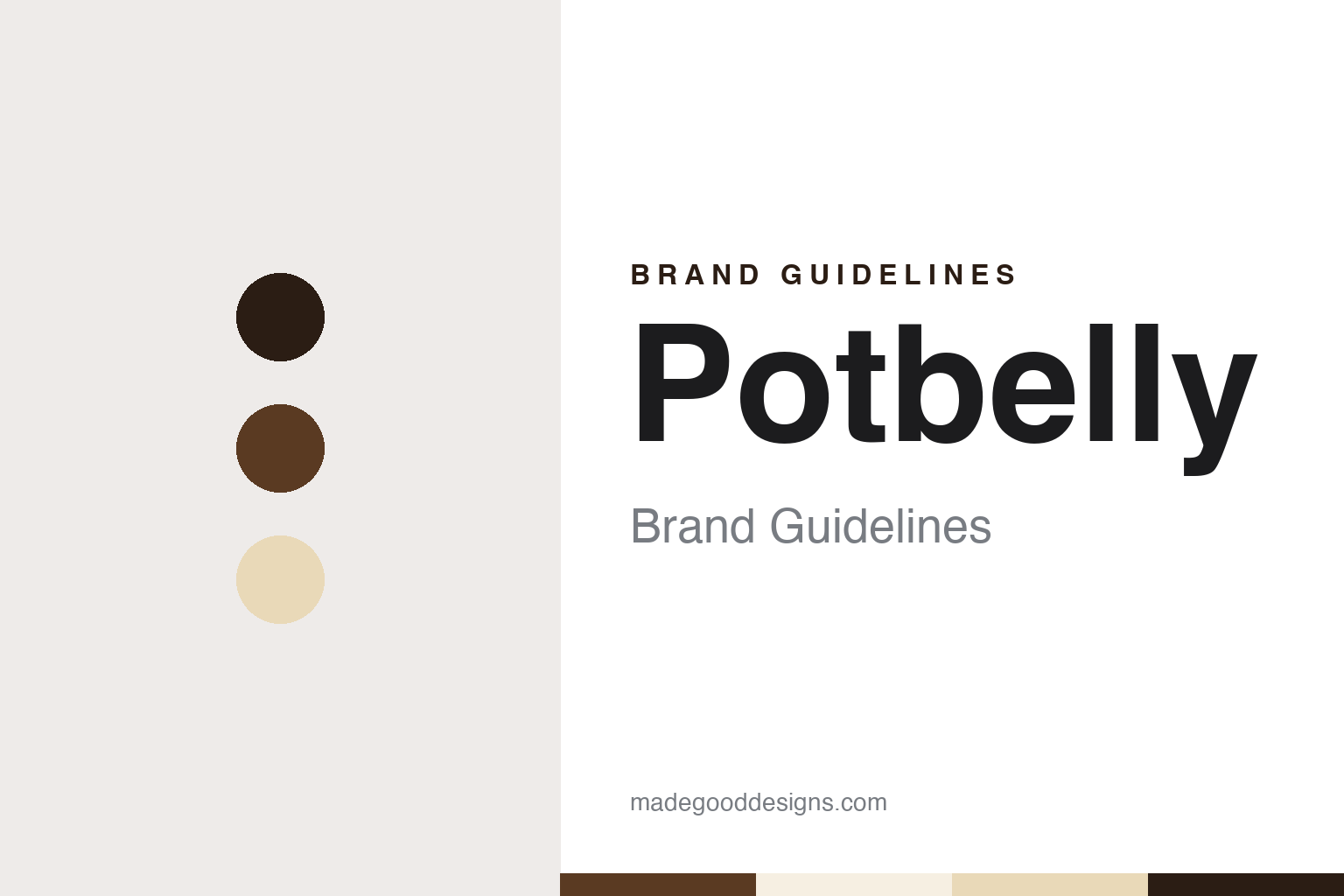
Potbelly Brand Guidelines
The Chicago sandwich shop named for an antique stove.
Aa
Two constants: an antique brown, stove black and toasted cream palette and an antique-shop slab serif register. Abstract homage — not a Potbelly product or mark; no sign, stove or logo is reproduced.
Hindsight
An antique store, a stove and a toasted sandwich.
Potbelly Sandwich Shop began inside an antique store. English Wikipedia says Peter Hastings opened a shop called Hindsight on North Lincoln Avenue, in the Lincoln Park neighbourhood of Chicago, in 1971. The store had an old potbelly stove — a round-bellied cast-iron stove — and Hastings began using it to make toasted sandwiches for the people who came in to browse. In 1977, Wikipedia says, the store was retooled into a restaurant, Potbelly Sandwich Works, and the name refers to that stove.
The Daily Meal told the same story in a profile by Dan Myers published in September 2014. It described a couple who ran a Chicago antique shop and decided one day to sell toasted sandwiches and homemade desserts, and it named Hastings as the original owner, adding that he refurbished potbelly stoves in the shop.
The chain as it exists today was built by a later owner. Bryant Keil bought the original store in 1996, according to Wikipedia, and Restaurant Business, writing in July 2023, said Keil bought Potbelly in 1996 when it was still an antique shop whose owners served toasted sandwiches and played live music, and that it had become a neighbourhood gathering spot. The Daily Meal said Keil turned it into a full-scale restaurant but kept much of the menu and the lunchtime live-music tradition. Restaurant Business described Keil as the founder of the Potbelly chain, and said he opened the second shop in 1997 and expanded from there; the company went public in 2013.
Wikipedia records the steps in between. In 2001 the venture firm Maveron, co-founded by the former Starbucks chairman Howard Schultz and Dan Levitan, invested in the company. In November 2007 a new store in Glen Ellyn, Illinois, opened with a drive-through, and a second drive-through shop followed in Waukegan. In October 2013 Potbelly became a public company through an initial public offering. In 2023, Restaurant Business reported that Keil and his son Hampden had signed an agreement to run Potbelly shops in Maryland as franchisees.
Colour
Abroad, public, and then RaceTrac.
Potbelly took its name and its stove beyond the United States through franchise partners. Wikipedia says that in February 2011 the chain opened franchise shops in Dubai, owned by the Kuwaiti retail group Alshaya. It opened in London at Westfield Stratford City in July 2015, and in Toronto in October 2016: Bisnow, reporting on the launch on 20 October 2016, said the Toronto shop had opened on Yonge Street, run by the Canadian franchisee Halsted Hospitality, and that its operators had chosen a corner of old Toronto close to the financial district. In December 2017, Wikipedia says, a franchised Potbelly opened in Cyber City, Gurgaon, in India, operated by the Kwals Group.
Leadership changed several times while the company was listed. In 2019 the chief executive was Alan Johnson, who presented the redesigned Chicago shops described below. In July 2020, Wikipedia says, Potbelly named Robert Wright, a former executive of Wendy’s, as its president and chief executive. In January 2024 the company introduced a redesigned version of its Potbelly Perks loyalty programme, and in March 2025 it announced incentives for franchisees who committed to opening new shops.
Then the company was sold. Restaurant Business reported on 23 October 2025 that RaceTrac, the family-owned, Atlanta-based convenience-store company, had completed its acquisition of Potbelly, ending its status as a publicly traded company; from that day, the magazine said, Potbelly was no longer traded on the Nasdaq. RaceTrac has owned Potbelly since 2025. Its chief executive and chair, Natalie Morhous, said in a statement quoted by the magazine that the acquisition added fast-casual expertise to RaceTrac’s portfolio “while maintaining the unique identity that makes Potbelly special.” As part of the deal, Restaurant Business said, Adam Noyes, previously Potbelly’s chief operating officer, was named president of the sandwich chain, while Wright would remain at the helm through the end of 2025.
The magazine noted that the acquisition opened a new growth path for the brand at RaceTrac outlets, alongside the franchising push Wright had pledged.
Typography
Design and documentation.
A sandwich shop has a short list of surfaces on which its identity can live. Outside, there is the sign over the door and, in many cases, a window or a pole sign that has to be read from a moving car. Inside, there is the menu board behind the counter, which carries the name, the colours and the type all at once, and which has to stay legible while prices and items change around it.
The rest of the identity travels with the food. Sandwiches are wrapped in printed paper or foil, slipped into bags, stacked into boxes for catering and handed over with cups and napkins, so a chain’s name and pattern leave the shop on objects that are thrown away within the hour. Ordering slips, stickers and receipts carry it too.
Each guide in this group looks at one sandwich or sub chain through those surfaces: where the business started and who founded it, who has owned it since, and how its name, logo, signage and packaging are described in sources that can be dated. Where a fact rests only on the company’s own account, the guide says so.
Aa
An antique-shop slab serif — the register of a painted shop sign and a wooden menu board. (Specimen set in Bitter, a slab-serif STAND-IN; NOT the Potbelly logo.)
Potbelly
A stove, antique décor and a quieter room.
The Potbelly identity starts with an object. The Daily Meal reported in 2014 that every Potbelly location was home to a potbelly stove, a holdover from the antique-store days, that each one was different, and that the stove was meant to stand for gathering with family and friends over a meal. The same article said the company’s green initiatives included paper packaging, so the bag and the wrapper carry the name out of the door.
The interiors followed the shop’s origins. Announcing a redesigned prototype in Chicago’s Logan Square on 12 November 2019, chief executive Alan Johnson told FastCasual.com and the Midwest real-estate journal rejournals.com: “Potbelly was founded in an antique shop and we’ve often kept antique décor in our shops to keep that spirit alive.” The new design, he said, kept the warm, established feel the brand was known for, “but with less clutter for a cleaner, more modern take on comfort.” It paired the chain’s booth seating with wood and natural elements, separated ordering from the dining room, and introduced a single menu board that presented the menu items in one area, alongside glass counters that let customers watch their sandwiches being made. A second redesigned shop was due to open in Park Ridge, Illinois, by the end of that month.
The refresh continued under Wright. FFXnow, the Northern Virginia news site, reported on 26 June 2025 that Potbelly had remodelled its shops at Fairfax Corner, opened in October 2003, and Reston Town Center, opened in June 2008, as part of what field marketing manager Anna Whalen called a “nationwide refresh initiative,” with selected legacy shops to be remodelled in phases through 2029. The changes, the site said, included new paint, wallpaper, décor, furniture and lighting as well as different interior and exterior signage, and the work was done at night so the shops could stay open.
For a design guide, Potbelly shows how a chain can carry the furniture of its original room — a stove, antique fittings, a hand-made feel — into its later shops, and then edit that inheritance as the shops are refreshed. Compare it with Subway, whose identity rests on arrows and a typeface rather than an object, and Jimmy John’s, another sandwich chain in this group. For this guide we use antique brown, stove black and toasted cream with a serif, an unofficial interpretation; no product or logo is reproduced.
Explore & save
Keep Potbelly’s identity on hand — save it to a board in the Made Good inspiration library.
Potbelly identity set
Pin the Potbelly antique brown, stove black and toasted cream palette and the antique-shop slab serif register to your own board.