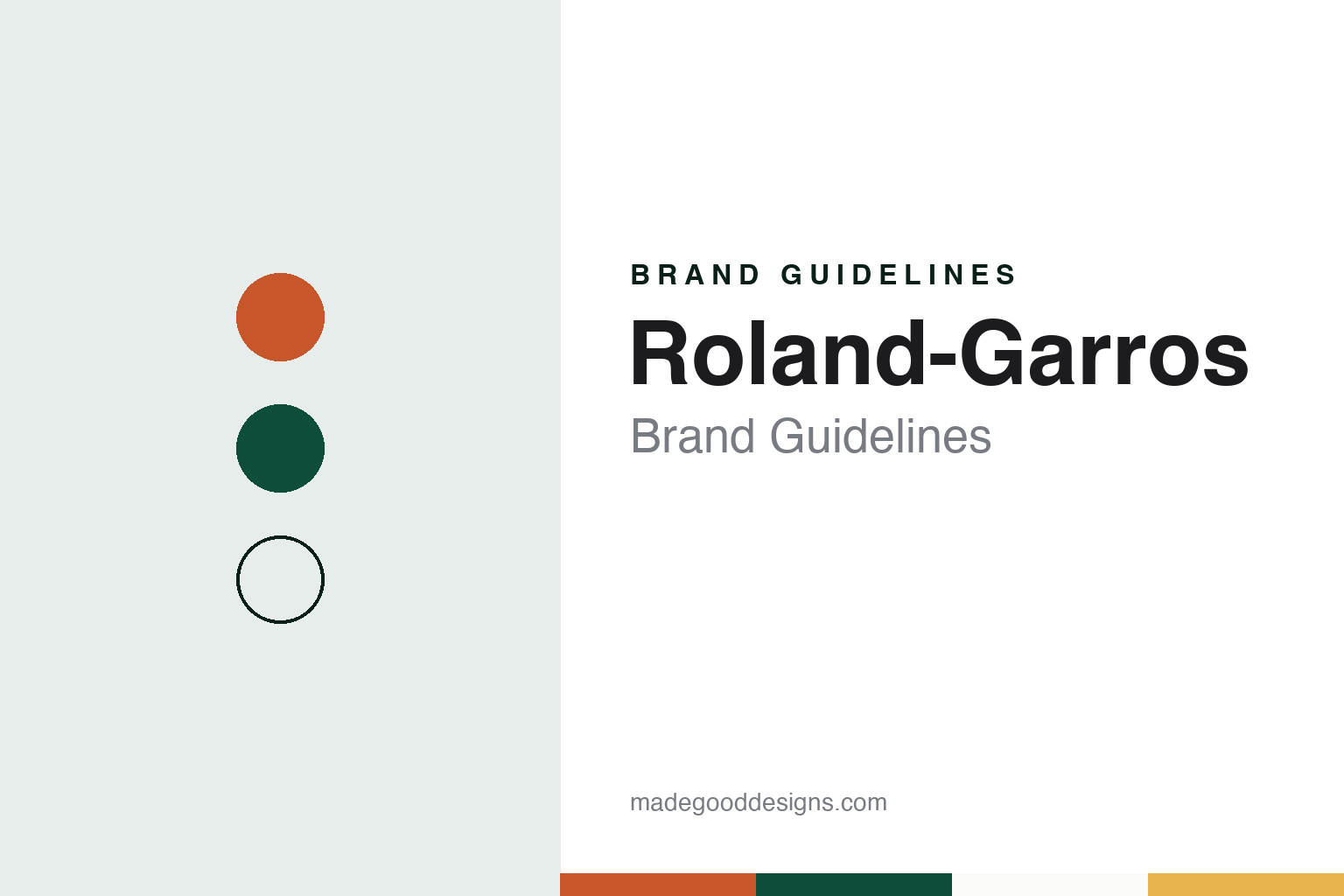
Roland-Garros Brand Guidelines
A Paris tournament that took an airman’s name and painted itself in brick-coloured clay.
Aa
Two constants: a clay orange, green and white palette and a Didone serif register. Abstract homage — not the Roland-Garros logo, posters or any trade mark; no logo is reproduced.
Porte d’Auteuil
A club championship in 1891 and a new stadium in 1928.
The tournament is older than its name. English Wikipedia says the French championships began in 1891 as an event open only to players who were members of French clubs, and that the championship did not reach Grand Slam level until 1925, when it admitted players from abroad. In its early years the event moved between Paris clubs, among them the Racing Club de France at the Croix-Catelan in the Bois de Boulogne and the Stade Français, and Wikipedia lists the surface as sand from 1892 and clay from 1908.
The stadium came from a sporting victory overseas. Wikipedia says that after the French players known as the Mousquetaires, René Lacoste, Jean Borotra, Henri Cochet and Jacques Brugnon, won the Davis Cup in the United States in 1927, France decided to defend the cup the following year at a new tennis stadium at Porte d’Auteuil, on the western edge of Paris. The president of the Stade Français, Émile Lesieur, offered the tennis authorities three hectares of land on one condition: that the new ground be named after Roland Garros, the French aviator and First World War fighter pilot, who had been his classmate at the HEC business school.
The name stuck to everything. The new stadium hosted the 1928 Davis Cup challenge, and Wikipedia says the French international championships moved there on 24 May 1928 and have been held there ever since. In English the event is still widely called the French Open, but the organisers, the venue and the brand all use Roland-Garros, the hyphenated form of the airman’s name, and Wikipedia says the tournament and the venue are both named after him.
The organiser is the national federation. Wikipedia names the Fédération Française de Tennis (FFT) as the French governing body for the sport, and it is the federation that runs the championships and the stadium. The event became an open tournament in 1968, the year of the French general strike, when professionals were allowed to compete alongside amateurs.
The central court has its own name. Wikipedia says the main show court was renamed Court Philippe-Chatrier in 2001, and another show court carries the name of Suzanne Lenglen. The men’s singles trophy is the Coupe des Mousquetaires, a name that links the prize back to the 1927 team whose Davis Cup win led to the stadium being built.
Colour
Orange clay, green surrounds and a brand built on a surface.
The colour of Roland-Garros is the colour of its courts. Wikipedia says the tournament has been played on clay since 1908 and describes the surface as a fine layer of red clay dust over the top of the court, which slows the ball and makes it bounce higher than on grass or hard courts. In French the surface is terre battue, beaten earth.
Wikipedia says the clay takes away some of the advantages of big servers and serve-and-volley players, because the ball slows and bounces higher. The choice of clay in Paris goes back to the early host clubs: Wikipedia says the Racing Club de France’s ground at the Croix-Catelan, an early venue, opened with grass courts that were later turned into clay because they were difficult to maintain.
The venue has been rebuilt around that palette. Wikipedia says a long debate over expansion ended in 2011 with the decision to keep the tournament at Porte d’Auteuil rather than move to a new site outside Paris. The plan included a roof over Court Philippe-Chatrier and a new show court beside the Jardin des Serres d’Auteuil, the historic botanical greenhouses next to the grounds. Legal challenges from environmental groups delayed the work; Wikipedia says construction began at the close of the 2018 edition.
The results changed how the grounds look. Wikipedia says Court Philippe-Chatrier was given redeveloped seating and a retractable roof, and that a new court named after Simonne Mathieu opened among the greenhouses, noted for its use of glasshouse-style architecture. Wikipedia lists both Court Philippe-Chatrier and Court Suzanne-Lenglen as having retractable roofs today, so play can continue on clay in the rain.
Across all of this the surface stays constant. Wikipedia says the US Open moved from clay to hard courts in 1978, leaving the Paris championships as the Grand Slam event played on clay, and the orange court remains the thread that runs from the 1928 stadium to the rebuilt one.
Typography
Clay, green and white.
A sporting event has no factory and no product on a shelf, so its identity lives almost entirely in graphics and objects that return on a calendar. The annual logo is a visible piece: many events keep a permanent mark and add a dated edition lockup each year, so a single season can be identified at a glance on tickets, programmes and merchandise. Posters do similar work in a looser register; some organisers commission a different artist every year, which turns the poster series into a running record of illustration and type styles across decades.
Trophies are the physical centre of the identity. Their silhouette, material and engraving are often fixed for long periods, and photographs of the presentation moment carry that shape far beyond the venue. Venue marks add a third layer: signage, painted grass or tarmac, gates and grandstand lettering that fix the event to a particular place.
Broadcast graphics complete the set. Score bugs, timing towers, lower thirds and title sequences are redesigned every few seasons, and they are where viewers meet the event’s typefaces and colours. Read together, these layers show how an event keeps a stable core while letting each edition look like its own year.
Aa
A high-contrast Didone serif — the register of a Paris poster title and a printed programme. (Specimen set in Playfair Display, a serif STAND-IN; NOT the Roland-Garros logo or wordmark.)
Roland-Garros
A gallery partnership and a new painting every spring.
Roland-Garros hands part of its identity to artists. The International Tennis Hall of Fame, in Newport, Rhode Island, wrote in May 2026 that in 1980 the French Tennis Federation and the Roland-Garros Championships Committee partnered with the Paris gallery Galerie Lelong & Co. to start commissioning contemporary artists from around the world to design the tournament’s official annual poster. The Hall of Fame says the tradition continues in 2026 and that it has gathered the posters into a digital exhibit, Roland-Garros: A Tribute.
The Hall of Fame describes the idea behind the series as bringing fine art to a sports audience, treating the players as artists, the court as a canvas, the racquet as a brush and the ball as the paint. Each year’s poster is a work by a different artist, and each takes its own approach to the clay, the court and the colours of the event, so the series works as an annual reinterpretation of the brand rather than a fixed advertising template.
The museum’s other displays show how the event’s image is tied to clothing as well as art. The Hall of Fame says its Courting Fashion exhibit covers French style figures such as Suzanne Lenglen and René Lacoste, two names tied to the Paris event: Lenglen’s is on a show court, and Lacoste was one of the Mousquetaires whose Davis Cup win led to the stadium. It also shows clay-marked shoes and clothing worn at the tournament.
The pieces of the brand fit together simply. The name comes from an aviator chosen by the man who gave the land; the colour comes from the courts; the dark green and white frame the clay; and the posters add a new artist’s view each spring. The federation keeps the name and the surface fixed and lets the posters change.
For a design guide, Roland-Garros shows how a playing surface can become a colour system, and how an annual art commission can refresh an event without changing its name or logo. Compare Wimbledon, which built its identity on grass, white clothing and a registered green and purple, and the Australian Open, which rebuilt its own mark around two letters in 2016. For this guide we use clay orange, court green and line white with a Didone serif, an unofficial interpretation; no product or logo is reproduced.
Explore & save
Keep Roland-Garros’s identity on hand — save it to a board in the Made Good inspiration library.
Roland-Garros identity set
Pin the Roland-Garros-inspired clay orange, green and white palette and the Didone serif register to your own board.