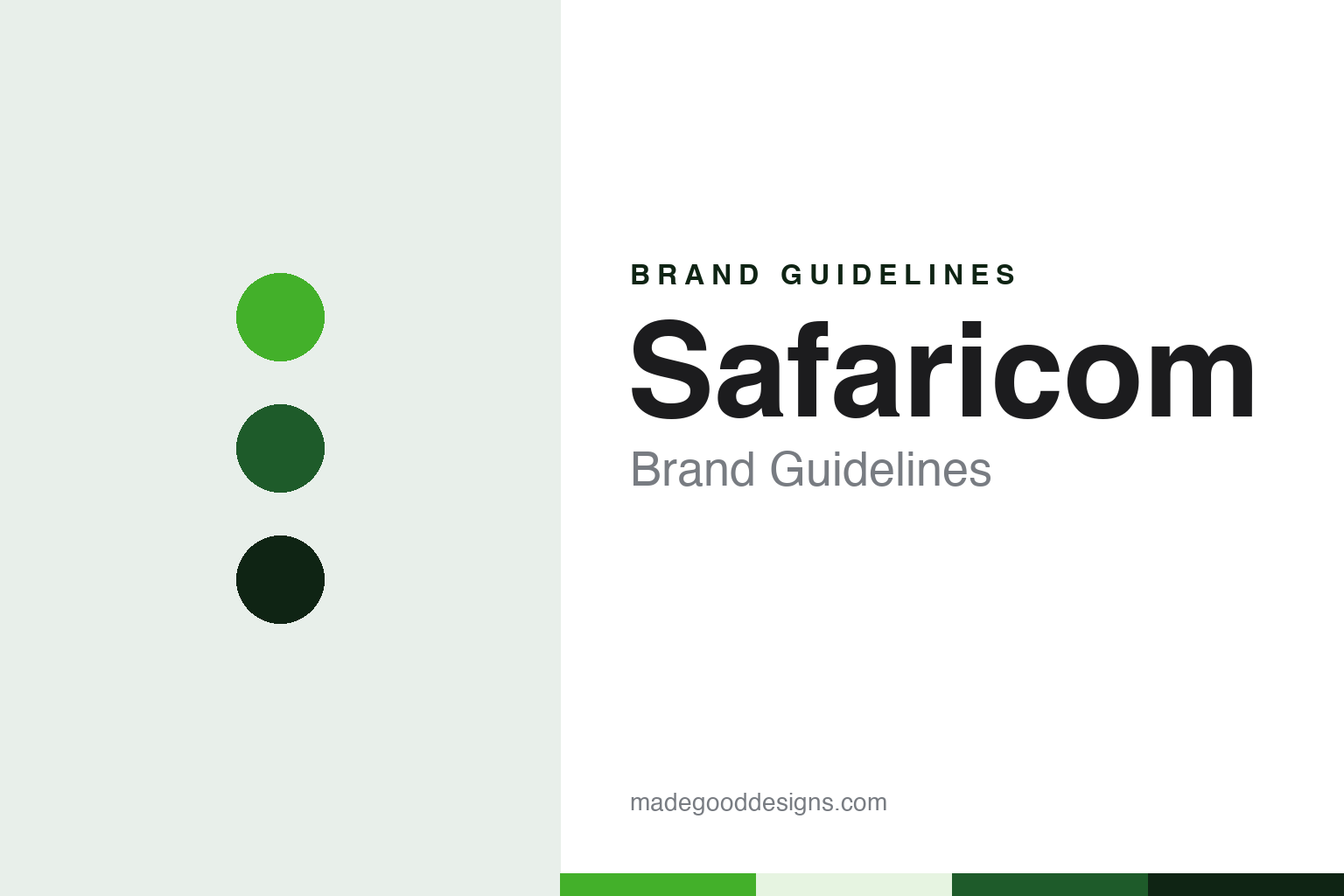
Safaricom Brand Guidelines
A state department, a British partner and a name chosen to sound Kenyan.
Aa
Two constants: a kiosk green, deep green and forest ink palette and a geometric bold sans register. Abstract homage — not a Safaricom asset or mark; no logo, icon or wordmark is reproduced.
A department becomes a company
Nairobi, 1993–2000.
Safaricom grew out of a state telephone monopoly. TechCabal, in a history published on 24 October 2025 as the company marked twenty-five years of its network, says Safaricom began as a department within the Kenya Posts & Telecommunications Corporation (KPTC), launched in 1993 with an analogue network. The next steps towards its present form, the site says, were its incorporation as a private limited liability company in 1997 and an upgrade to the GSM digital standard. Wikipedia describes the 1997 company as a wholly owned subsidiary of Telkom Kenya, and gives its headquarters as Safaricom House in Nairobi.
A British partner arrived three years later. Wikipedia and TechCabal both say that in May 2000 Vodafone Group acquired a stake in the company and took over its management. TechCabal says Michael Joseph was appointed founding chief executive in July 2000. Wikipedia says he served until November 2010, when Bob Collymore took over and Joseph moved to the board as chairman. In a statement quoted by TechCabal in 2025, the current chief executive, Peter Ndegwa, dated the opening call on the network to 2000, and Wikipedia records that in May 2000 the company also launched a service called Kipokezi for sending email and chat messages from standard mobile phones.
Ownership widened in 2008, when, according to both sources, the Kenyan government offered part of its shareholding to the public through a listing on the Nairobi Securities Exchange. TechCabal reported in April 2020 that Vodafone and the South African operator Vodacom both held shares in Safaricom. Ndegwa took charge in 2020, TechCabal says, succeeding Collymore, and the company’s Ethiopian subsidiary, Safaricom Ethiopia, launched in 2022.
The name itself was chosen with that foreign partner in view. Kenyans.co.ke reported on 23 October 2018 that Gina Din Kariuki, founder of the communications consultancy Gina Din Group, was instrumental in naming the company. The site quoted Michael Joseph as saying she suggested going with the name “Safaricom” rather than “Vodafone”, so that the business entered the market as a Kenyan company. Kariuki herself was quoted as saying she handled Safaricom from the time it started, for twelve continuous years.
Colour
M for mobile, pesa for money.
The service name that sits beside Safaricom is M-Pesa. Wikipedia explains the name as “M” for mobile and pesa, the Swahili word for money, and says the service was launched in 2007 by Vodafone for Safaricom and Vodacom. Kenyans.co.ke, writing in October 2019, dated the launch to March 2007, and TechCabal wrote in April 2020 that Vodafone launched the M-Pesa brand for Safaricom in 2007.
The idea started as something narrower. TechCabal’s 2025 history says that in 2003 Safaricom and Vodafone began a project funded by a grant from the UK’s Department for International Development, intended to let microfinance borrowers receive and repay loans by phone. A pilot began in October 2005. When M-Pesa was launched to the public in 2007, the site says, it was a general money-transfer service rather than a loan tool, and Wikipedia gives the same account of a service that was broadened after its pilot.
The brand surface was the shopfront. TechCabal says Safaricom used its existing network of airtime resellers as M-Pesa agents, and describes small kiosks and shops across Kenya “often painted in Safaricom’s distinctive green”. Later service names kept the same M- prefix: Wikipedia and TechCabal both record M-Shwari, launched in 2012 as a partnership with the Commercial Bank of Africa, now NCBA Bank, and Wikipedia dates its launch to November 2012.
Ownership of the name changed hands in 2020. TechCabal reported on 8 April 2020 that Safaricom and Vodacom had acquired the intellectual property rights to the M-Pesa brand from Vodafone through a joint venture, and quoted their statement that the two companies now had “full control of the M-PESA brand, product development and support services”. Until then, the site said, the rights had belonged to the British telecommunications company that launched the brand in 2007.
Typography
Surnames, coined words and one colour.
Retail and telecom names across Japan, Australia and Africa tend to come from a small set of sources. Some carry a founder’s surname, sometimes in the plural when a family of brothers or partners started the business together. Others are coined words built from Latin or English roots, chosen to sound settled and durable rather than to describe a product. A third group joins two everyday words into one, so that a service name reads as a single compound rather than a description. Acronyms also recur, especially where a company began as a network or a division with a long formal title.
For a design reader the more useful pattern is how these identities travel. A shop name has to work on a fascia board seen from across a car park, on a till receipt, on a carrier bag and on an app icon. A telecom mark has to sit on a SIM card no bigger than a thumbnail, on a scratch-off airtime voucher, on a kiosk umbrella and on a phone screen. Many of these companies settle on a single house colour and apply it everywhere, so that the colour does the work of recognition even where the wordmark is too small to read.
Aa
A geometric bold sans — after a Kenyan network’s one-word name. (Specimen set in Montserrat, a sans STAND-IN; NOT the Safaricom logo or any Safaricom typeface.)
Safaricom
A logo for seven days.
The M-Pesa mark has also been changed for a single occasion. Kenyans.co.ke reported that on Wednesday 9 October 2019 Safaricom launched a new M-Pesa logo at an event at its headquarters in Westlands, Nairobi, with a design inspired by the marathon runner Eliud Kipchoge. Sitoyo Lopokoiyit, the company’s chief financial services officer, said the new logo would be in use for the next seven days in honour of Kipchoge, who had been named the new face of M-Pesa. The site said Safaricom had released a teaser of the design changes on 7 October, two days before the launch.
The launch was tied to a race rather than to a permanent redesign. Kenyans.co.ke said Lopokoiyit also announced a free SMS line for customers to send Kipchoge good wishes and free YouTube access so that customers could stream his attempt. Michael Joseph, named by the site as Safaricom’s chief executive at the time, said the company was renewing its commitment to Kipchoge and that it was fitting to offer the M-Pesa brand in his recognition. The site recalled that when the service was launched in March 2007 it was aimed at people sending money from Kenyan cities such as Nairobi to their homes in rural areas.
The colour is the other constant in the published record. TechCabal’s 2025 history links Safaricom’s green to the kiosks and shops that became M-Pesa agents, and places the company’s story inside twenty-five years of a network switched on in 2000. The European network Orange, launched in 1994, took a colour as its name.
For a design guide, Safaricom shows how a network can pair a name chosen to sound local, a service name built from one letter and one Swahili word, and a single house green that runs across kiosks and shopfronts. Compare Vodafone, the British group that took a stake in 2000, and MTN, the Johannesburg group that claimed yellow. For this guide we use kiosk green, deep green and forest ink with a sans, an unofficial interpretation; no product or logo is reproduced.
Explore & save
Keep Safaricom’s identity on hand — save it to a board in the Made Good inspiration library.
Safaricom identity set
Pin the Safaricom kiosk green, deep green and forest ink palette and the geometric bold sans register to your own board.