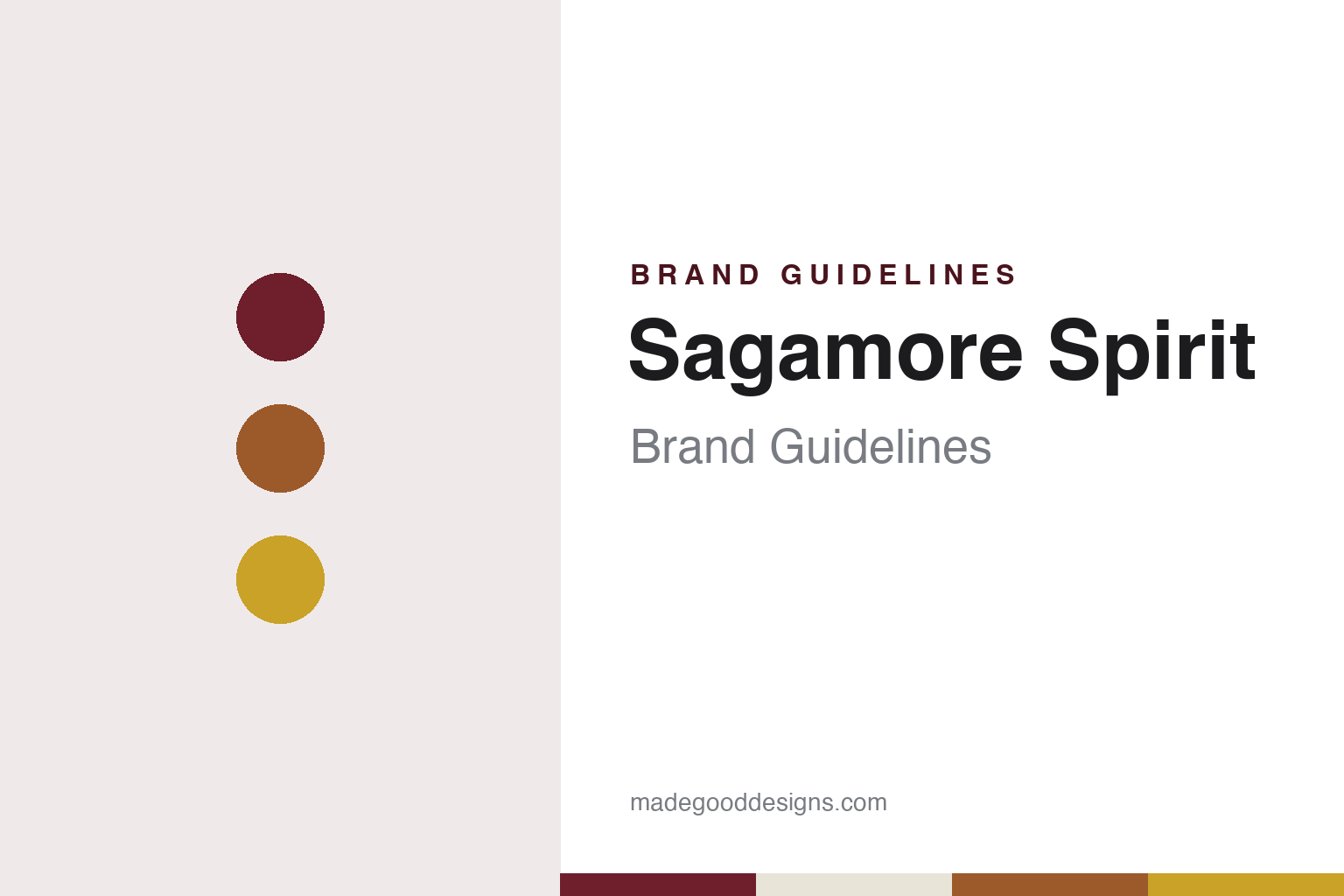
Sagamore Spirit Brand Guidelines
The Maryland rye named for a horse farm and its spring.
Aa
Two constants: a capsule burgundy, corten amber and Calvert gold palette and an incised capital serif register. Abstract homage — not a Sagamore Spirit product or mark; no label, logo or bottle is reproduced.
A horse farm, a springhouse and a rye
Sagamore Farm, Kevin Plank and the return of Maryland rye.
Sagamore Spirit takes its name, and its water, from Sagamore Farm in Reisterstown, Maryland. English Wikipedia says the farm was put together in 1925 by the Baltimore businessman Isaac Edward Emerson as a gift for his daughter Margaret, who later passed it to her son, the racehorse owner Alfred G. Vanderbilt Jr. Vanderbilt staged the 1938 match race between Seabiscuit and War Admiral at Pimlico, and he sold the farm in 1986. In 2007 it was bought by Kevin Plank, the founder of Under Armour, with a long-term plan to restore it.
The whiskey company followed in 2013. Plank founded Sagamore Spirit that year, The Whiskey Wash reported in 2023, and the Baltimore news site Baltimore Fishbowl names Bill McDermond as its co-founder. The idea was to make rye in a state that once had a strong distilling tradition. Brian Treacy, the company’s president, told the packaging trade press in 2016 that Maryland had been home to more than 40 distilleries before Prohibition, and that Sagamore wanted to make a spirit worthy of that heritage.
The first whiskey reached shelves before the company had a still of its own. Whisky Advocate reported in April 2017 that Sagamore Spirit Straight Rye launched in 2016 as a blend of two straight rye whiskeys made to Sagamore’s specifications at the contract distiller MGP, from a recipe developed by Larry Ebersold, a former MGP master distiller. Launch announcements published by Wine Industry Advisor and Packaging Strategies in the summer of 2016 describe the blend as one high-rye and one low-rye mash bill, cut to 83 proof with spring water from the farm, and list Maryland, Washington, D.C. and Delaware as the first markets, with New York to follow.
Colour
A diamond bottle, a 1909 date and three small diamonds.
Sagamore’s packaging was built around the farm. According to the 2016 launch announcements, the company’s brand team worked with two creative studios, Sagamore Creative of Baltimore and Ptarmak of Austin, Texas, and with the packaging supplier Saxco International of Horsham, Pennsylvania, on a custom bottle mould. The result was a diamond-shaped 750 ml flint-glass bottle with flat shoulders and a heavy base.
The glass carries embossed marks on the front, back and bottom. The number 1909 appears on the front and back: it is the year the Sagamore Farm springhouse was built, the announcements say, and the springhouse is where the company draws the water used to bring its rye to bottling strength. Treacy explained at the time that the farm sits on a shelf of limestone rock, and Whisky Advocate later described the water as limestone-filtered. A three-diamond logo is moulded into the bottom of the bottle and printed on the black wooden top of the natural cork stopper, which is covered by a burgundy and black capsule.
The labels were part of the same handmade story. The 2016 announcements say the tricolour pressure-sensitive labels were applied by hand, and that each bottle was marked by hand with a batch number and a bottler number and signed by the person who bottled it.
The three diamonds travelled from the bottle to the buildings. In a project entry published by Architect magazine in January 2018, the Baltimore studio Ashton Design says it designed the site and building signage, the signs for the on-site restaurant, Rye Street Tavern, and a two-storey hand-painted mural at the distillery entrance. The outdoor signs are made of corten weathering steel, chosen because it ages to an amber colour like aged whiskey, and the angles of the sign panels were taken from the Calvert coat of arms on the Maryland flag, with cut-outs of Sagamore’s three diamonds. The main entrance sign is a single 20-foot piece of one-inch steel.
Typography
Design and documentation.
The seven brands in this group are all American whiskey names known for rye, often alongside bourbon: Sagamore Spirit, Old Overholt, Templeton, Pikesville, James E. Pepper, Willett and Catoctin Creek. They sit at very different points in the trade, from family-run distilleries to labels that belong to much larger drinks groups, and a single name can stand for a working distillery, a revived old brand or a whiskey made somewhere else and bottled under the label.
In the United States the word on the label has a legal meaning. Federal rules on spirits labelling (27 CFR 5.143) define rye whisky as whisky made from a fermented mash of at least 51 per cent rye, distilled at 160 proof or less and stored in charred new oak barrels at 125 proof or less; a whisky called “straight” must spend at least two years in those barrels. The same rules set out bourbon on the same pattern, with corn in place of rye. What the rules fix is the recipe and the barrel, not the look of the bottle, so the identity of each brand is carried by its name, its label and the place it claims.
That makes the questions behind each name worth asking plainly: who started it, who owns it now, and where its whiskey is actually distilled, aged and bottled. Each guide separates what independent sources record from what the company says about itself — its founding story, its owners over time, where its whiskey is made and how its labels have changed — and marks plainly what rests only on the company’s own word.
Aa
An incised capital serif for a rye with a cut-steel campus. (Specimen set in Cinzel, a serif STAND-IN; NOT the Sagamore Spirit logo.)
Sagamore Spirit
A waterfront distillery in Baltimore, and an Italian majority owner.
The company’s own distillery opened on 21 April 2017 in Baltimore’s Port Covington district, on a five-acre site on the Patapsco River waterfront, after about 18 months of construction, Whisky Advocate reported. Production there had begun on 10 April 2017. Baltimore Fishbowl reported at the opening that the buildings were designed by the Baltimore architects Ayers Saint Gross, with large windows that show the equipment inside, and that the 22,000-square-foot distillery houses a 40-foot copper column still. A 120-foot water tower on the site holds spring water brought from Sagamore Farm, which Whisky Advocate put at about 22 miles away. The whiskey is aged in barns in Baltimore County before it returns to the city to be bottled, the two publications reported.
The farm has since moved closer to the glass. English Wikipedia says Sagamore Farm announced in November 2020 that it would shift from breeding and training Thoroughbreds to growing grain for Sagamore Spirit.
Ownership changed in 2023. In a release dated 14 September 2023, the Italian group Illva Saronno Holding, the company behind Disaronno, announced that it had bought a majority stake in Sagamore Spirit, and Plank said Illva would move its North American headquarters to Maryland. The Whiskey Wash reported that the deal took Illva’s whiskey business beyond The Busker, its Irish whiskey, and into American rye. Illva Saronno has held the majority since 2023, and the terms were not disclosed. Before the deal, the release said, the brand sat within Sagamore Ventures, Plank’s Baltimore-based family office.
For a design guide, Sagamore Spirit shows how a young whiskey can build its identity from real places — a 1909 springhouse, a horse farm and a state flag — rather than an invented past, and carry one small mark, three diamonds, from the base of a bottle to a steel gate sign. Compare WhistlePig, another farm-named American rye, and Disaronno, the amaretto from the same Italian owner. For this guide we use capsule burgundy, corten amber and Calvert gold with an incised serif, an unofficial interpretation; no product or logo is reproduced.
Explore & save
Keep Sagamore Spirit’s identity on hand — save it to a board in the Made Good inspiration library.
Sagamore Spirit identity set
Pin the Sagamore Spirit capsule burgundy, corten amber and Calvert gold palette and the incised capital serif register to your own board.