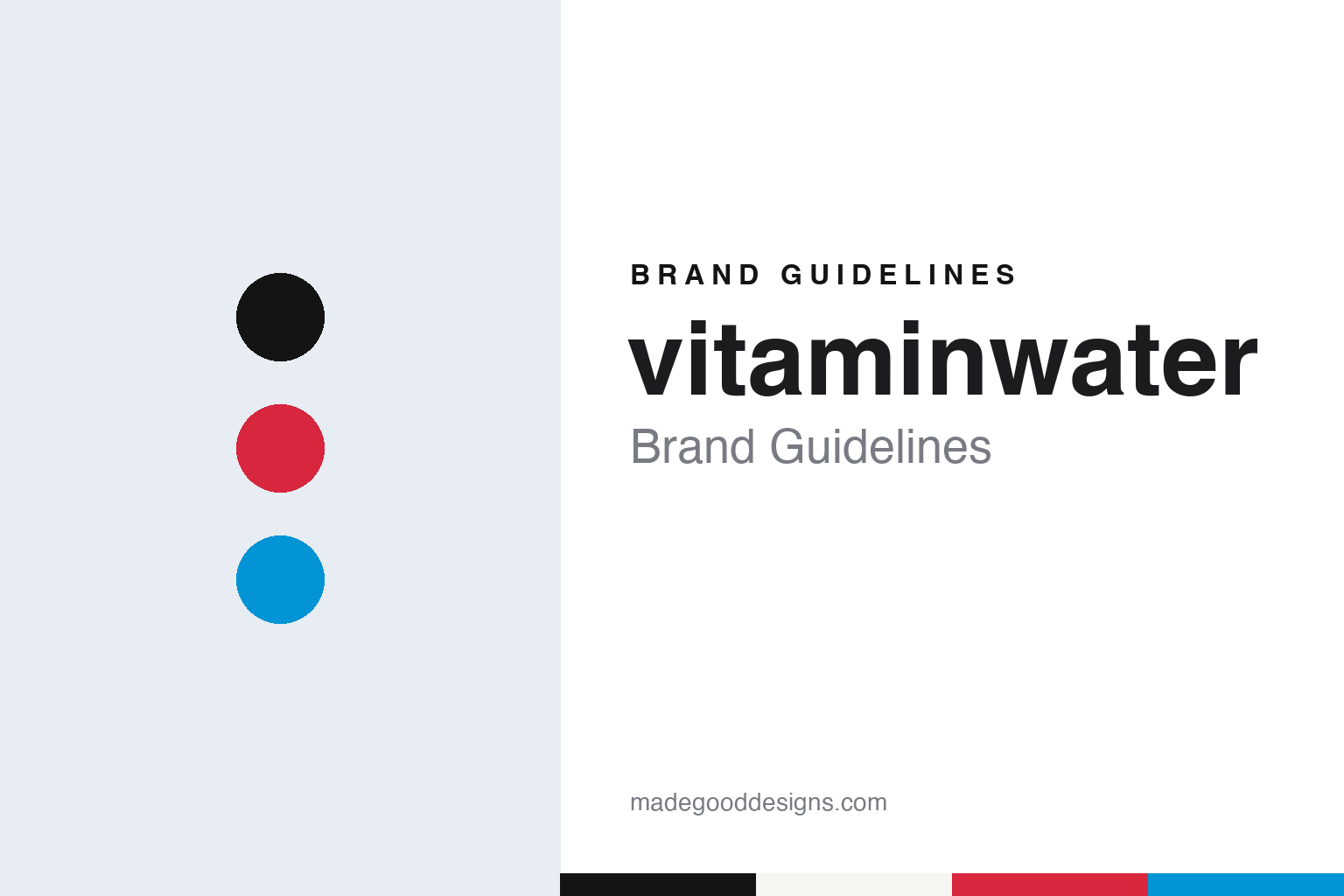
vitaminwater Brand Guidelines
Glacéau’s 2000 bottle, redrawn in 2025.
Aa
Two constants: a label black, zero white and flavour colour palette and a neo-grotesque sans register. Abstract homage — not a vitaminwater product or mark; no label, logo or bottle is reproduced.
Glacéau, New York
A drinks company built shop by shop in New York.
vitaminwater — the brand writes its name in lower case, English Wikipedia notes — belongs to Energy Brands Inc., which trades as Glacéau and is a subsidiary of The Coca-Cola Company based in Whitestone, Queens, New York. According to English Wikipedia, the entrepreneur J. Darius Bikoff founded the Glacéau Water Co. in January 1994 and set up Energy Brands on 22 May 1996 to distribute the first Glacéau product, smartwater, to natural-food stores and independent retailers in the New York area. The same account says Bikoff started the business with his own savings and contracted with an aquifer in Connecticut for the base water.
The range grew in stages. Fruitwater followed in 1998 and vitaminwater in 2000, English Wikipedia says, and Bikoff launched each line the same way: by placing bottles himself in small independent shops before approaching distributors. By 2001 the company’s drinks were sold in more than 4,000 stores in the New York area, according to the same account, and nationwide distribution followed in the early 2000s. Coca-Cola, in a release of May 2025, called vitaminwater a “New York-born-and-bred brand” and said it had helped create the enhanced-water category 25 years earlier.
The ownership changed several times before Coca-Cola arrived. English Wikipedia says the luxury group LVMH bought a 30 per cent stake in Energy Brands, a stake that passed through another investor to India’s Tata Group in August 2006. In October 2004 the rapper 50 Cent (Curtis Jackson) took a minority share as part of an endorsement arrangement, and he worked with the company on a grape-flavoured variant called Formula 50. In May 2007 The Coca-Cola Company announced that it would acquire Energy Brands, and English Wikipedia says the business continued to run largely on its own, with Bikoff and its existing managers in charge.
Colour
From a separate drop icon to a droplet “a.”
Colour does the sorting on the bottle: English Wikipedia lists each flavour with its own label colour, under short names such as power-c, focus, essential and XXX. Before 2025 the label carried a lower-case wordmark set in Helvetica, a separate drop icon and a horizontal grid, design coverage of the redesign notes.
The line has also branched. English Wikipedia says a range called vitaminwater10 launched on 2 April 2009 and was followed by vitaminwater zero, and that a sparkling cousin, fruitwater, was sold between 2013 and 2015. The sister brand smartwater has had its own famous faces: Jennifer Aniston from 2007 to 2020, then Gal Gadot and, from June 2022, Zendaya, English Wikipedia says.
In 2025 the brand changed its look for the first time in 25 years. Coca-Cola announced on 14 May 2025 that a refreshed identity had begun rolling out across the range in March, with “an enlarged and stacked logo with modernized typography” and labels in what it called “vibrant, flavor-forward colors.” Full-sugar varieties now carry black labels and zero-sugar varieties white labels. The release quoted Amanda Harkins, the brand director, and Matt Cooper, vitaminwater’s design director, who said the creative brief set a challenge “to make the brand more provocative and irreverent.”
The identity was created with forpeople, a creative studio based in London and Amsterdam, GDUSA reported. According to GDUSA and Design Compass (29 May 2025), the typeface changed from Helvetica to TWK Lausanne, a droplet-shaped “a” replaced the separate drop icon, and the dot of the “i” was stretched to recall a vitamin pill. Design Compass added that the horizontal grid was dropped in favour of colour across the whole bottle, and that using black for full sugar and white for zero reverses a common soft-drink convention.
Typography
Design and documentation.
The seven brands in this group are all water names: vitaminwater, Liquid I.V., Core, Crystal Geyser, Deer Park, Arrowhead and Harrogate. Water brands in general sit at many different points in the trade, from family companies that still carry a founder’s name to labels that now belong to much larger food and drinks groups, and a single brand can be sold everywhere from a corner shop to a restaurant table.
A water brand’s identity is usually carried less by what is in the bottle than by a label, a name and the place or idea it promises, because the company behind the name may have changed hands, moved its production or grown far beyond the place where it started. That makes the questions behind each name worth asking plainly: who started it, who owns it now, and where its products are actually made and bottled.
Each guide separates what independent sources record from what the company says about itself — its founding story, its owners over time, where its products are made and how its labels have changed — and marks plainly what rests only on the company’s own word.
Aa
A neo-grotesque sans for a stacked lower-case wordmark. (Specimen set in Hanken Grotesk, a sans-serif STAND-IN; NOT the vitaminwater logo or TWK Lausanne.)
vitaminwater
A Coca-Cola brand that kept its New York accent.
Under Coca-Cola the brand travelled. English Wikipedia says Energy Brands launched its drinks in the United Kingdom and Australia in 2008, in France in 2009 and in Argentina in 2011. At home, Coca-Cola’s 2025 release referred back to a 2024 campaign called “vitaminwater from New York,” and introduced new flavours under the names elevate, re-hydrate zero sugar and power-c zero sugar.
The brand’s marketing has also been tested in court. Ackerman v. The Coca-Cola Company, a proposed class action over vitaminwater’s labelling and marketing, was filed in the US District Court for the Eastern District of New York in January 2009 with the backing of the Center for Science in the Public Interest, and was settled in 2016 with changes to the labels, according to the CSPI and the consultancy Analysis Group.
A separate MGD article looks at the vitaminwater font.
For a design guide, vitaminwater shows how a flavour colour code can carry a drinks range for 25 years, and how a single choice — black label or white — can sort a whole shelf after a redesign. Compare Aquarius, Coca-Cola’s 1983 Japanese drink brand, and Core, another bottled-water brand from the United States. For this guide we use label black, zero white and dragonfruit red with a neo-grotesque sans, an unofficial interpretation; no product or logo is reproduced.
Explore & save
Keep vitaminwater’s identity on hand — save it to a board in the Made Good inspiration library.
vitaminwater identity set
Pin the vitaminwater label black, zero white and flavour colour palette and the neo-grotesque sans register to your own board.