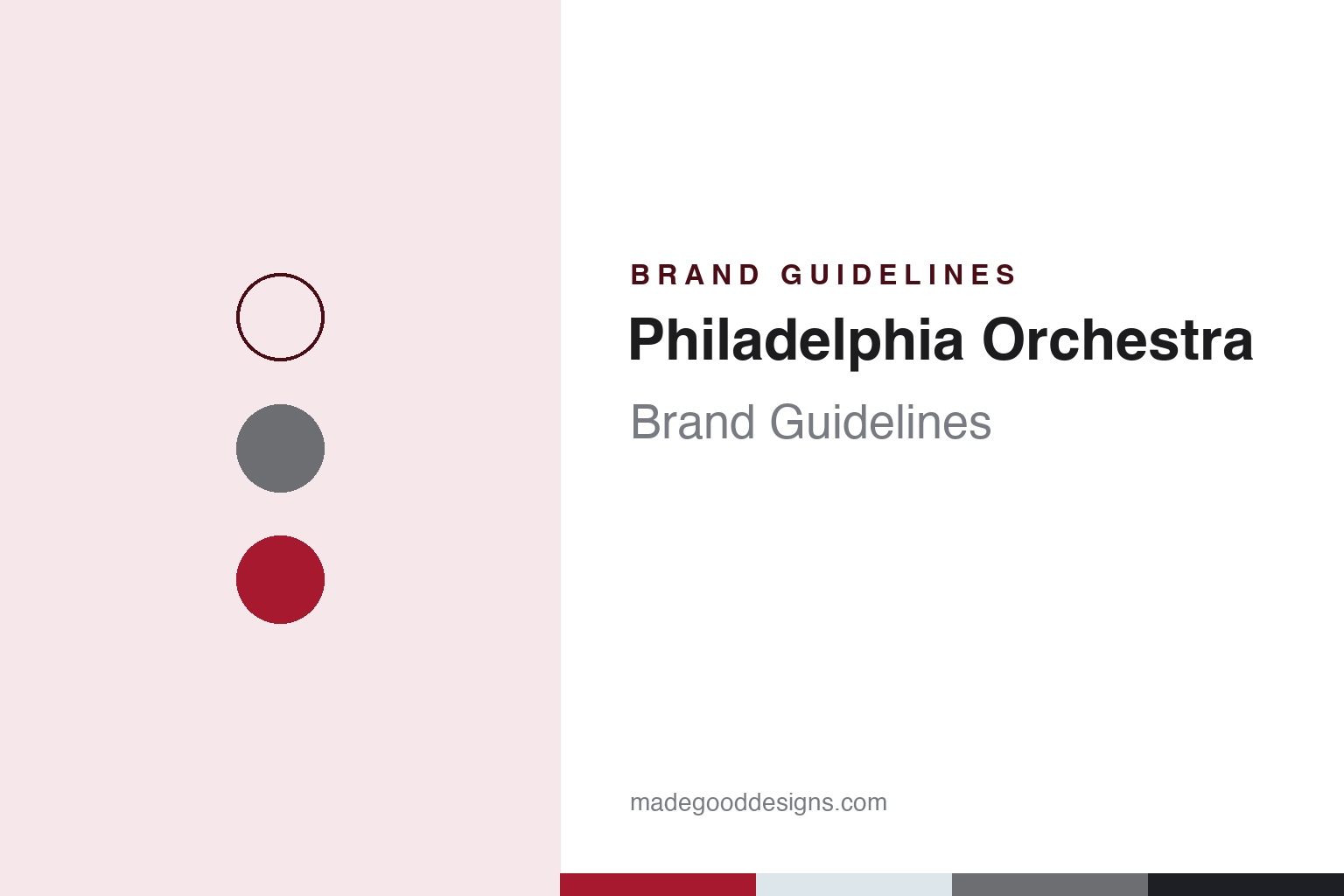
Philadelphia Orchestra Brand Guidelines
A Broad Street orchestra, a brownstone academy, a glass vault and a P drawn like a violin scroll.
Aa
Two constants: a logotype red, Kimmel glass, logotype gray and Broad Street ink palette and a Didone scroll serif register. Abstract homage — not a Philadelphia Orchestra asset or mark; no logo, photograph or orchestra lettering is reproduced.
An orchestra for the Academy
Fritz Scheel, a brownstone opera house and a recording studio in Camden, 1900–1944.
The Philadelphia Orchestra was founded in 1900. English Wikipedia says it was founded by Fritz Scheel, who was also its conductor, and that it grew out of a small group of musicians led by the pianist F. Cresson Schell. Scheel was music director until 1907, followed by Karl Pohlig from 1908 to 1912 and then Leopold Stokowski, who held the post from 1912 to 1938.
For its opening century the orchestra played in a building half a century older than itself. The Academy of Music on Broad Street was built between 1855 and 1857. English Wikipedia says an architectural competition announced in October 1854 was won by the Philadelphia firm of Napoleon LeBrun and Gustavus Runge, who used the German round-arch style known as Rundbogenstil and kept the brick and brownstone exterior plain so that more of the budget could go on the interior, leaving open the possibility of a marble cladding later. The hall opened with an inaugural ball on 26 January 1857 and was designated a National Historic Landmark in 1962. It was the orchestra’s home from 1900 until 2001, and English Wikipedia says the orchestra still owns it. In 1916 Stokowski conducted the American premiere of Mahler’s Eighth Symphony there.
The orchestra’s name travelled early through records. English Wikipedia says its recordings began for the Victor Talking Machine Company in Camden, New Jersey, in 1917, when Stokowski conducted two of Brahms’s Hungarian Dances, and that electrical recordings followed at Victor’s Trinity Church studio in Camden in April 1925, beginning with Saint-Saëns’s Danse macabre. From 1926 Victor recorded the orchestra inside the Academy, and in 1939–40 Stokowski and the orchestra recorded the soundtrack for Walt Disney’s Fantasia in multi-track sound.
The same source records a radio broadcast on NBC in 1929 sponsored by a company and a television broadcast on CBS in 1948. It also notes a close tie with Sergei Rachmaninoff: Stokowski conducted the world premiere of the Rhapsody on a Theme of Paganini with the composer on 7 November 1934, and the Symphonic Dances, his last work, dedicated to the orchestra, were premiered by Eugene Ormandy and the Philadelphians on 3 January 1941. From 1935 to 1976 the orchestra also played summer concerts in Fairmount Park as the Robin Hood Dell Orchestra.
Colour
Ormandy, a move to a glass vault and a hall renamed for a Philadelphia singer.
Eugene Ormandy joined in 1936, shared the post with Stokowski until 1938 and was music director until 1980. English Wikipedia says that after the wartime recording ban the orchestra moved to Columbia Records in 1944 and stayed for 23 years before returning to RCA Victor in 1968, and that Ormandy took the orchestra to the People’s Republic of China in 1973, playing in Beijing and Shanghai. Riccardo Muti followed from 1980 to 1992, Wolfgang Sawallisch from 1993 to 2003 and Christoph Eschenbach from 2003 to 2008; Yannick Nézet-Séguin has been music director since 2012, with the title changed to music and artistic director in February 2023.
The move out of the Academy was decades in the making. English Wikipedia’s article on the Kimmel Center for the Performing Arts says the orchestra approved a plan for a new concert hall in 1986, that the project was merged with a wider venue as the Regional Performing Arts Center in 1996, and that construction began in 1998. The architect was Rafael Viñoly, with Artec Consultants as acousticians, and a vaulted glass ceiling encloses the whole structure as a public lobby. The centre was named for the philanthropist Sidney Kimmel in 2000. The orchestra gave its premiere concert in the new hall on 15 December 2001, and the centre officially opened, still unfinished, on 16 December.
The orchestra filed for Chapter 11 reorganisation on 16 April 2011 and emerged on 30 July 2012, English Wikipedia says.
The organisation around the orchestra has since grown. The Associated Press reported on 28 February 2024 that the Philadelphia Orchestra and the Kimmel Center had united in 2021. The Philadelphia Inquirer reported on 10 January 2024 that the umbrella organisation, which covers the orchestra, the Kimmel Center, the Academy of Music and the Miller Theater, had adopted the presenting name Ensemble Arts Philly. The paper said the venue names would stay the same, tickets would read “Ensemble Arts Philly presents…”, the website kimmelculturalcampus.org would become ensembleartsphilly.org, and the parent company’s legal name would remain The Philadelphia Orchestra and Kimmel Center, Inc. Crystal Brewe, the chief marketing and audience experience officer, told the paper that a year of research had found the old destination model had become a “stacking of brands”. 6abc reported the announcement the same day.
The hall itself changed name the same year. The AP said the orchestra’s auditorium had been known as Verizon Hall from 1999 through 2023 and would be renamed Marian Anderson Hall, after the contralto born in Philadelphia who in 1955 sang at New York’s Metropolitan Opera; the renaming was announced a day after the anniversary of her birth, and the AP said the hall would reopen with a concert on 8 June 2024 conducted by Nézet-Séguin, with Audra McDonald, Angel Blue and Marcus Roberts. The AP added that a statue of Anderson was planned near the hall.
Typography
A Bodoni P, a red and gray logotype and close-ups of strings.
An orchestra’s identity has to cover far more than a name on a poster. The season brochure is often the central object of the year: it sets the photography, the type and the colour that later carry through to concert programmes, tickets, emails and the website. Many orchestras also live inside a building they do not own, so their mark sits beside the hall’s own identity on banners, signage and listings, and the two need to stay distinct without competing. Where an orchestra has a summer festival, a lighter concert series or a choir, each strand usually takes its own colour or sign within one family, so that audiences can tell them apart while still seeing the parent name.
Recording and broadcasting add further layers. An in-house record label needs a cover system that can hold a composer, a work, a conductor and a soloist on a small square that is read mostly on a screen, while radio and streaming partners place the orchestra’s name inside their own frames and idents. Education and community programmes for schools, families and young players often borrow the core typeface and adjust it to feel more open, and tour posters must work in other languages and on other cities’ walls. A practical identity for an orchestra is often a toolkit rather than a single logo: a wordmark, a short palette, one or two typefaces and a few graphic devices that can be rearranged for each of these uses.
Aa
Didone scroll serif — after the Bodoni letterforms of the orchestra’s logotype. (Specimen set in Bodoni Moda, a serif STAND-IN; NOT the Philadelphia Orchestra logo or any orchestra lettering.)
Philadelphia Orchestra
From a fermata arc to a single redrawn letter.
The orchestra’s mark is a letter. Pentagram says its partner Paula Scher designed a new identity for the orchestra timed to the arrival of Charles Dutoit as chief conductor and artistic adviser, a post English Wikipedia dates from 2008. The studio says the previous logo organised the long name under an arc that resembled the musical notation of a fermata and also alluded to the vaulted ceiling of the Kimmel Center.
In its place Pentagram drew a Bodoni P redrawn to match the scroll of a string instrument, with the bowl of the letter ending in a ball terminal. The studio says the P is paired with a red and gray logotype set in Bodoni Book, scaled to fit the length of the name, and that the P can be used on its own where a small size would make the full logotype illegible. In programmes and advertising, Pentagram says, the identity is accompanied by close-up photography of string instruments, and it also designed environmental graphics for the orchestra’s home at the Kimmel Center.
For a design guide, the Philadelphia Orchestra shows an identity carried by one letter and two buildings: a brownstone Academy of Music it still owns, a Viñoly glass vault on Broad Street, a hall renamed for Marian Anderson in 2024, and a presenting name, Ensemble Arts Philly, that sits above the orchestra without replacing it. Compare the Carnegie Hall and New York Philharmonic guides. For this guide we use logotype red, Kimmel glass, logotype gray and Broad Street ink with a serif, an unofficial interpretation; no product or logo is reproduced.
Explore & save
Keep Philadelphia Orchestra’s identity on hand — save it to a board in the Made Good inspiration library.
Philadelphia Orchestra identity set
Pin the Philadelphia Orchestra logotype red, Kimmel glass, logotype gray and Broad Street ink palette and the Didone scroll serif register to your own board.