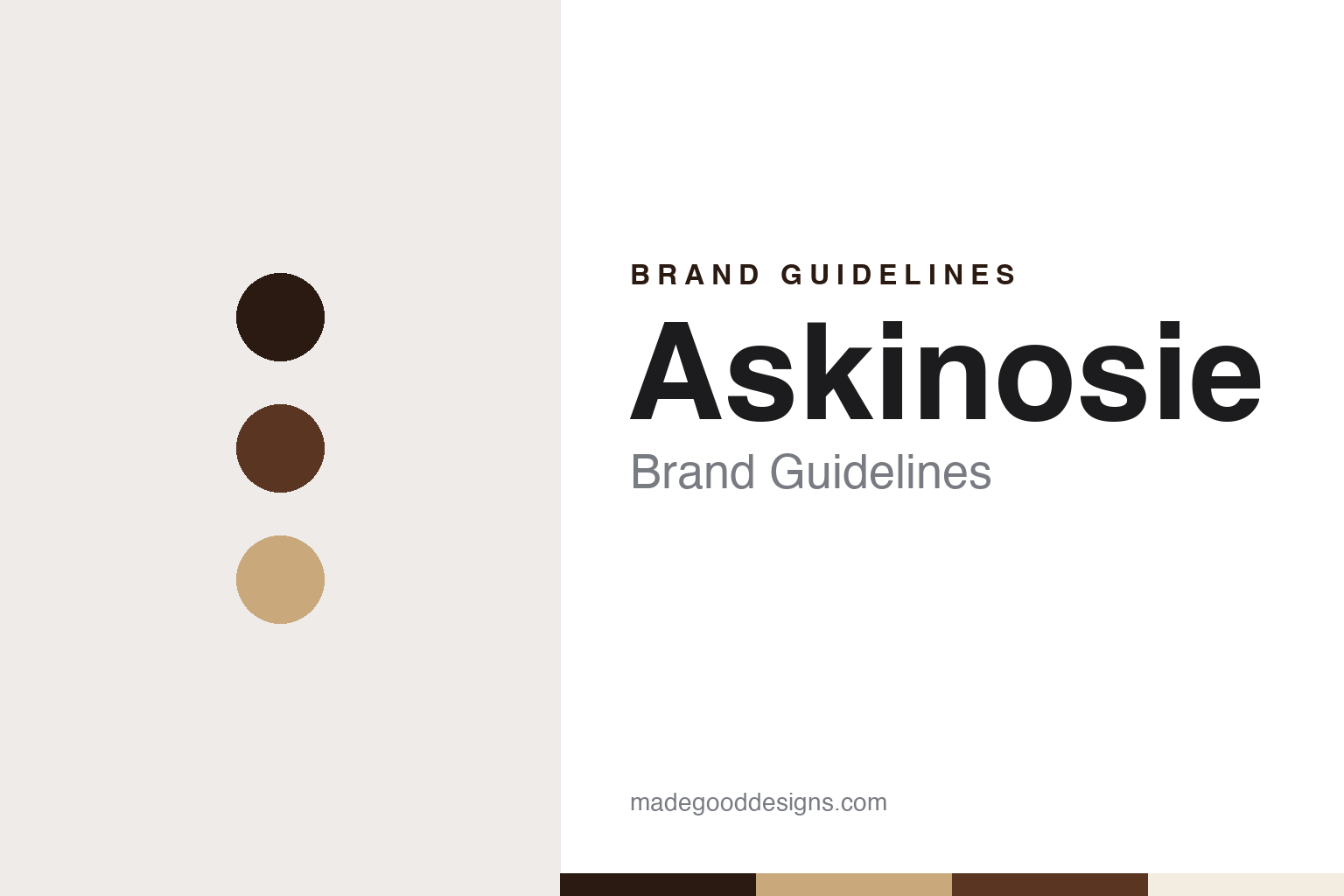
Askinosie Brand Guidelines
The former lawyer’s bean-to-bar maker in Springfield, Missouri.
Aa
Two constants: an Askinosie cocoa, kraft and unbleached-paper palette and a workshop slab serif register. Abstract homage — not an Askinosie product or mark; no bar, bag, logo or photograph is reproduced.
From the courtroom
A criminal defence lawyer turns chocolate maker.
Askinosie Chocolate is a bean-to-bar chocolate maker in Springfield, Missouri, and the name on its bars is its founder’s. Shawn Askinosie spent about two decades as a criminal defense lawyer before he turned to chocolate. A 2013 post on the blog of The Great Game of Business, the open-book management programme associated with the Springfield businessman Jack Stack, says he “ended a 20-year career as a criminal defense attorney” and established the company in 2005; English Wikipedia, citing a 2008 Kansas City Star profile, says he sold his first chocolate bar in 2007. We give both dates.
The beans came before the bars. The company says its first origin was San José del Tambo, a village in the foothills of the Andes in Ecuador, which Shawn Askinosie first visited in 2006 and has returned to every year since; it names the farmer Vitaliano Sarabia as the figure most associated with that bar. It says he first went to Davao, in the Philippines, in 2008, looking for a new source of beans during what it calls a worldwide chocolate shortage, and began working there with a farmer named Peter Cruz. In 2010 he made his first visit to Tanzania, where the company says it worked with a woman-led farmer group in Tenende until early 2014 and now buys from a group in Mababu, in the Kyela district, about ten miles away.
Its website now lists four origins: Davao, Mababu, San José del Tambo and Zamora, in Ecuador’s Amazon region, which the company calls its first new origin since 2010 and its second bar made with a female-led farmer group.
Askinosie is still run by the family that started it. Its website names Shawn Askinosie as founder and chief executive and his daughter, Lawren Askinosie, as chief marketing officer, and says her work focuses on women cocoa farmers and the girls in their communities. The sources we checked record no sale of the business or outside parent company; the trading entity named on its website is Askinosie Chocolate, LLC.
Colour
Direct trade and open books.
Askinosie’s best-known idea is about money rather than flavour. English Wikipedia says direct trade, profit sharing, prices above fair-trade levels and open accounting have been part of the business since it began, and links them to A Stake in the Outcome, Jack Stack’s 2002 book about building a culture of ownership in a company. Wikipedia’s article on direct trade names Askinosie, with the Massachusetts maker Taza, among the “original direct traders” in chocolate that have answered criticism of the term with greater transparency; Askinosie’s website carries a transparency report.
The company describes the model in detail. It says it pays farmers above the Fair Trade market price when it buys their beans, then shares profits with them after the chocolate made from those beans has been sold. It says it shows the farmers its financial statements “in their language” and explains how the profit share is calculated, which it calls its Open Book Management policy, and that Shawn Askinosie visits each farmer group at least once a year to taste beans, discuss fermentation and compare harvests. The Great Game of Business blog reported in 2013 that the programme borrowed the name of Stack’s book, that it then covered farmers in Ecuador, the Philippines, Honduras and Tanzania, and that Askinosie handed over the shares in cash in person, quoting him: “It’s not a life-changing amount of money like winning the lottery … but it is significant and appreciated.”
The chocolate is made in Springfield. The company says it is made “by hand in small batches at a micro-factory in Southwest Missouri,” and its own step-by-step account of production says it presses its own cocoa butter from the same beans as the chocolate, conches in a hundred-year-old Italian conche, and buys in only one ingredient for its dark bars: cane sugar.
Its range runs from single-origin dark bars to dark milk and white chocolate, cocoa powder, nibs and a line of collaboration bars it calls CollaBARation, made with other food producers. The company says its 62% dark milk bar with fleur de sel, made with Davao beans, has twice won a Good Food Award.
Typography
Couverture and bean-to-bar.
The seven brands in this group all make chocolate, and they come from four countries: Valrhona, Michel Cluizel and Pralus from France, Amedei from Italy, Felchlin from Switzerland, and Guittard and Askinosie from the United States. They sit at different points in the chocolate trade, from names known mainly to pastry kitchens to small makers known mainly by the bar on the shelf.
At one end are couverture houses, whose chocolate is sold in blocks, pistoles and callets to chefs, chocolatiers and bakers as much as to shoppers, and whose brand often reaches the public second-hand, through a restaurant dessert or a patisserie window. At the other end are bean-to-bar makers, who buy cocoa beans, roast and grind them in their own workshop and sell finished bars, and whose identity rests on the farm, the origin and the maker’s name. Many firms sit somewhere between the two, selling to professionals and to the public at once.
Each guide separates what independent sources record from what the company says about itself — who founded it, who owns it now, where its beans come from and where its chocolate is made — and marks plainly what rests only on the company’s own word.
Aa
A workshop slab serif — paper bags, string and a farmer’s photograph. (Specimen set in Zilla Slab, a serif STAND-IN; NOT the Askinosie logo.)
Askinosie
A farmer on the front of the bag.
Askinosie’s packaging carries its sourcing story. In the company’s own account of how a bar is made, each bar is placed by hand in a compostable inner wrapper, heat-sealed, and then put with a map into an unbleached natural waxed paper bag with a picture of one of the farmers it buys from on the front. It says the string tied around the bag is reused from the bags in which its beans are shipped from Ecuador. Its page for the Zamora bar names the lead farmer, Monica Guaman, as the person pictured on that bar.
The company’s story extends beyond the bars. Through Chocolate University, which it describes as a public charity serving students in Southwest Missouri and at its cocoa origins, it says it takes local high-school students to Tanzania to work alongside the Mababu farmers and learn about small business; the company says the fees from its factory tours go to the programme. In 2017 Shawn Askinosie published Meaningful Work with TarcherPerigee, a book the company describes as written with Lawren Askinosie, about how business leaders can find their calling. The website also calls Askinosie one of Forbes’ 25 best small companies in America, which we give as its own description.
For a design guide, Askinosie shows how a small maker can make its supply chain the identity: plain paper, string and a farmer’s photograph say more about the brand than any wordmark. Compare Taza Chocolate, another American maker built around direct trade, and Dandelion Chocolate, a San Francisco bean-to-bar maker. For this guide we use cocoa brown, kraft and unbleached paper with a slab serif, an unofficial interpretation; no product or logo is reproduced.
Explore & save
Keep Askinosie’s identity on hand — save it to a board in the Made Good inspiration library.
Askinosie identity set
Pin the Askinosie cocoa, kraft and unbleached-paper palette and the workshop slab serif register to your own board.