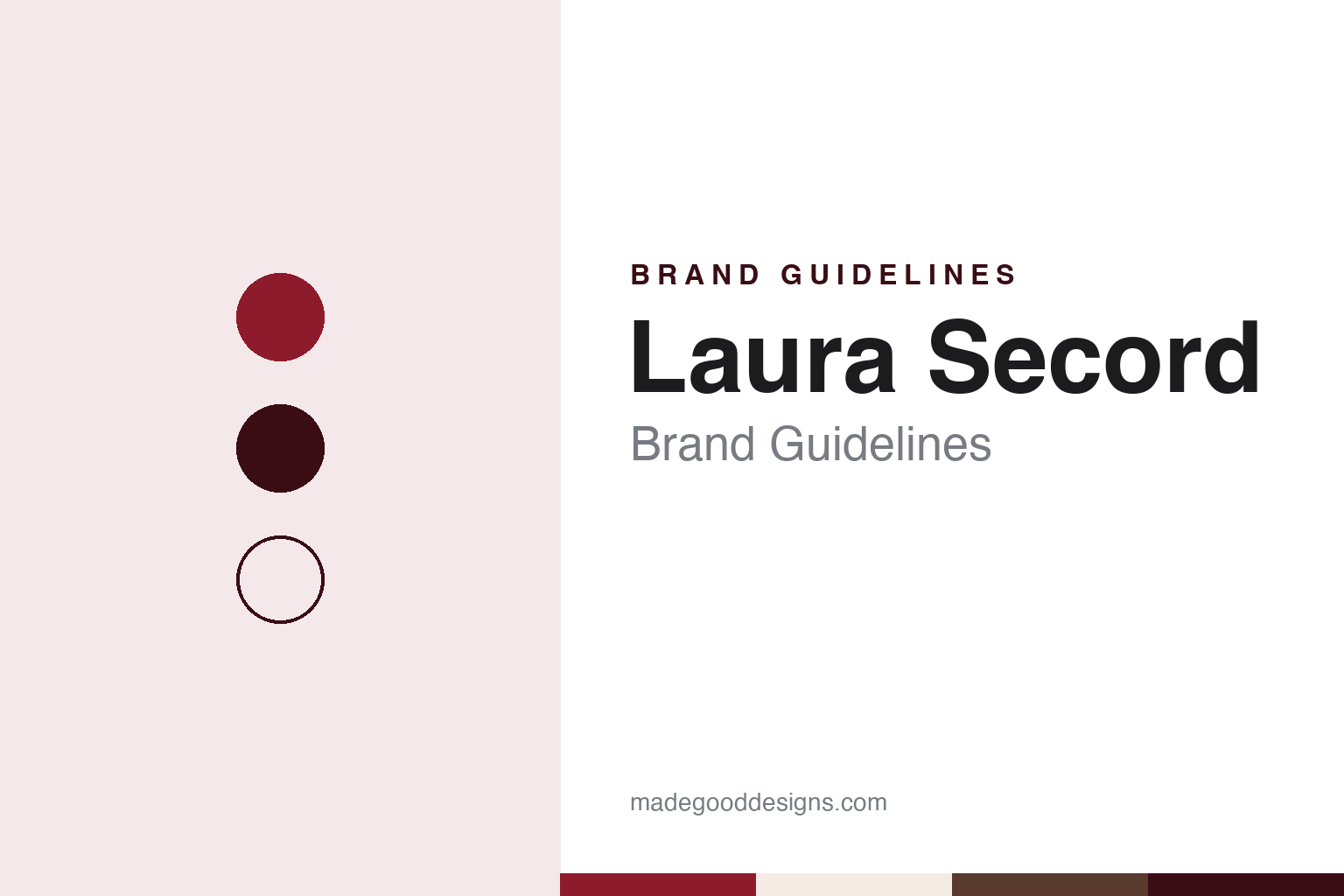
Laura Secord Brand Guidelines
The Toronto chocolate shop named for a War of 1812 heroine.
Aa
Two constants: a Laura Secord red, cocoa and cream palette and a heritage serif register. Abstract homage — not a Laura Secord product or mark; no box, logo or portrait is reproduced.
Yonge Street, 1913
A Toronto candy shop named for a heroine.
Laura Secord began as one shop on Yonge Street in Toronto in 1913. Its founder, Frank P. O’Connor, named it after Laura Secord, who in 1813 made a journey to warn the British officer James FitzGibbon of a planned American attack, a warning English Wikipedia credits with contributing to the British victory at the Battle of Beaver Dams. Canadian Business, in a 2011 profile, put it more simply: a chocolate retailer “named for the War of 1812 heroine who warned British forces of an American attack.”
The company’s own history page says O’Connor sold hand-made chocolates and turned the flat above the shop into a kitchen where he prepared his own products. It says success took the business across Ontario and Quebec, that an office opened in Winnipeg in the 1930s, when pharmacies also began to carry Laura Secord products, and that by 1950 there were as many as 96 shops in the two provinces. We give those figures as the company’s.
The name has always been the brand’s strongest asset. It ties a box of chocolates to a figure from Canadian school history, and the company still describes its mission in the language of tradition, saying it is “inspired by the courage and determination of Canadian heroine Laura Secord.”
Colour
Brewer, confectioner, Nestlé, Chicago.
From the late 1960s the company changed hands repeatedly. In 1969 the O’Connor family sold it to the brewer John Labatt Limited, English Wikipedia says, citing Canadian Business. In 1983 Labatt sold it to Rowntree Mackintosh of York, England, and when Rowntree was absorbed by Nestlé in 1988, Laura Secord went with it.
Nestlé’s Canadian unit then let it go. The trade magazine Candy Industry reported in November 1998 that Nestlé Canada would sell the business, and CBC News later dated the sale to Archibald Candy Corporation of Chicago to 1999; Canadian Business also gives 1999. Archibald was the parent of the Midwestern chain Fannie May and of Fanny Farmer.
The arrangement did not last. In April 2003, CBC News reported that Archibald had hired advisers to explore a sale of Laura Secord so that it could concentrate on Fannie May and Fanny Farmer. At that point, CBC said, Laura Secord ran 174 shops, sold through more than 2,000 other retail outlets in Canada and employed 1,600 people. Archibald itself went bankrupt, English Wikipedia says, citing the Chicago Tribune in 2004.
In 2004 Laura Secord was sold to a group of private investors. English Wikipedia names the Boston firm Gordon Brothers, citing an August 2004 trade report, and the Toronto Sun’s QMI Agency in 2010 described the owners as a group including Gordon Brothers Group and EG Capital Group, with Quebec’s Fonds de solidarité holding a small portion. The company was then based in Mississauga, outside Toronto. Its interim president had acknowledged the age of the brand the previous autumn, the report said, quoting him: “Our market studies have shown that it is a brand that still suits my mother, but maybe not me if I am 25 or 30 years old.”
Typography
Chocolate in three countries.
The seven brands in this group all sell chocolate, and they come from three countries: Haigh’s, Darrell Lea and Koko Black from Australia, Whittaker’s from New Zealand, and Laura Secord, Purdys and Rogers’ Chocolates from Canada. They are grouped here because they share a market position more than a style: each is a home-grown name in a country whose chocolate shelves are also stocked by international groups.
They reach shoppers in different ways. Some are known mainly through their own shops, where the window, the counter and the box do much of the work of a brand; others are known mainly through supermarket shelves, where a wrapper has a few seconds to be recognised. Many sit between the two, and the line between a chocolatier, a confectioner and a chocolate maker is not always drawn the same way from one company to the next.
Each guide separates what independent sources record from what the company says about itself — who founded it, who owns it now, where its cocoa comes from and where its chocolate is made — and marks plainly what rests only on the company’s own word.
Aa
A heritage serif — for a brand named after a historical figure. (Specimen set in Playfair Display, a serif STAND-IN; NOT the Laura Secord logo.)
Laura Secord
Back in Canadian hands.
In February 2010 the QMI Agency reported that Laura Secord had been sold to Nutriart, a Quebec City chocolate maker that would take over its 129 stores. Nutriart had been the specialised chocolate-making division of Biscuits Leclerc; the report said it had become fully independent the previous July and was owned by Jean Leclerc, a former Quebec Liberal cabinet minister and former president of the family biscuit company, working with his brother Jacques. The company’s website confirms that Jean and Jacques Leclerc have owned Laura Secord since February 2010.
Canadian Business called the deal a homecoming in April 2011, but also described the brand as widely seen as “your grandmother’s chocolate shop,” quoting a retail consultant, and counted 128 stores. It reported that Laura Secord had bought its base chocolate from the American supplier Blommer Chocolate and would now be supplied from Nutriart’s facility in Quebec City, which could also make some finished products, such as 100-gram bars. Its chief retail officer told the magazine that the stores were also experimenting with coffee, frozen yogurt and soft ice cream, with mixed results. The same article said a mould for a 500-gram Easter bunny, popular in the 1970s and 1980s, had been brought back into use. We could not find a current company statement on where its chocolate is made.
Today the website describes Laura Secord as selling more than 400 products, from dark, milk and white chocolate and chocolate-covered hazelnuts to caramel crunch, fudge and ice cream, and it sells online. Sources differ on its size: the website speaks of “over 70 stores across the country,” while English Wikipedia, citing the same site, put the figure at about 100 outlets as of 2023, with offices in Mississauga and Quebec City. The company calls itself “Canada’s largest and best-known chocolatier”; that is its own description.
For a design guide, Laura Secord shows how a name taken from national history can carry a shop brand through half a century of changing owners. Compare Purdys Chocolatier, the Vancouver chain that stayed with one family, and Rowntree’s, its owner from 1983. For this guide we use a deep red, cocoa and cream with a serif, an unofficial interpretation; no product or logo is reproduced.
Explore & save
Keep Laura Secord’s identity on hand — save it to a board in the Made Good inspiration library.
Laura Secord identity set
Pin the Laura Secord red, cocoa & cream palette and the heritage serif register to your own board.