Swizzels Brand Guidelines
The New Mills family firm behind Love Hearts and Parma Violets.
Aa
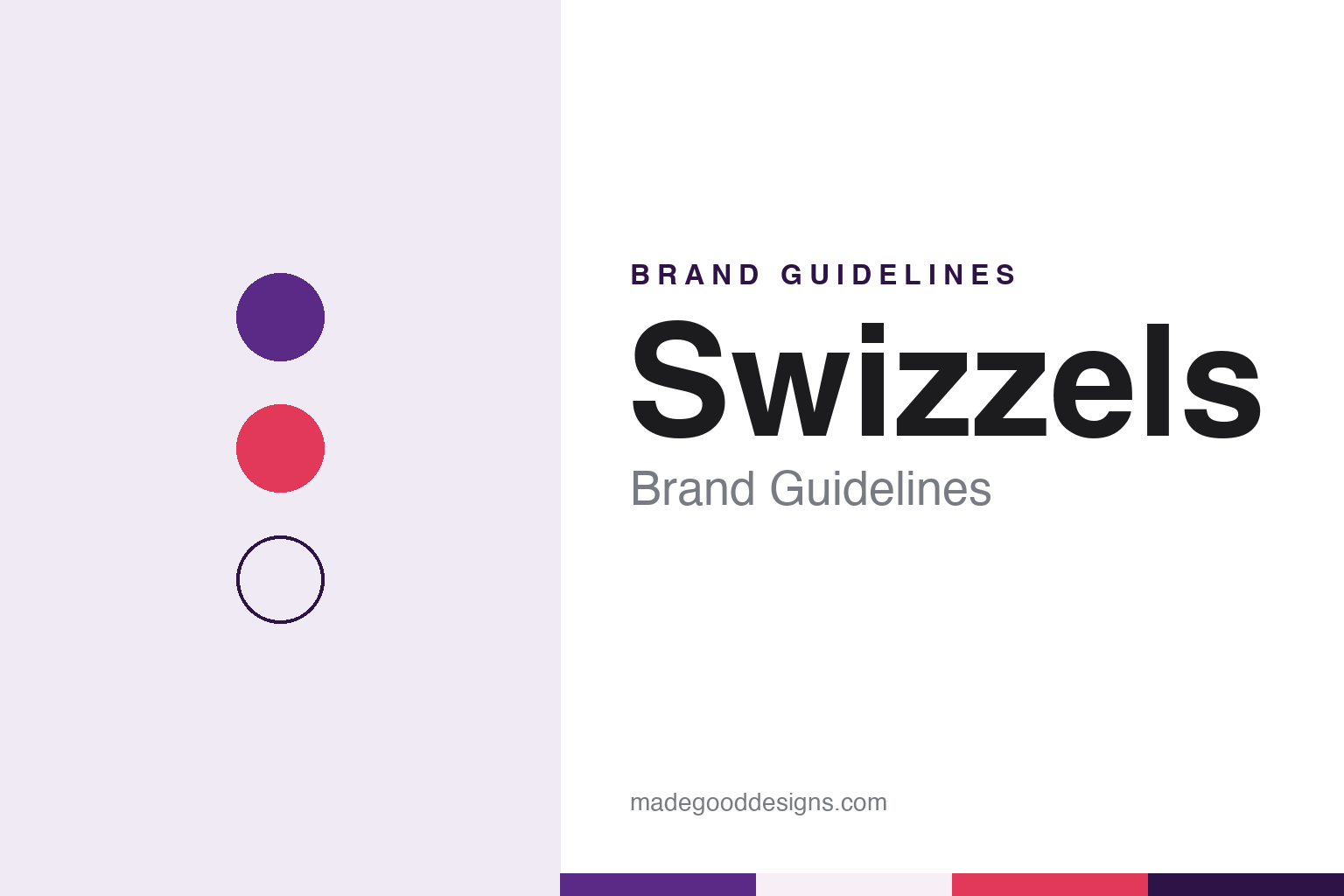
Two constants: a Swizzels violet, red and white palette and a rounded display sans register. Abstract homage — not a Swizzels product or mark; no pack, logo or sweet is reproduced.
Matlow Bros. and David Dee
Jelly sweets, fizzy tablets and a move north.
Swizzels traces its start to 1928, when, the company says, Alfred and Maurice Matlow launched Matlow Bros. Ltd, making jelly sweets in a small factory in London. The Daily Telegraph, in a 2011 profile cited by English Wikipedia, put the brothers’ beginnings earlier, in the 1920s, selling jellied sweets from a market stall in Hackney. In 1933 the Matlows joined forces with another sweet-factory owner, David Dee, sharing factory space in east London. Dee’s business specialised in fizzy sweets made as compressed tablets, and it is this side, Swizzels Ltd, that gave the company its name; the joint business did not formally become Swizzels Matlow Ltd until 1975, the company says.
The early range set the pattern. The company dates Rainbow Drops and Fizzers, which it calls the original compressed fizzy sweet, to the 1930s, along with a puffed-rice caramel bar, Bettabar. Rainbow Drops, it says, were first sold loose and scooped into paper bags.
The Second World War moved the business north. In 1940, the company says, with their premises battered by the Blitz, both businesses relocated to New Mills, in Derbyshire, into a former textile mill where wicks for miners’ lamps had been made. The move was meant to be temporary but became permanent. The company says the mill, rebuilt after a fire in 1883, stands against the backdrop of the Sett Valley, and that during the war the factory also made water-purifying tablets for the government.
Colour
Violets, hearts and a chewy lolly.
The best-known Swizzels sweets arrived after the war. Parma Violets, small lilac discs named after the Parma violet, came out in 1946; the company says they were first marketed as breath fresheners and often sold in pubs. To mark their 70th anniversary in 2016 Swizzels released a Parma Violets cheese, made, English Wikipedia says, by the Cheshire Cheese Company.
Love Hearts followed in 1954. The company says they first appeared as a gift in crackers, reading “I LOVE YOU,” and that some early messages did not survive the 1960s. English Wikipedia describes how they are made by the pressed-tablet method: finely ground sugar is compressed under high pressure and the message is stamped into the face, which is then picked out in red so the words can be read. The messages are set in sans-serif capitals, scaled and sometimes stretched to fit inside the heart outline. Love Hearts have been used for special editions, including packs for the 2011 royal wedding reported by Packaging News, and in 2022 they were temporarily renamed Kind Hearts, with messages such as “Be Kind,” in a partnership with the charity YoungMinds, the Chronicle reported.
Two more favourites followed: New Refreshers, the flat chew with a sherbet centre, in 1955, and the Drumstick chewy lolly in 1957, the company says. Other long-running lines include Double Lollies, which the company calls the first double-flavoured sherbet lolly and dates to 1954, and Double Dip, launched in 1976. The “New” in Refreshers keeps it distinct from Barratt’s older tablet sweet of the same name, a difference set out in a 2001 trade-mark decision by the UK Intellectual Property Office.
Typography
Design and documentation.
The seven brands in this group all make sweets and gummies, and they come from Germany, Sweden, Britain and the United States: Katjes, Trolli, Werther’s Original, Cloetta, Maynards Bassetts, Swizzels and Jelly Belly. Sweet and gummy brands in general sit at many different points in the trade, from family firms that still carry a founder’s surname to names that now belong to much larger confectionery groups, and a single brand can be sold everywhere from a corner shop to a supermarket aisle.
A sweet brand’s identity is usually carried less by a single product than by a pack, a name and the treat it promises, because the company behind the name may have changed hands, moved its factory or grown far beyond the town where it started. That makes the questions behind each name worth asking plainly: who started it, who owns it now, and where its sweets are actually made and packed.
Each guide separates what independent sources record from what the company says about itself — its founding story, its owners over time, where its sweets are made and how its packaging has changed — and marks plainly what rests only on the company’s own word.
Aa
A rounded display sans for a maker of small stamped sweets. (Specimen set in Baloo 2, a sans STAND-IN; NOT the Swizzels logo.)
Swizzels
Still family-run, still in New Mills.
Swizzels has stayed independent. It is a private limited company, Swizzels Matlow Ltd, and the company describes itself as having “strong family-business roots.” Its own timeline lists members of the Matlow and Dee families joining the board over several generations, from Trevor Matlow in 1955, later joint chairman, and Michael and Brian Dee in the 1960s, to Jonathan Dee in 2004 and Jeremy Dee, managing director, in 2008. In 1971, the company says, it received the Queen’s Award to Industry for exports. Its accounts for 2019, filed at Companies House, reported revenue of about £78.6 million and 654 employees, English Wikipedia says, and the Telegraph reported in 2011 that about a fifth of output was exported.
The sweets are still made in New Mills; the factory featured in the BBC Two series Inside the Factory in 2016, the Manchester Evening News reported. In 2012 the company launched Squashies, soft foam sweets based on its classic flavours, which it says were conceived by Jonathan Dee and won a Top Launch award from The Grocer. Demand led to a second factory: the company says it opened an additional site at Middlewich, Cheshire, in 2022 to make Squashies. The company also says it removed artificial colours from all its product lines in 2008 and launched its first television advertisement, featuring a character called Mr Swizzels, in 2020. Love Hearts marked their 70th year in 2024, and Refreshers their 70th in 2025.
For a design guide, Swizzels shows how a family maker keeps tiny, cheap sweets recognisable through stamped type, a few strong colours and long-lived names. Compare PEZ, another maker of compressed sweets, and Maynards Bassetts, the Mondelez sweets brand. For this guide we use a violet, a love-heart red and a tablet white with a sans, an unofficial interpretation; no product or logo is reproduced.
Explore & save
Keep Swizzels’s identity on hand — save it to a board in the Made Good inspiration library.
Swizzels identity set
Pin the Swizzels violet, red and white palette and the rounded display sans register to your own board.