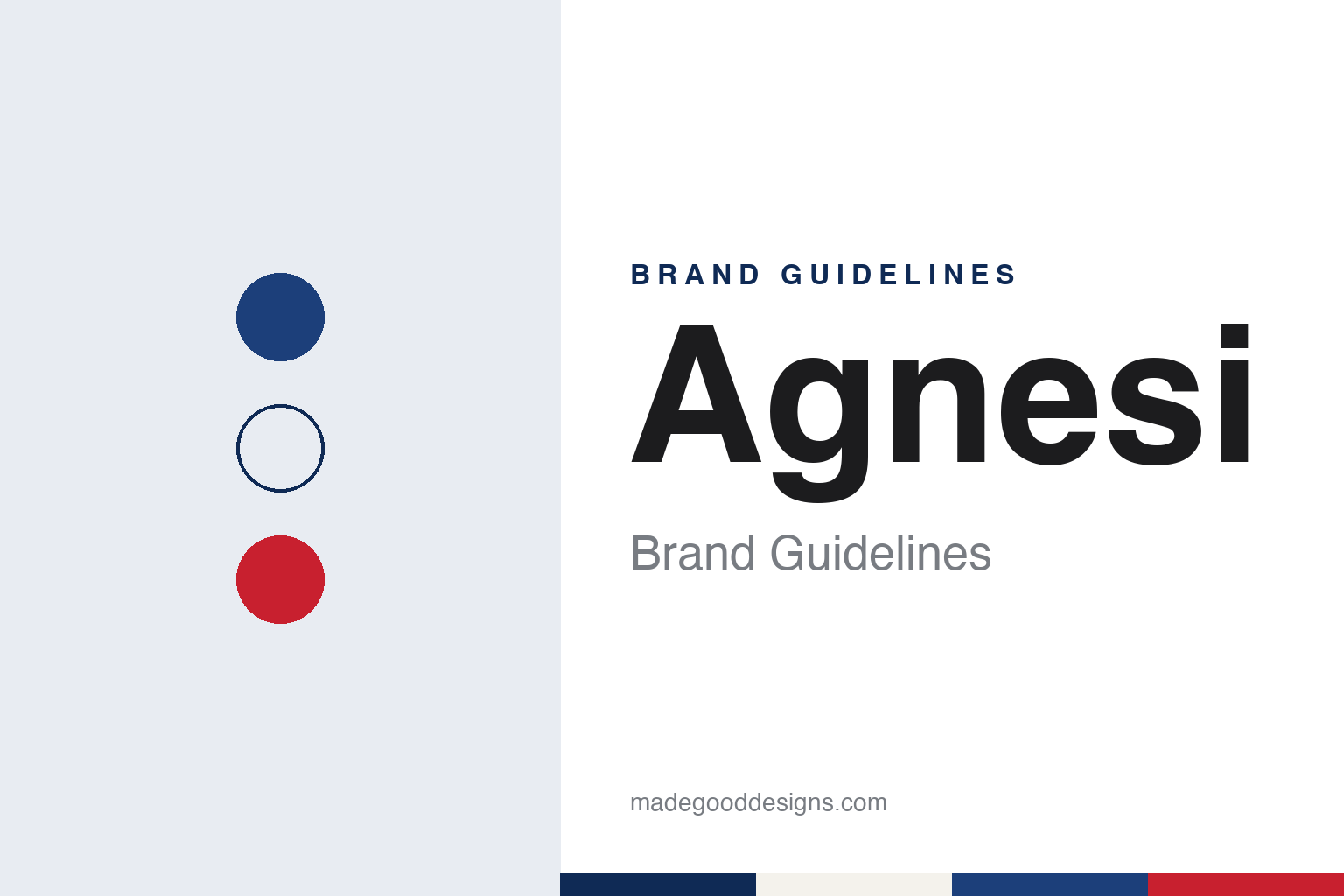
Agnesi Brand Guidelines
The Ligurian pasta brand of the sailing ship.
Aa
Two constants: a sea blue, sail white and badge red palette and a modernist sans register. Abstract homage — not an Agnesi product or mark; no pack, logo or sailing ship is reproduced.
A mill and a fleet
A Ligurian mill, a wheat fleet and a sailing-ship emblem.
Agnesi began in 1824, when Paolo Battista Agnesi (1790–1863) bought a mill at Pontedassio, in the hills behind the Ligurian port of Oneglia, and began making pasta there directly, Italian and English Wikipedia say. The company tells the same story on its website: Agnesi bought a mill “beyond the bridge,” the first step in what it calls a 200-year journey. The Italian trade site Alimentando called it one of Italy’s oldest pasta brands in 2015.
The family looked abroad for its wheat. Italian Wikipedia says Paolo Battista’s son Giuseppe learned milling techniques in France, and that the family fitted out its own fleet of sailing ships to bring in Taganrog durum wheat, then regarded as the finest hard wheat in the world, which the company says came from Ukraine. English Wikipedia adds that a further mill was set up near the port of Oneglia and that the business became Paolo Agnesi e Figli. The sailing ship became the company’s emblem, and it still is. Archive drawings on the company’s website show a brig named after Paolo Battista Agnesi in 1877, and Giuseppe Agnesi directing the unloading of its wheat at Oneglia. The company says that in the 1980s it chose Kronos durum wheat from Arizona, and that today its wheat is 100% Italian.
Disaster reshaped the business. The 1887 earthquake destroyed the Pontedassio mill and damaged the plant at Oneglia, Italian Wikipedia says. In 1888 Giacomo Agnesi, Paolo Battista’s eldest son, took charge and concentrated production on the coast, building a three-storey mill with a pasta factory beside it at Oneglia, linked to the railway by its own connection. His son Vincenzo Agnesi automated the plant: by the end of the First World War, Italian Wikipedia says, spaghetti were made there without manual intervention, and in 1917 the firm became a joint-stock company. Oneglia is now part of the city of Imperia.
Colour
Sealed packs, posters, a silent advert and a museum.
Agnesi’s brand history is unusually well recorded. Italian Wikipedia says the firm registered its first trademark in September 1896, and that in the 1920s it introduced a sealed blue pack carrying the sailing ship, and counts it among the earliest marketing in the pasta trade. The company dates its sealed packs earlier, to the end of the 19th century, and calls them a new idea that changed the way pasta was sold.
After the Second World War Agnesi turned to illustrators and advertising agencies. The company says posters by Peynet and Testa in the 1950s opened “new roads” in its advertising and produced a poster campaign still remembered today; Italian Wikipedia credits the Testa agency with posters and television work, including Carosello spots with Herbert Pagani. In 1985 a television advertisement, “Silenzio, parla Agnesi” (“Silence, Agnesi speaks”), made by the Turin agency Canard, won a Gold Lion at the Cannes advertising festival, Italian Wikipedia says; English Wikipedia credits that Cannes award to the art director Lorenzo Marini, who worked with Canard. The company says the idea came from a meeting that fell silent for a daily ritual at the plant: tasting freshly made pasta.
The brand also has a museum lineage. In 1958 Vincenzo Agnesi and Massimo Alberini opened the Museo Storico degli Spaghetti in the family house at Pontedassio, which Italian Wikipedia describes as the first museum in the world devoted to the history of pasta. After the family left the company, his heirs Eva and Riccardo Agnesi set up the Fondazione Vincenzo Agnesi in 1991, and in 1993 the foundation opened the Museo Nazionale delle Paste Alimentari in Rome, which closed in 2007. Vincenzo Agnesi also proposed, in the 1960s, a way of cooking spaghetti with the heat turned off, the company says; it has revived the idea as the “Metodo Agnesi.”
Typography
Design and documentation.
The seven brands in this group all make pasta, and all of them come from Italy: Granoro, Pastificio dei Campi, Di Martino, Setaro, Benedetto Cavalieri, Agnesi and Giovanni Rana. Italian pasta makers in general sit at many different points in the trade, from small family workshops that still carry a founder’s surname to names that now belong to much larger food groups, and the same word, pasta, covers both dried shapes made from durum wheat semolina and fresh or filled pasta sold from the chiller.
A pasta brand’s identity is usually carried less by a single shape than by a pack, a name and the place it promises, because the company behind the name may have changed hands, moved its factory or grown far beyond the town where it started. That makes the questions behind each name worth asking plainly: who started it, who owns it now, and where its pasta is actually made and packed.
Each guide separates what independent sources record from what the company says about itself — its founding story, its owners over time, where its pasta is made and how its packaging has changed — and marks plainly what rests only on the company’s own word.
Aa
A modernist sans for a brand redrawn from its 1950s packs. (Specimen set in Jost, a sans STAND-IN; NOT the Agnesi logo.)
Agnesi
From the family to Danone, Paribas and Colussi, and from Imperia to Fossano.
The family’s control ended in stages. Vincenzo Agnesi led the company until the 1970s, when it ran into operating difficulties, Italian Wikipedia says; in 1980 it became Agnesi SpA. Danone took its first shares in 1987 and full control from the family in 1995. In 1997 Danone sold Agnesi to the bank Paribas, and in 1999 the Italian food group Colussi completed the purchase together with Banca Commerciale Italiana and Banca Euromobiliare. The Italian news agency ANSA, reporting in 2016, described the 1999 deal as a purchase from Danone; the company’s own history says that in 1999 Colussi bought Agnesi from a foreign owner and made it Italian again.
Under Colussi the brand moved inland. On 13 December 2016 the historic plant at Imperia packed its last pasta, a pack of Fusilli No. 102, and production was concentrated at Fossano, in Piedmont, ANSA reported. The group said it had invested nearly €10 million at Fossano and that the Imperia site could not be updated to meet the demands of the market; ANSA also reported that exports made up 65% of Agnesi’s revenue. The company says its wheat now comes from a controlled supply chain of 193 farms in central and southern Italy, mainly in Umbria and Puglia, and that its pasta is bronze-drawn. Its shapes still carry numbers, such as Penne Rigate No. 19 and Fusilli No. 102.
The identity has been refreshed under Colussi. In 2015 the group relaunched the brand with a pack chosen through a competition among agencies and drawn by an English designer, inspired by Agnesi’s 1950s packs, with a stylised ship set in a red badge carrying the date 1824, ADC Group reported; the relaunch also revived “Silenzio, parla Agnesi.” Since 2020, the company says, its packs sold in Italy have contained no plastic. It says the ship, “always part of our logo,” has now become the logo’s essence, and that the blue and white of its current look take the colours of the sea and of sails, in homage to Liguria.
For a design guide, Agnesi shows how a sailing ship from a family’s own wheat fleet can stay at the centre of a pasta brand for generations and through four owners. Compare Colussi, its owner since 1999, and De Cecco, another milling family with a long-lived pasta trademark. For this guide we use sea blue, sail white and a badge red with a modernist sans, an unofficial interpretation; no product or logo is reproduced.
Explore & save
Keep Agnesi’s identity on hand — save it to a board in the Made Good inspiration library.
Agnesi identity set
Pin the Agnesi sea blue, sail white and badge red palette and the modernist sans register to your own board.