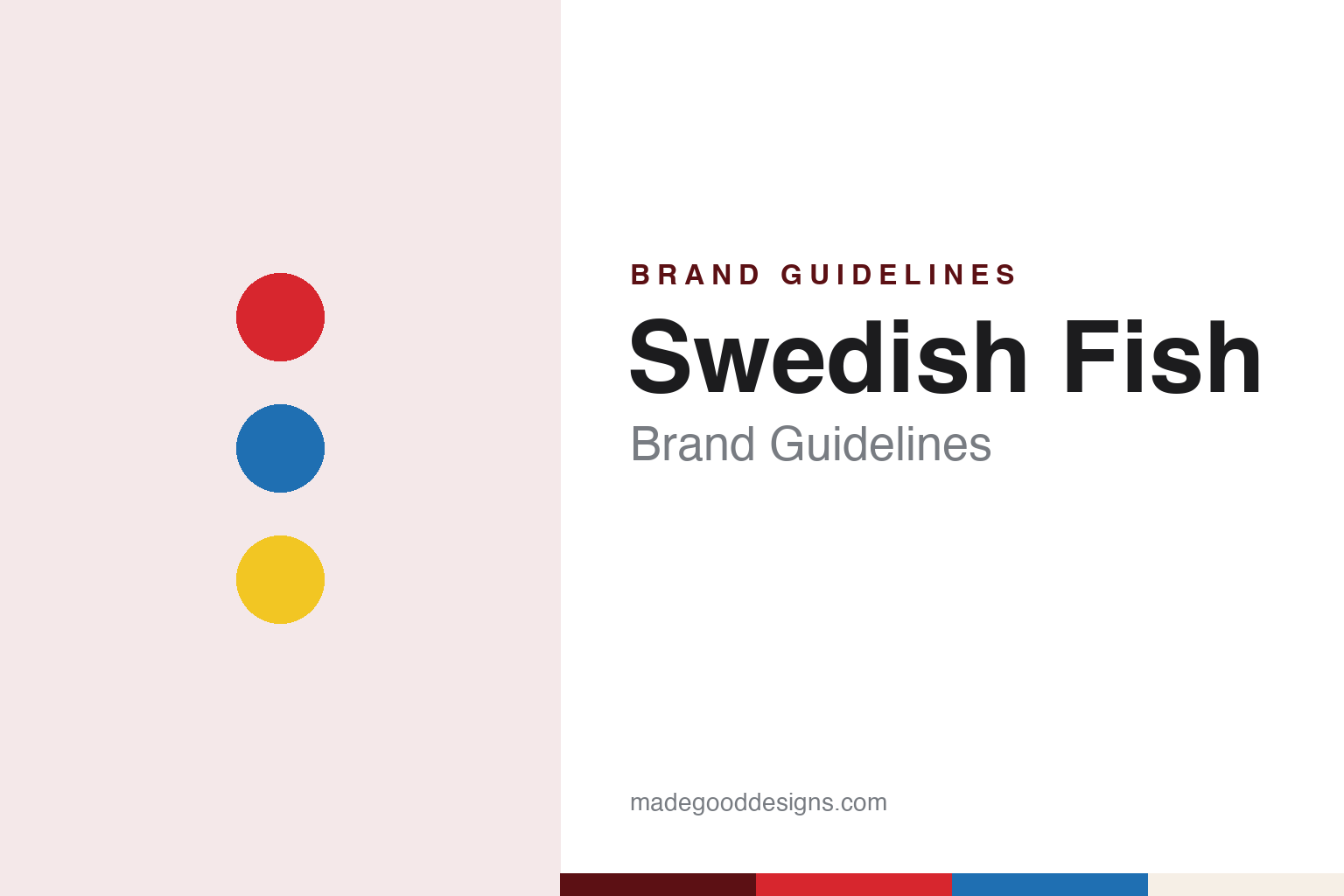
Swedish Fish Brand Guidelines
A Malmö gummy made for America, now made in Canada.
Aa
Two constants: a fish red, Baltic blue and pastel yellow palette and a bold friendly sans register. Abstract homage — not a Swedish Fish product or mark; no pack, logo or sweet is reproduced.
Malmö Lakrits Compani
A Malmö liquorice firm and a sweet for American shelves.
Swedish Fish are Swedish in origin but were made for America. Their creator was Malaco, a confectioner from Malmö, in southern Sweden. Cloetta, which owns Malaco today, says the company was founded in 1934 under the name Malmö Lakrits Compani — Malmö Liquorice Company — and the brand name is built from the first letters of those words. Swedish Wikipedia says it was set up by a Danish company, A/S Lagerman junior, that production began on Lundavägen in Malmö, and that it moved in 1948 into a new factory in the Sofielund industrial district.
The fish came later. Mental Floss reported in 2017 that Swedish Fish first reached American shores in the late 1950s, as an import from Malaco, and that they were developed specifically for the US and Canadian markets; English Wikipedia gives the year as 1957. They became a fixture of American candy counters in the 1960s and 1970s, Mental Floss said. The magazine also classed them as starch jellies — gummies made without gelatine.
The North American route ran through Jaret International, the company also linked to Sour Patch Kids. Mondelēz International’s history of its Hamilton, Ontario, plant says that in 1964 Jaret and Malaco imported confections from Sweden for distribution in North America, and that the same Hamilton site was taken over in 1978 by a company it calls M&A.
Colour
One fish, two owners.
Who owns Swedish Fish depends on which side of the Atlantic you stand. In North America the brand belongs to Mondelēz International. Mondelēz’s timeline for the Hamilton plant traces the line: Allan Candy bought M&A in 1991; Cadbury Schweppes bought Allan Candy in 1995; Kraft Foods bought Cadbury in 2010; and in 2012 the plant joined Mondelēz, the snacks company split off from Kraft that year. Mental Floss described Swedish Fish as owned and distributed in the United States by Cadbury Adams, Cadbury’s American confectionery arm; in Canada, English Wikipedia says, the fish are sold under Mondelēz’s Maynards Bassetts brand.
The fish are made in Canada. Mondelēz says its Hamilton plant makes Swedish Fish and Swedish Berries alongside Sour Patch Kids and Maynards Wine Gums, and calls it the largest-volume producer of starch-moulded products in its network. When Mondelēz Canada finished a C$40 million expansion there in October 2019, Just Food reported a new Maynards line able to make 11 million pieces a day for customers in the United States and Canada.
In Sweden the story belongs to Malaco, which has had a long run of owners of its own. Swedish Wikipedia says the chocolate maker Marabou bought Malaco in 1988, that it became part of Freia Marabou in 1990, and that Kraft General Foods bought that parent in 1993. Cloetta’s history says the Dutch group CSM bought Malaco in 1997 and the confectioner Leaf in 1999, and that Cloetta and Leaf merged in 2012, which brought Malaco into Cloetta. In between, Cloetta’s history says, the private-equity firms CVC and Nordic Capital bought CSM’s confectionery division in 2005 and renamed it Leaf. Swedish Wikipedia says Malaco opened a second factory at Slagelse, in Denmark, in 1968, which closed in 2011, and that its Malmö factory closed in April 2001, leaving only warehousing in the city.
Typography
Design and documentation.
The seven brands in this group all make sugar candy, and all of them are sold as American brands: Sour Patch Kids, Swedish Fish, Twizzlers, Red Vines, Airheads, Nerds and Warheads. American candy brands in general sit at many different points in the trade, from names still tied to a single family firm to names that now belong to much larger food groups, and a single brand can be sold everywhere from a gas-station counter to a cinema concession stand.
A candy brand’s identity is usually carried less by a single sweet than by a pack, a name, a colour and sometimes a character, because the company behind the name may have changed hands, moved its factory or grown far beyond the town where it started. That makes the questions behind each name worth asking plainly: who started it, who owns it now, and where its candy is actually made and packed.
Each guide separates what independent sources record from what the company says about itself — its founding story, its owners over time, where its candy is made and how its packaging has changed — and marks plainly what rests only on the company’s own word.
Aa
A bold, friendly sans for a single, simple shape. (Specimen set in Rubik, a sans STAND-IN; NOT the Swedish Fish logo.)
Swedish Fish
Pastellfiskar at home, Swedish Fish abroad.
The name itself tells the origin story. Mental Floss wrote that the fish were sold in the United States in red, green, orange and yellow, and that in Sweden Malaco sells them as pastellfiskar, “pastel fish,” including a salty liquorice version flavoured with salmiak. English Wikipedia says Malaco also includes them in Gott & Blandat, its mixed bag of sweets, which it dates to 1979; Cloetta describes Gott & Blandat as Malaco’s answer to the growing popularity of pick-and-mix. English Wikipedia adds that the Swedish and North American recipes are not the same.
In America the brand is now presented by Mondelēz on its Snackworks website, where it describes Swedish Fish as “The #1 Fish Shaped Candy.” The flavour has also travelled: Mental Floss reported that the chain Rita’s Italian Ice offered a Swedish Fish flavour in 2009, and noted later spin-offs with Oreo and Trident gum, both Mondelēz brands. English Wikipedia says Nabisco tested Swedish Fish Oreos at the supermarket chain Kroger in 2016. Mondelēz’s Hamilton plant also lists a sibling sweet, Swedish Berries, among its products.
That leaves one sweet with two owners and two names: a Swedish idea, developed in Malmö for American buyers, made in Ontario for North America, and sold at home in Sweden by a company that is now part of Cloetta.
For a design guide, Swedish Fish shows how a single simple shape and a place name can carry a brand across an ocean and several owners. Compare Cloetta, which owns Malaco today, and Sour Patch Kids, made in the same Hamilton plant. For this guide we use a fish red, a Baltic blue and a pastel yellow with a bold sans, an unofficial interpretation; no product or logo is reproduced.
Explore & save
Keep Swedish Fish’s identity on hand — save it to a board in the Made Good inspiration library.
Swedish Fish identity set
Pin the Swedish Fish red, Baltic blue and pastel yellow palette and the bold friendly sans register to your own board.