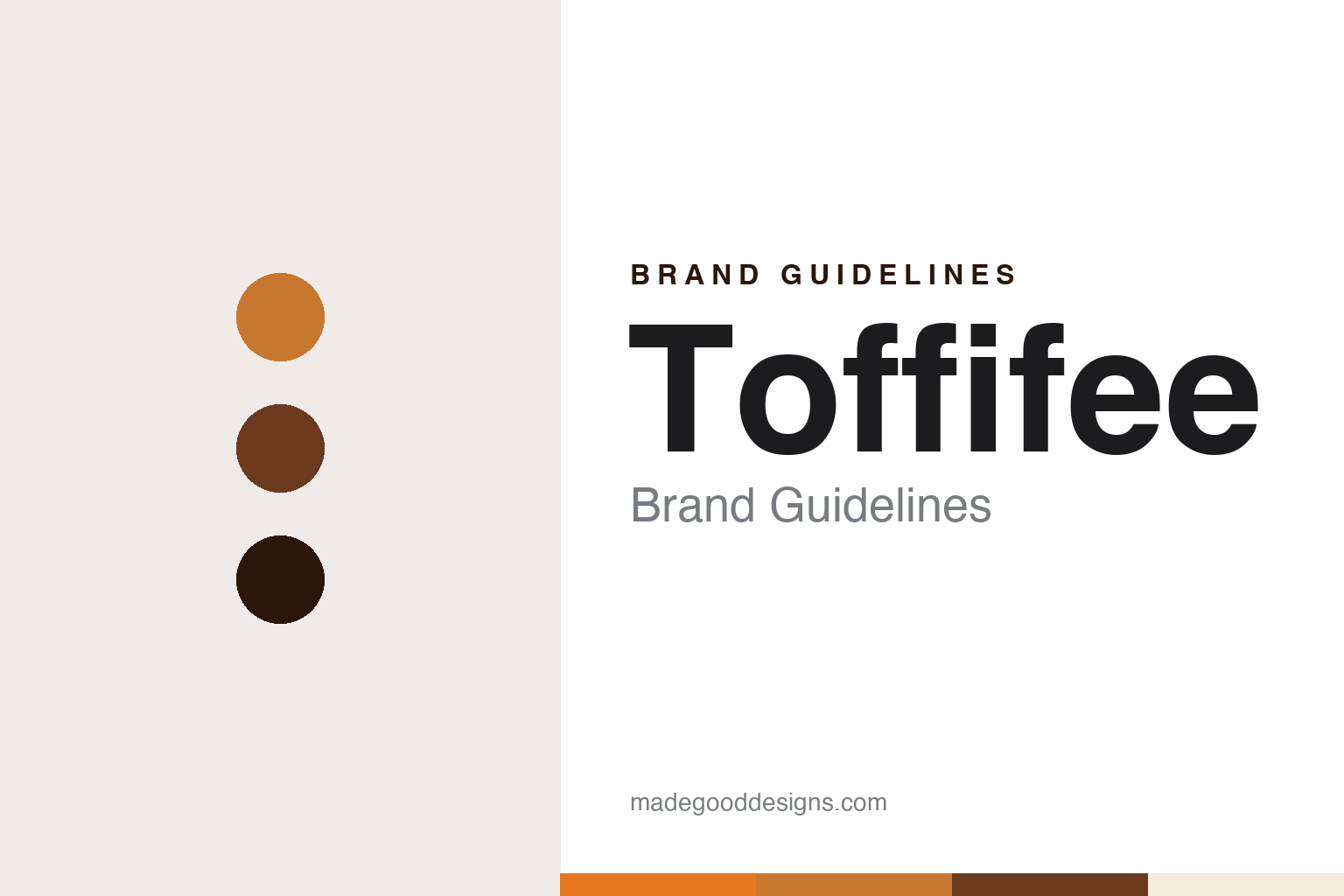
Toffifee Brand Guidelines
Storck’s hazelnut caramel cup, sold as Toffifay in the US.
Aa
Two constants: a caramel, hazelnut and orange palette and a rounded friendly sans register. Abstract homage — not a Toffifee product or mark; no pack, tray or logo is reproduced.
A Storck novelty of 1973
A Westphalian sweet maker and its second generation of brands.
Toffifee is a brand of August Storck KG, the German confectioner now based in Berlin. The company traces itself to 1903, when August Storck, known as Oberwelland, founded a sugar-confectionery works in Werther in Westphalia, German Wikipedia says; after the Second World War it built a new factory in neighbouring Halle (Westfalen), which remains its main plant. Under Klaus Oberwelland, who ran the company from 1971 to 2003, Storck turned a run of single-product brands into household names. The business magazine manager magazin called him in 2005 the father of brands including nimm2, merci, Werther’s Original and Toffifee, and German Wikipedia says Toffifee was developed under his leadership.
Toffifee arrived in 1973, following the Storck brands nimm2 in 1962, merci in 1965, Campino in 1966 and Werther’s Original in 1969, as German and English Wikipedia list them. Storck calls it a “world novelty” and says it was the first confectionery of its kind. German Wikipedia, citing the brand’s own history, says it went on sale first in West Germany and Austria, reached Switzerland in the 1980s and was sold in more than 100 countries by the start of the 21st century; Storck still gives the figure as more than one hundred countries.
The name is a coinage. German Wikipedia describes it as an invented word modelled on the English “toffee,” the hard caramel. Only in the United States is it spelled Toffifay, so that the spoken name sounds like the German one.
Colour
A smart shell with a rich inside.
The product is its own diagram. Each piece is a small caramel cup holding a whole hazelnut in nougat cream, closed with a drop of chocolate; Storck’s English line for it is “a smart shell with a rich inside.” The cups sit in a tray inside the box, and English Wikipedia says boxes range from four to 96 pieces. German Wikipedia says the design of the standard pack has hardly changed since 1973 apart from adjustments to the main picture on the front, and that its advertising has been made from the start by the Otto Pahnke agency, later Pahnke Markenmacherei.
Its advertising has long leaned on fun and family. The brand’s own timeline dates the slogan “… es steckt viel Spaß in Toffifee!” to 1980, with television spots that presented it as a speciality for the whole family; in English it runs “… there’s so much fun in Toffifee!” German Wikipedia lists later lines including “Für mehr Wir” in 2015 and “So fühlt sich Familie an” in 2018. In the 1990s, the timeline says, its commercials sent explorers big and small on journeys of discovery, and for the brand’s 40th birthday in April 2013 Storck issued a “Happy Birthday” special edition with a competition and a birthday-cake recipe in the promotional pack.
The recipe has gained relatives. A Double Chocolate limited edition appeared in autumn 2021, the first change of flavour, German Wikipedia says, followed by Coconut in summer 2022 and White Chocolate in autumn 2022, both announced by Storck as limited editions. White Chocolate, with a light cream filling and a drop of white chocolate, now sits alongside the classic in Storck’s German range.
Typography
Design and documentation.
The seven brands in this group all make sweets or chocolate, and they come from four European countries — Germany, Britain, Spain and Finland: Maoam, Barratt, Walker’s Nonsuch, Toffifee, Merci, Fini and Panda. European confectionery brands in general sit at many different points in the trade, from family firms that still carry a founder’s surname to names that now belong to much larger food groups, and a single brand can be sold everywhere from a corner kiosk to a supermarket shelf.
A confectionery brand’s identity is usually carried less by a single sweet than by a pack, a name and the treat it promises, because the company behind the name may have changed hands, moved its factory or grown far beyond the town where it started. That makes the questions behind each name worth asking plainly: who started it, who owns it now, and where its sweets are actually made and packed.
Each guide separates what independent sources record from what the company says about itself — its founding story, its owners over time, where its sweets are made and how its packaging has changed — and marks plainly what rests only on the company’s own word.
Aa
A rounded friendly sans for a sweet sold on fun and family. (Specimen set in Fredoka, a sans STAND-IN; NOT the Toffifee logo.)
Toffifee
One owner, two German plants and a white American box.
Toffifee has had one owner since its launch. Storck is a family company: Axel Oberwelland has chaired its management since 2003, and English Wikipedia names him as the owner. German Wikipedia ranks Storck as Germany’s second-largest confectionery maker by sales in 2022. Since the company’s centenary in 2003, it adds, the Storck name has appeared on the packs of all its brands, Toffifee included.
On where it is made, Storck says on its website that more than 3,800 staff at Halle (Westfalen) make Toffifee, Werther’s Original, nimm2, Mamba and Dickmann’s there; its other German production sites are Berlin and Ohrdruf in Thuringia. The trade site ConfectioneryNews reported in 2017 that Toffifay for the American market would be produced at Storck’s existing factory in Berlin.
That same 2017 report, by Oliver Nieburg, describes the brand’s biggest change of look. Toffifay had been sold in the United States since the 1980s, but Storck’s American marketing director told ConfectioneryNews that it had “not quite taken off” there, with aided brand awareness below 20%. After several years of research, Storck repositioned it as an indulgent treat for women aged 25 to 49, in new white packaging that she said had “a more feminine feel,” with a playful character called “Mr Irresistible” for a national television campaign. Europe, the report said, would keep its orange packs, and Germany remained the largest market. English Wikipedia says the original spelling and pack design are also used in Canada.
For a design guide, Toffifee shows how a product whose cross-section explains itself can keep the same pack for half a century, and how one market can be given a different spelling and colour without changing the sweet. Compare Werther’s Original, Storck’s caramel named after its home town, and merci, its chocolate brand of 1965. For this guide we use a pack orange, caramel and hazelnut brown with a rounded sans, an unofficial interpretation; no product or logo is reproduced.
Explore & save
Keep Toffifee’s identity on hand — save it to a board in the Made Good inspiration library.
Toffifee identity set
Pin the Toffifee pack orange, caramel and hazelnut brown palette and the rounded friendly sans register to your own board.