Acecook Brand Guidelines
The Osaka noodle maker with a piglet chef and Vietnam’s Hảo Hảo.
Aa
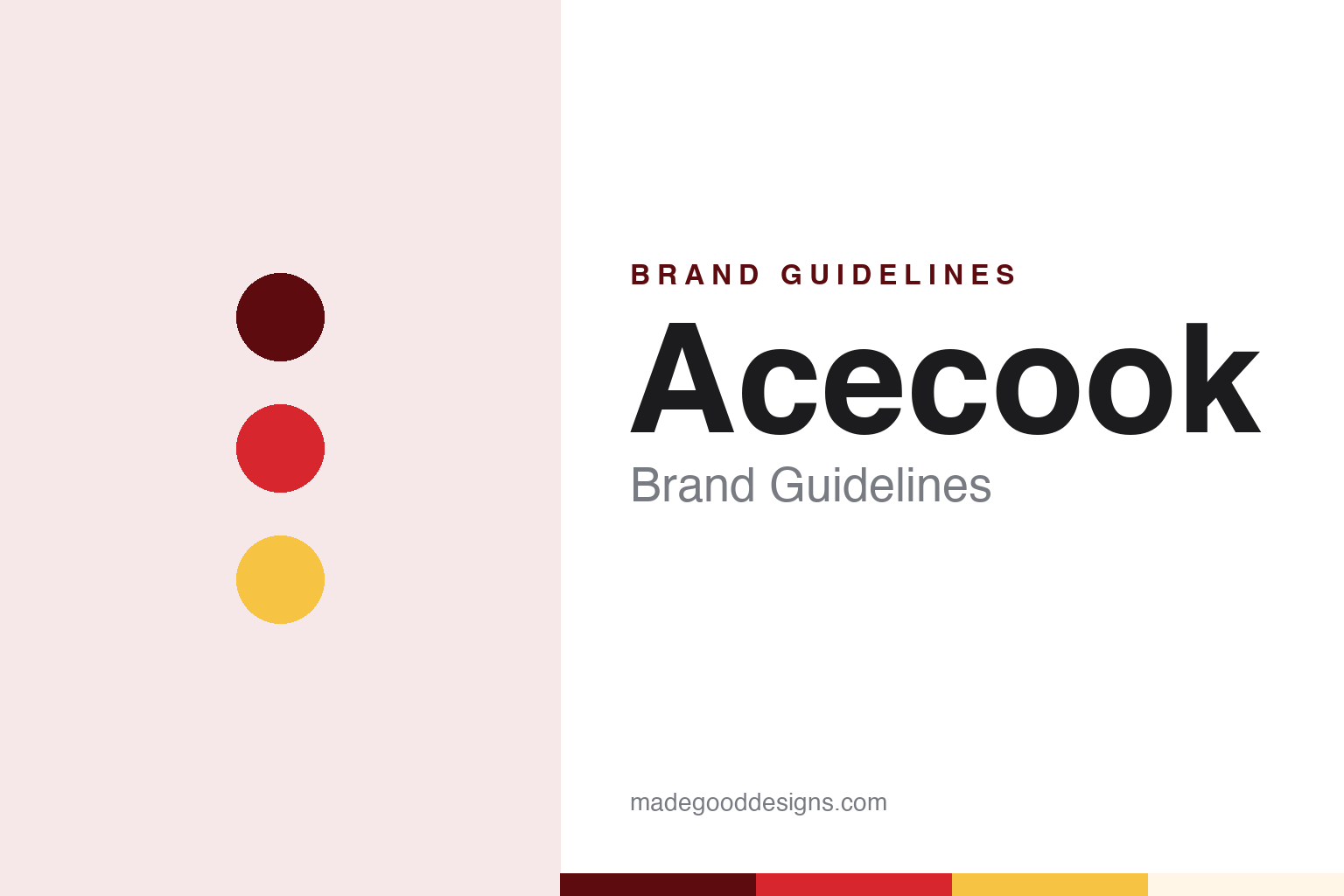
Two constants: a noodle red, chilli and gold palette and a rounded friendly sans register. Abstract homage — not an Acecook product or mark; no pack, logo or mascot is reproduced.
Bread, biscuits, noodles
A bakery near Sumiyoshi and a piglet with a frying pan.
Acecook began as a bakery. Japanese Wikipedia, citing interviews published by the Sankei Shimbun, says Keiji Muraoka founded a bread business in 1948 in Sumiyoshi ward, Osaka, near the Sumiyoshi Taisha shrine, and sold his loaves from a small stand in front of Osaka Station, carting them there each day. On 20 January 1954 he incorporated the business as Umeshin Seika, a maker of biscuits, which kept longer than bread.
Noodles came five years later. In April 1959 the company began making instant noodles, aiming at the Tokyo region rather than Osaka, where Nissin was already selling, according to the Sankei account. Its first was Peking Ramen, a seasoned noodle, followed the same year by Ace Ramen. The firm traded for a time as Ace Shokuhin and took the name Acecook in 1964, Japanese Wikipedia says. Its first factory near Tokyo, in Kawagoe, Saitama, opened in 1962.
The brand’s mascot dates from the first noodles. Acecook’s profile of Kobuta, a piglet who works as a cook, gives his birthday as 1 April 1959 and says he always carries a frying pan. Japanese Wikipedia, citing the company and Weekly ASCII, traces his changes: the first piglet held a Chinese soup spoon, the second (January 1960) a frying pan, the third (April 1961) was plumper, and the fourth, from June 1963, is the rounder figure still in use. A fifth, Disney-style version introduced in August 1996 did not catch on, and the company returned to the fourth in August 2001. Kobuta is used in Japan only.
Colour
Wantanmen, Super Cup and Hảo Hảo.
The product that made the company was Acecook Wantanmen, a wonton noodle with a separate soup sachet launched on 27 August 1963. Japanese Wikipedia, citing the company and the marketing magazine Senden Kaigi, says it became a hit that won the company customers in the Kansai region, and that television commercials from 1965 made it known nationwide. Later long-sellers include Wakame Ramen of 1983 and the Super Cup of July 1988, which offered one and a half times the usual portion when smaller cups dominated and became a leading large-cup noodle with young convenience-store shoppers. In 2001 Acecook added Soup Harusame, a glass-noodle soup.
The company’s second home is Vietnam. Acecook says it set up a joint venture there, Vifon-Acecook Co., Ltd., in 1993, and Acecook Vietnam dates the sale of its first product to 7 July 1995. In 2000 the venture launched Hảo Hảo in its sour-and-spicy shrimp flavour, made to suit Vietnamese tastes; Japanese Wikipedia, citing the company and a 2017 consultancy column, says it became a national staple and made the company the leading instant-noodle maker in Vietnam, a position the company says it reached in 2001. The venture was renamed Acecook Vietnam in 2004. Its own mascot is not a piglet but “Tasty Kid,” a human boy.
The noodles have since travelled back. In October 2018 the Asahi Shimbun reported that Acecook was importing Hảo Hảo into Japan, as the number of Vietnamese residents there grew. Acecook Vietnam now says it exports to more than 40 countries, and it marked 25 years of Hảo Hảo in 2025.
The company’s identity was reset on 13 January 2015. In a press release Acecook replaced its katakana logotype with roman lettering spelling “ACECOOK,” kept the fourth Kobuta unchanged, and introduced the corporate slogan “Cook happiness,” combined with the logo on packs and advertising; its television commercials gained an opening animated logo with a sound signature.
Typography
Design and documentation.
The seven brands in this group make coffee, tea, noodles and sauces, and they come from Singapore, Indonesia, Japan, Vietnam and Malaysia: Prima Taste, Indocafe, Kopiko, Acecook, Chin-su, OLDTOWN White Coffee and BOH. Drink and food brands of this kind in general sit at many different points in the trade, from family firms that still carry a founder’s name to names that now belong to much larger food groups, and a single brand can be sold everywhere from a coffee shop counter to a supermarket shelf.
A drink or food brand’s identity is usually carried less by a single product than by a pack, a name and the cup or bowl it promises, because the company behind the name may have changed hands, moved its factory or grown far beyond the town where it started. That makes the questions behind each name worth asking plainly: who started it, who owns it now, and where its products are actually made and packed.
Each guide separates what independent sources record from what the company says about itself — its founding story, its owners over time, where its products are made and how its packaging has changed — and marks plainly what rests only on the company’s own word.
Aa
A rounded friendly sans for a noodle brand fronted by a piglet chef. (Specimen set in Nunito, a sans STAND-IN; NOT the Acecook logo.)
Acecook
A family firm, a rescue partner and factories in three countries.
Acecook has stayed with the Muraoka family while tying itself to a larger rival. Japanese Wikipedia, citing a 2020 Sankei Shimbun interview series, says that in 1981, after losses from golf-course development and an unsuccessful fresh-noodle venture, the company came close to collapse and entered a business tie-up with the instant-noodle maker Sanyo Foods, whose president backed Acecook by supporting its shares. The same article names Sanyo Foods as Acecook’s main shareholder and describes Acecook as its consolidated subsidiary. The founder’s son Hiroshi Muraoka became president in 1994, and on 28 March 2024 the founder’s grandson Hiroto Muraoka succeeded him, the company announced.
Acecook is headquartered in Esaka, in Suita, Osaka Prefecture. Japanese Wikipedia lists its Japanese factories in Kawagoe, Saitama, where a new Kanto plant began production in May 2026 beside the 1962 Tokyo plant, and at Katō and Tatsuno in Hyōgo Prefecture. Acecook Vietnam is based in Tân Phú district, Ho Chi Minh City, and around 2020 the company described its Vietnamese operation as seven sites with eleven factories. In Myanmar, Acecook says it opened a Yangon branch in April 2014, set up Acecook Myanmar in March 2015 and completed a factory in the Thilawa Special Economic Zone in spring 2017.
For a design guide, Acecook shows how one company can run two identities: a piglet chef that has fronted Japanese packs since 1959, and a Vietnamese brand built around a single hit noodle. Compare Nissin, the Osaka instant-noodle pioneer, and Chin-su, the Vietnamese sauce brand. For this guide we use a noodle red, a deep chilli and a noodle gold with a rounded sans, an unofficial interpretation; no product or logo is reproduced.
Explore & save
Keep Acecook’s identity on hand — save it to a board in the Made Good inspiration library.
Acecook identity set
Pin the Acecook noodle red, chilli and gold palette and the rounded friendly sans register to your own board.