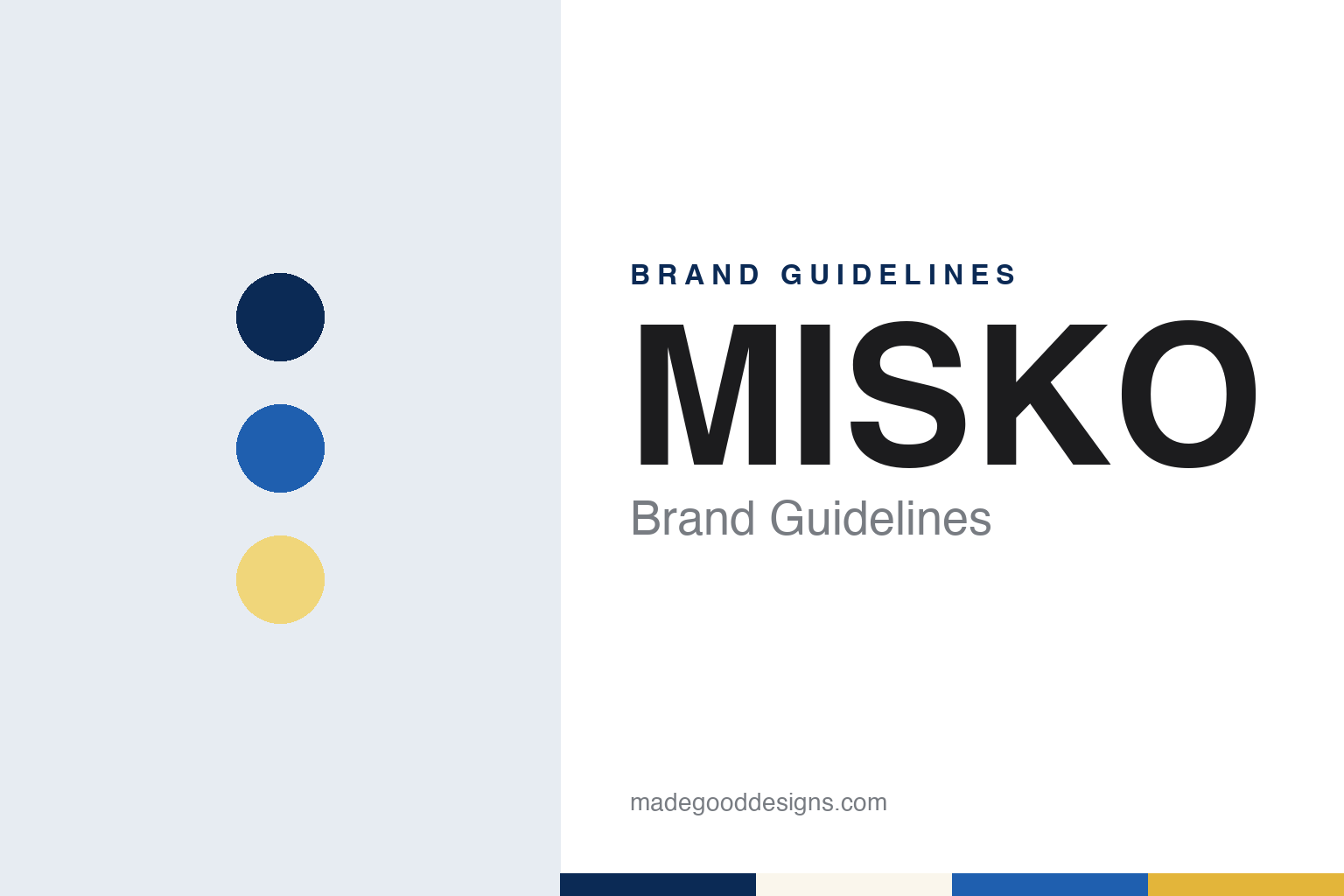
MISKO Brand Guidelines
The Piraeus pasta of monk Akakios, now made by Barilla.
Aa
Two constants: an Aegean navy, pack blue and durum gold palette and a sturdy grotesque sans register. Abstract homage — not a MISKO product or mark; no pack, logo or character is reproduced.
Piraeus to Patras
Two families, a merger and a trademark.
MISKO — ΜΙΣΚΟ in Greek capitals — is a Greek pasta brand with two beginnings. Greek Wikipedia says the company was founded in Piraeus, the port of Athens, in 1927 by the Michailidis and Konstantinis families. The brand that most Greeks know, however, was built after 1953 by a different group of owners.
At the centre of that second beginning was Eleftherios (Lefteris) Mantzikas. According to Greek Wikipedia’s biography of him, which cites a 1993 book by Vasilis Krapsitis, Mantzikas founded a pasta company called Record in March 1945 with Emmanouil Papanastasiou, a refugee from Kyzikos in Asia Minor. In October 1953 Record merged with two other pasta makers — Thriambos, owned by the Theodorakis family in Athens, and the Patras firm of Papachrysanthou & Kamperou — and the combined business bought the MISKO trademark. Krapsitis’s biography presents Mantzikas, who came from Epirus in north-western Greece, as a great benefactor of his home region.
Greek Wikipedia’s article on MISKO tells the same story from the brand’s side: in 1953 MISKO was acquired by the Mantzikas, Papanastasiou and Papachrysanthou families and moved to Patras, in the western Peloponnese. The Mantzikas biography says the new Patras plant was the first pasta factory in the city built to what it calls purely European standards, and the MISKO article describes it as the first automated pasta factory in Greece. The MISKO article itself carries a notice, dated 2017, that it lacks sources.
Colour
Monk Akakios, a packet and a long run at the top.
MISKO’s best-known advertising starred a monk. Greek Wikipedia says the character of Akakios, a monk, was introduced in the Mantzikas era, with the line “Ακάκιε, μην ξεχάσεις τα μακαρόνια να είναι ΜΙΣΚΟ” — roughly, “Akakios, don’t forget, the pasta has to be MISKO.” The Mantzikas biography says the idea came to him in the mid-1950s during a trip to the monasteries of Meteora, in central Greece. From 1968 to 1988, the MISKO article says, the brand’s advertising was handled by the LAMBDA-ALPHA agency of Lefkios Aloneftis.
The MISKO article also names the people who ran the business alongside Mantzikas. They included his half-brother Charilaos Mantzikas, who directed a subsidiary called BANTA; Nikos Chytopoulos, director of the Patras plant until 1983; Antonis Theodorakis, financial director until 1982; Angelos Asonitis, in charge of sales and operations until 1992; and Kostas Anagnostopoulos, the commercial director.
The packet was another first. Greek Wikipedia says MISKO was the first Greek pasta maker to sell its pasta packaged, in cylindrical one-kilogram packets, at a time when pasta was sold loose; the article presents this as a way of ending loose sales and adulteration. It says the company made its pasta from durum wheat semolina from Greek hard wheat, and that in the early 1960s it added new products including kritharaki, the rice-shaped pasta, egg spaghettini and Metsovitika egg noodles.
The same article charts MISKO’s rise. By the late 1950s and 1960s, it says, MISKO held first place in the Greek pasta market; in 1978 it was the 36th largest Greek industrial company and one of Europe’s larger pasta makers, covering 37% of Greek pasta consumption while also exporting. In 1979 it received a “Golden Hermes” award for its exports to the Middle East, Asia and Africa, and the article counts 56 distinctions over the second half of the 20th century.
Typography
Design and documentation.
The seven brands in this group all make food or drink, and all of them come from Portugal or Greece: Compal, Delta Cafés, Pavlides, Misko, Loux, Fage and Kyknos. Food and drink brands in general sit at many different points in the trade, from family firms that still carry a founder’s surname to names that now belong to much larger food groups, and a single brand can be sold everywhere from a corner shop to a supermarket shelf.
A food or drink brand’s identity is usually carried less by a single product than by a pack, a name and the meal or moment it promises, because the company behind the name may have changed hands, moved its factory or grown far beyond the town where it started. That makes the questions behind each name worth asking plainly: who started it, who owns it now, and where its products are actually made and packed.
Each guide separates what independent sources record from what the company says about itself — its founding story, its owners over time, where its products are made and how its packaging has changed — and marks plainly what rests only on the company’s own word.
Aa
A sturdy grotesque sans for a pantry staple written in capitals. (Specimen set in Archivo, a sans STAND-IN; NOT the MISKO logo.)
MISKO
An Italian owner and a plant in Boeotia.
MISKO passed to Italian ownership in the early 1990s. Greek Wikipedia’s MISKO article and Italian Wikipedia’s article on Barilla both date the acquisition to 1991; Greek Wikipedia’s biography of Lefteris Mantzikas gives 1992, and says Mantzikas stayed on as honorary president. English Wikipedia lists MISKO among the Barilla Group’s brands, alongside Barilla itself, Voiello and Wasa.
Under Barilla came a new plant. In 2000, Greek Wikipedia says, the company opened a new production plant in Boeotia, north-west of Athens; Greek Wikipedia’s article on the Boeotia regional unit places the MISKO pasta factory at Eleonas, near Thebes, and calls it the third-largest pasta factory in Europe. Italian Wikipedia lists Thebes among the pasta plants Barilla owns and runs, and English Wikipedia counts Greece among the Group’s production sites outside Italy. In 2009, the MISKO article says, the brand added wholegrain pasta to its range.
The Greek company today trades as Barilla Hellas, with its head office in Marousi, in the northern suburbs of Athens, according to Greek Wikipedia.
For a design guide, MISKO shows how a national staple can be built from a pack, a name in capitals and one memorable advertising character, and how that identity can survive a change of owner. Compare it with Barilla, its Italian parent, and with Voiello, a Neapolitan pasta brand that Barilla also owns. No official MISKO colours or typefaces are published, so the tones here are drawn from the sea at Piraeus and Patras and from durum wheat, and the type from the brand’s habit of writing its name in capitals. For this guide we use Aegean navy, pack blue and durum gold with a sans, an unofficial interpretation; no product or logo is reproduced.
Explore & save
Keep MISKO’s identity on hand — save it to a board in the Made Good inspiration library.
MISKO identity set
Pin the MISKO Aegean navy, pack blue and durum gold palette and the sturdy grotesque sans register to your own board.