Aik Cheong Brand Guidelines
The Melaka coffee roaster that began in a Temple Street shop in 1955.
Aa
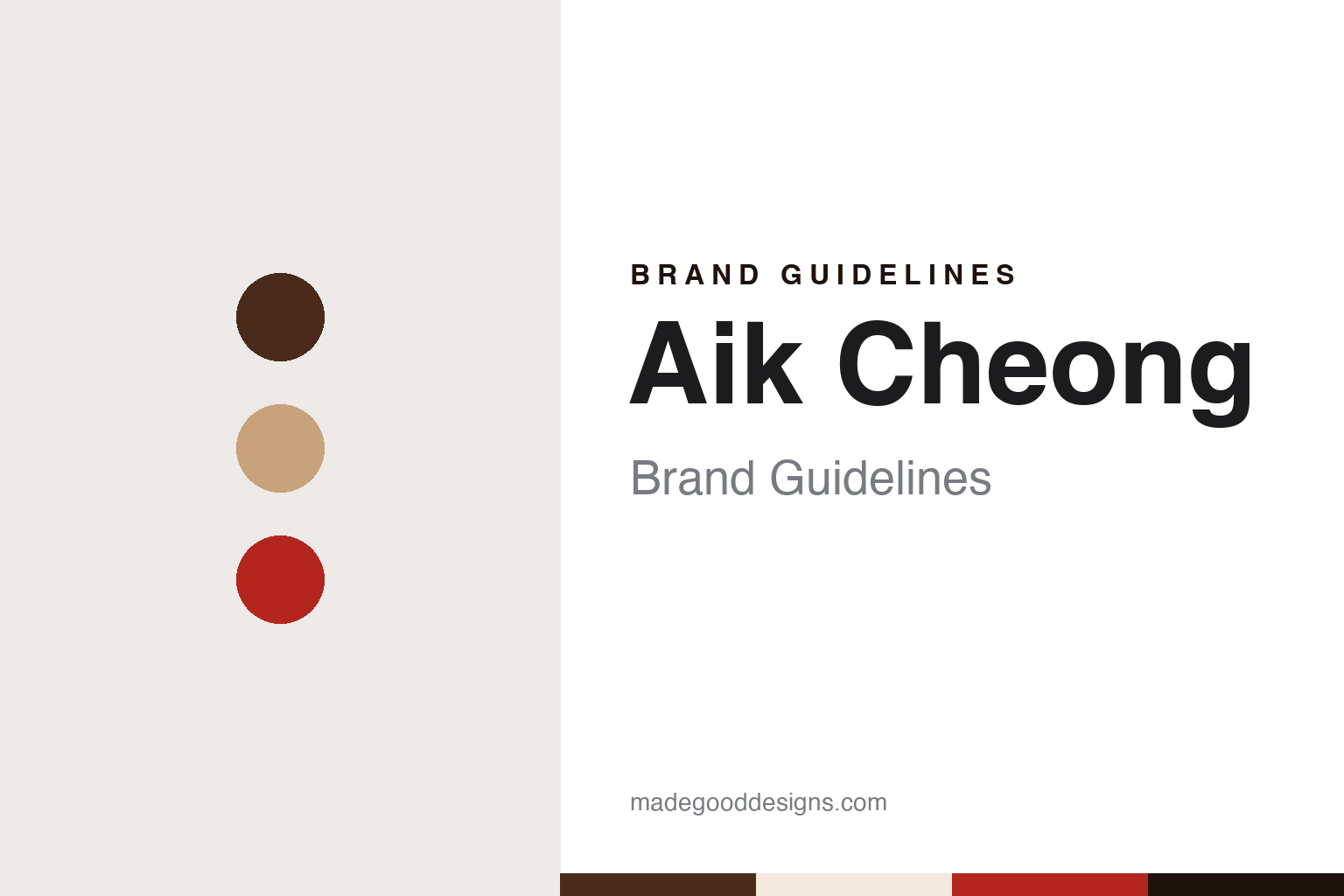
Two constants: an Aik Cheong roast brown, crema and red palette and a roaster’s serif register. Abstract homage — not an Aik Cheong product or mark; no sachet, logo or label is reproduced.
Temple Street
A wooden shop in old Melaka, two years before independence.
Aik Cheong Coffee Roaster began in 1955 in a small wooden shop on Temple Street, in the old town of Melaka, two years before Malaya’s independence, Vulcan Post reported in February 2023. Its Chinese name is 益昌咖啡. In those first years the business imported coffee beans from Indonesia, the Philippines and South America, then ground, roasted and packed them by hand for the local market. The company’s own account, as summarised by Vulcan Post, says customers then were content with a few grades of coffee, and that the trade was much simpler than it is today.
The founder was a woman, Madam Low Kwai Heong (刘桂香). Chinese-language sources cited by Vulcan Post describe her riding a bicycle from door to door to sell coffee beans, and grinding the beans into powder herself. The company remained a family business. Vulcan Post named her grandson, Leong Lip Cheong (梁立中), as the person leading it in 2023, and reported that he had passed the job of speaking for the company to Tang Joo Shen, its head of business development for Malaysia and China, who had started out at Aik Cheong as a storekeeper.
As the business grew it moved to larger premises several times. The company now operates from an eight-acre site in Cheng, Melaka, where, according to the figures it publishes, electronic and mechanical machines sort, grade, roast and pack the coffee. It gives its output as about 800,000 sachets a day and about three tonnes of roasted beans a day, and says it still buys beans from the same village in Indonesia that it has used for decades. These are the company’s own figures, reported by Vulcan Post, rather than independently audited numbers.
The brand is visible to anyone driving into the state: an Aik Cheong-sponsored billboard welcomes motorists to Melaka from the North–South Expressway, Vulcan Post noted. In September 2025 the company marked its 70th anniversary with a limited “Vintage 70” edition of its kopi O, the black coffee of Malaysian coffee shops, in Classic and Sugar Added versions, made with Liberica beans, Mini Me Insights reported.
Colour
From kopi powder to the IT’S cup.
Vulcan Post called Aik Cheong a household name known for its instant drinks, sold in shopping malls and convenience stores. Over the past decade the company has widened that range and, alongside it, the look of its packs. In 2019 it launched the “IT’S” cup series, ready-to-mix cups with names such as It’s Cappuccino, It’s White Coffee and It’s Matcha Latte. Vulcan Post described the cups as a clear departure from the brand’s familiar sachets, with bright colours and a minimal typeface, and the Chinese-language business site BizLife reported in March 2022 that the range was aimed at younger buyers in the mid-to-high-end market and had taken about eighteen months of development.
Other lines followed. In April 2022 Aik Cheong released Project CHNO, a freeze-dried coffee in what Mini Me Insights called unique packaging, with an Italian Blend added in July 2023. Drip-coffee sachets arrived in October 2022, among them a Classic Intenso and an Asian Signature blend. The Café Art name covers flavoured drinks, including a lemon tea launched in 2023 and a chocolate series introduced in the first half of 2024 with Chocolate Hazelnut, Chocolate Mint and Chocolate Kosong. A separate brand, BLACK, is used for specialty coffee beans and brews.
The company has also moved into ready-to-drink products. At the MIHAS 2024 halal trade show in Kuala Lumpur in September 2024 it showed IT’S Chocolate Latte drinks and a freeze-dried fruit tea in capsules, Mini Me Insights reported, and at THAIFEX 2025 in Bangkok it showed cold-brew capsule drinks. In December 2025 the same trade title reported new Chocolate Pistachio and Instant Spanish Latte products in Malaysia.
Typography
Malaysian food and drink brands.
The seven brands in this group all make food or drink, and all of them come from Malaysia: Ayamas, Adabi, Aik Cheong, Apollo, Cintan, Dutch Lady and Massimo. Malaysian food and drink brands in general sit at many different points in the trade, from family firms that still carry a founder’s name to names that now belong to much larger food groups, and a single brand can be sold everywhere from a neighbourhood sundry shop to a supermarket shelf.
A food or drink brand’s identity is usually carried less by a single product than by a pack, a name and the meal or snack it promises, because the company behind the name may have changed hands, moved its factory or grown far beyond the town where it started. That makes the questions behind each name worth asking plainly: who started it, who owns it now, and where its products are actually made and packed.
Each guide separates what independent sources record from what the company says about itself — its founding story, its owners over time, where its products are made and how its packaging has changed — and marks plainly what rests only on the company’s own word.
Aa
A warm, bookish serif for a seventy-year-old roaster. (Specimen set in Fraunces, a serif STAND-IN; NOT the Aik Cheong logo.)
Aik Cheong
A Melaka family roaster selling to more than 50 countries.
Exports have shaped Aik Cheong’s growth. In 2006 it was among the first group of Malaysian coffee brands to enter China formally, Tang Joo Shen told BizLife, as reported by Vulcan Post. Its export model appoints a single sole distributor in each country, so that it needs only one business partner to start selling there; Tang described that route as slow and costly, and said online, cross-border selling had since made exporting simpler. In 2018 he said about 60 per cent of the business came from exports, and by 2022 the company said it was exporting to more than 50 countries.
The company has stated larger ambitions since then. In July 2025 the Malay Mail reported that Aik Cheong was eyeing global expansion and targeting the top spot by 2030,, describing it as “not just a kopitiam brand,” a reference to Malaysia’s traditional coffee shops. The trading company is Aik Cheong Sdn Bhd, which is still based in Melaka.
A note on names: the domain aikcheong.com is not the company’s; it was listed for sale in October 2026, and the company’s website sits at aikcheong.com.my.
For a design guide, Aik Cheong shows how a family coffee roaster can keep a traditional sachet range while giving a newer line, the IT’S cups, a brighter and more minimal look aimed at younger buyers. Compare OLDTOWN White Coffee, the Ipoh white-coffee maker, and Julie’s, another Melaka food brand. For this guide we use roast brown, crema and a coffee-shop red with a serif, an unofficial interpretation; no product or logo is reproduced.
Explore & save
Keep Aik Cheong’s identity on hand — save it to a board in the Made Good inspiration library.
Aik Cheong identity set
Pin the Aik Cheong roast brown, crema and red palette and the roaster’s serif register to your own board.