Pöttyös Brand Guidelines
The polka-dotted curd bar from Mátészalka.
Aa
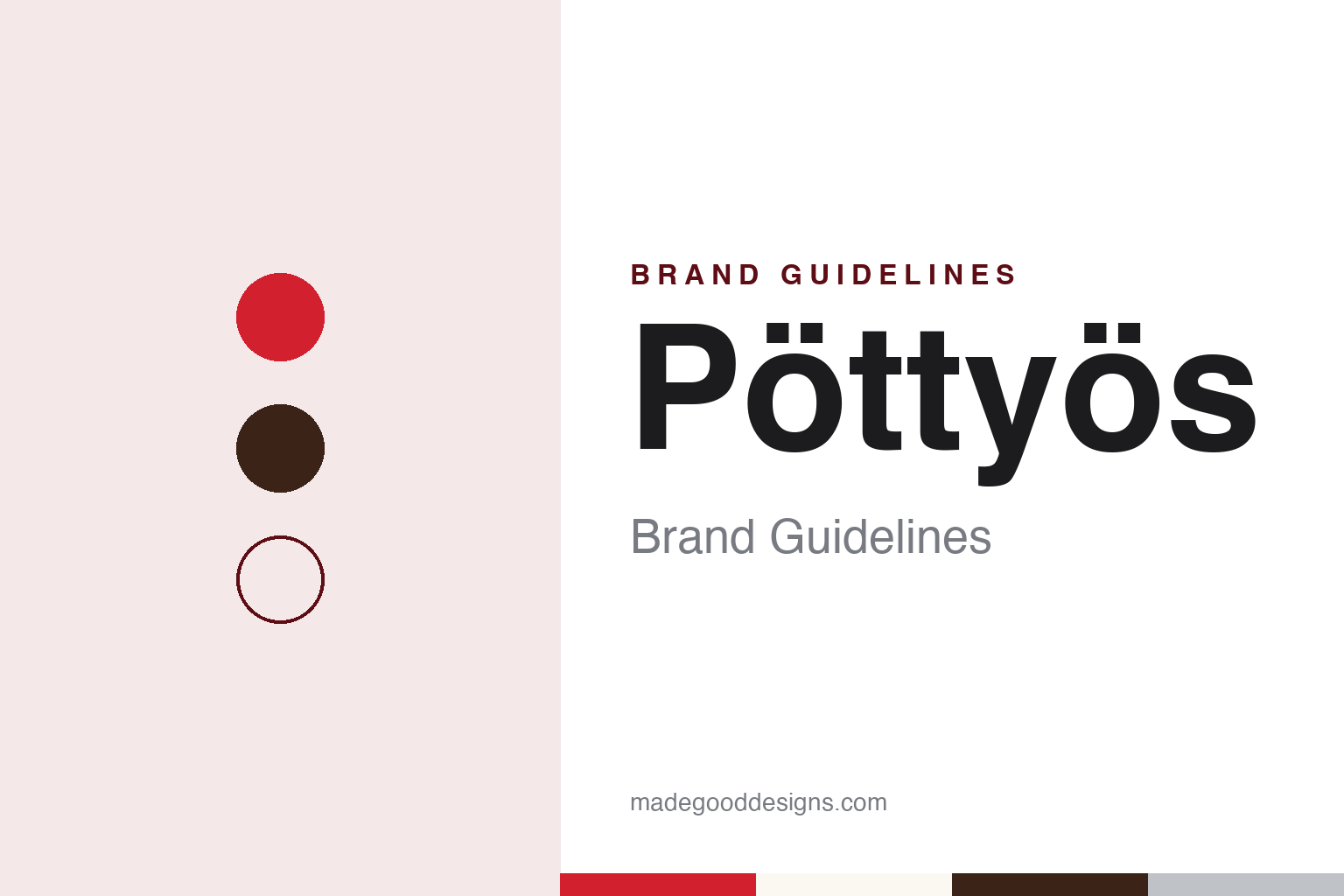
Two constants: a polka red, cocoa and curd white palette and a rounded friendly sans register. Abstract homage — not a Pöttyös product or mark; no pack, logo or bar is reproduced.
A study trip and a name
A Soviet sweet, a Budapest dairy and a psychologist.
Pöttyös is the brand of Túró Rudi, the chilled bar of sweetened curd cheese, or túró, in a cocoa coating that Hungary has made since 1968. “Pöttyös” means “polka-dotted,” and the distinctive red polka dots are what regular buyers associate with the bar, English Wikipedia says. The brand belongs to FrieslandCampina Hungária, the Hungarian subsidiary of the Dutch dairy cooperative Royal FrieslandCampina.
The idea came from the Soviet Union. The maker’s own brand history says that in 1954 three Hungarian dairy specialists — the industry director Imre Takó, Dr Ferenc Ketting, a food engineer at the Hungarian Dairy Research Institute, and Zsolt Borka, who represented the plants — made a two-week study trip to the USSR to look at its dairy industry. There they saw a soft, round, sugared confection of curd, butter and fat coated in chocolate; not knowing its name, they called it “túró mignon.” Hungarian Wikipedia identifies the Soviet original as the glazed syrok. A report on the trip appeared in the trade journal Tejipari Értesítő, the company says, and because parts of the research institute were then housed in the Erzsébetváros dairy in Budapest, the new product was developed there in the 1960s.
The practical work was given to the dairy’s foreman, Rudolf Mandeville, and his small team. Some Hungarian reports, among them Népszabadság in 1999 and Index in 2006, have credited him with inspiring the name, Hungarian Wikipedia notes. The maker says that is a mistake and that the name was coined by Sándor Klein, a young psychologist who taught at the Budapest Technical University and who was also asked to develop the pack and run the launch campaign. “Rudi” plays on rúd, Hungarian for “rod” or “bar,” and is also a nickname for Rudolf, English Wikipedia says.
Colour
Dots from the start, a refused campaign and a slogan.
The polka dots are as old as the product. According to the company’s brand history, the original wrapper, decorated with the head of a little girl with red pigtails, already carried the dot pattern, and it was designed by two of Klein’s students at the College of Applied Arts in Budapest. The name was not welcomed everywhere. The head of the advertising group at the state newspaper publisher Hírlapkiadó Vállalat called it immoral and refused to run advertisements for it in the publisher’s papers, so the planned launch campaign never took place, the company says.
The wrapper changed with the machinery. At first, the company says, bars were packed by hand, the paper twisted around each end like a szaloncukor, the Hungarian Christmas sweet; metal foil arrived in the 1980s and an easy-open tear strip after 2000. Advertising moved from leaflets and pocket calendars to newspaper adverts and then television. In the 1980s, when two other dairies were also making Túró Rudi, the brand adopted the slogan “A Pöttyös az igazi” — “the dotted one is the real one,” according to the company. The bar had its first film role in 1984, in the family film Kismaszat és a Gézengúzok, the company says, and in 1986 the band 100 Folk Celsius recorded a song called “Túró Rudi,” Hungarian Wikipedia records.
A renewal of the brand began in 2000, covering both the packaging and the tone of its communication, the company says; it greeted the new decade with a new design and its first website, and appeared several times at Budapest’s Sziget festival. The company says the brand has won awards including Superbrands. The range has since grown far beyond the plain bar, from fruit-flavoured and giant Óriás versions to the seasonal Túró Bonbon in 2007, the GURU bar in 2010, the Pöttyös Tejsüti sponge snack in 2016 and a Pöttyös cocoa milk in 2019, according to the company.
Typography
Design and documentation.
The seven brands in this group all make food or drink, and all of them come from Hungary: Szamos, Tibi, Sport, Dreher, Borsodi, Unicum and Pöttyös. Hungarian food and drink brands in general sit at many different points in the trade, from family firms that still carry a founder’s surname to names that now belong to much larger food or drinks groups, and a single brand can be sold everywhere from a corner shop to a supermarket shelf.
A food or drink brand’s identity is usually carried less by a single product than by a pack, a name and the treat or the drink it promises, because the company behind the name may have changed hands, moved its factory or grown far beyond the town where it started. That makes the questions behind each name worth asking plainly: who started it, who owns it now, and where its products are actually made and packed.
Each guide separates what independent sources record from what the company says about itself — its founding story, its owners over time, where its products are made and how its packaging has changed — and marks plainly what rests only on the company’s own word.
Aa
A rounded friendly sans for a brand named after its dots. (Specimen set in Fredoka, a sans STAND-IN; NOT the Pöttyös logo.)
Pöttyös
From Budapest to Mátészalka, and two owners of one name.
Mass production began in 1968 at the Erzsébetváros dairy, but cramped conditions soon sent it east to Szabolcs county, the company says. The dismantled wooden machine went first to Nyíregyháza for a trial run of a few weeks and then to a curd plant beside the old railway station in Mátészalka, where 25 to 30 workers on three shifts cut the curd into three-decagram pieces by eye. A new Mátészalka plant opened on 20 August 1970, and Túró Rudi got its own section there in the 1980s. Hungarian Wikipedia, citing the regional news site szon.hu, puts the plant’s capacity in 2015 at one million bars a day.
Under the planned economy there was a single TÚRÓ RUDI trademark, registered to the dairy industry’s state trust, and other plants made the bar too: a farming co-operative at Nagybánhegyes from 1981 to 1999 and the Kaposvár dairy’s plant at Marcali from 1984, Hungarian Wikipedia says. In the 1990s the Mátészalka and Nagybánhegyes plants came under common management within the Nutricia group, the company says. After privatisation the name was split between two owners. Danone bought the Marcali plant in spring 1995, the regional daily Somogyi Hírlap reported, and in 2009 Sole-Mizo bought Danone’s Marcali business, Origo reported that December. Hungarian Wikipedia, citing the Hungarian intellectual property office’s register in 2020, says FrieslandCampina holds most of the registered marks, including “Pöttyös Túró Rudi,” while one is linked to Sole-Mizo. FrieslandCampina itself was formed when the Dutch cooperatives Friesland Foods and Campina merged on 30 December 2008, English Wikipedia says.
The dots also travelled. The company says the bar was launched in Slovakia and Romania in 2004 under the name Dots, reached Auchan stores in Italy in 2006 and also went on sale in Spain; Index reported in January 2005 that Pöttyös adverts had appeared on Bratislava’s buses and trams and on Slovak television, and in July 2006 that Italy was its first Western market. English Wikipedia gives 2003 as the year of the Dots launch.
For a design guide, Pöttyös shows how a pattern printed on a wrapper since the 1960s can give a product its brand name. Compare Szamos, the Budapest marzipan and confectionery house, and Babybel, another dairy snack. For this guide we use a polka red, a cocoa brown and a curd white with a rounded sans, an unofficial interpretation; no product or logo is reproduced.
Explore & save
Keep Pöttyös’s identity on hand — save it to a board in the Made Good inspiration library.
Pöttyös identity set
Pin the Pöttyös polka red, cocoa and curd white palette and the rounded friendly sans register to your own board.