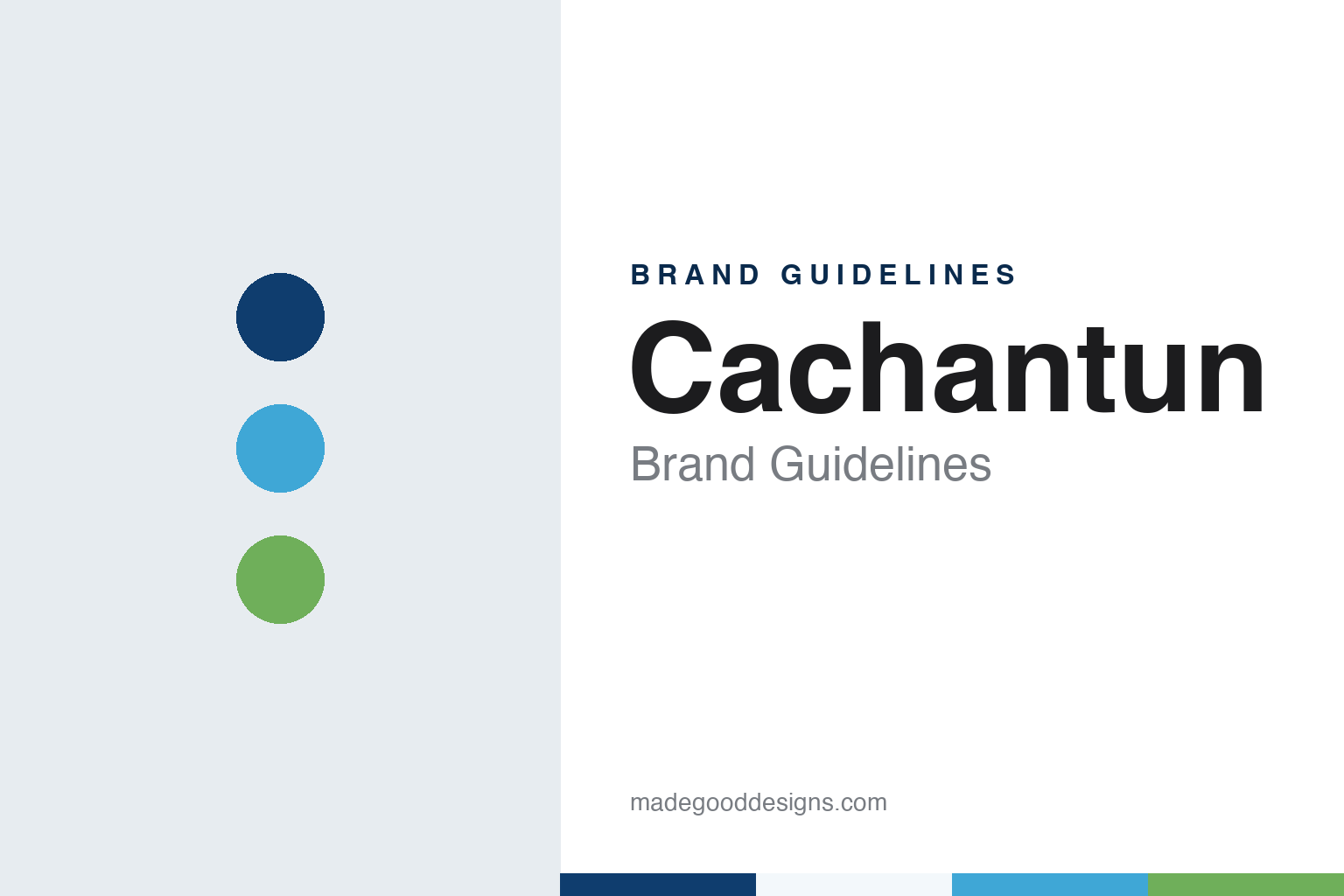
Cachantun Brand Guidelines
The Coinco spring CCU has bottled since 1960.
Aa
Two constants: a deep navy, spring blue and valley green palette and a clean geometric sans register. Abstract homage — not a Cachantun product or mark; no bottle, label or logo is reproduced.
A spring at Copequén
A Mapudungun name, an old spring and bottling from 1920.
Cachantun is a mineral water from a spring at Copequén, a small rural village in the comuna of Coinco, in Chile’s O’Higgins Region, south of Santiago. Spanish Wikipedia places Copequén about 5 km east of Coinco, on the south bank of the Cachapoal river, with the spring to the south-west of the village. It says the spring was first used by the Picunche, the people of central Chile before the Spanish arrived, and that its water has been bottled at a plant there under the Cachantún name since 1920. The brand’s own website says the water has been bottled “for more than 100 years” at its single source spring in Coinco, and gives 1920 as the starting date on every product it lists.
The name comes from Mapudungun, the Mapuche language, but the sources give it different meanings. CCU, the brand’s owner, said on its website in 2013 that Cachantun means “piel hermosa,” or “beautiful skin,” and earlier versions of the Cachantun website said the same. Spanish Wikipedia instead derives the name from cad, “much,” and antün, the shining of the sun — a water whose clarity recalls sunshine. The company writes the name without an accent, as Cachantun; Spanish Wikipedia and the tennis tournaments spell it Cachantún.
An earlier version of the Cachantun website told the story in a few lines. The spring, it said, was well known before the Spanish reached Chile’s Central Valley; its industrial exploitation began in 1920; and in 1960 it was bought by CCU. A later version, from about 2015, added that the water comes from natural springs fed by underground aquifers in Coinco, “a land with abundant reserves of water.” Copequén itself has a long recorded history: Spanish Wikipedia notes a governor appointed there under Inca rule and Spanish settlement from around 1545, and describes the village today as a rural community of 856 people at the 2017 census.
Colour
CCU, Pepsi and a 1960 purchase.
The buyer was the Compañía Cervecerías Unidas, or CCU, the Santiago brewer and drinks group. Spanish Wikipedia, citing CCU’s own published history, says CCU began making Pepsi under an agreement with PepsiCo in 1959 — the drink reached the market on 12 March that year, according to the newspaper La Nación — and bought Cachantun “the following year,” in 1960. CCU’s brand page in 2013 said the water had been extracted and bottled by CCU since 1960 “directly at its source” in Coinco.
In 2007, Spanish Wikipedia says, CCU went into partnership with Nestlé for bottled water and the production of Nestlé Pure Life. Cachantun now sits in the subsidiary Aguas CCU-Nestlé, alongside Porvenir, Perrier, Nestlé Pura Vida and the purified water Manantial. CCU’s brand list describes Porvenir as bottled since 1943 at a source in the Casablanca valley, and calls Mas the pioneering flavoured-water brand in Chile — CCU’s own description. In 2013 CCU grouped Mas and Mas Woman under the Cachantun name, as “Mas de Cachantun” and “Mas Woman de Cachantun.”
The core range is simple. Cachantun’s website lists three mineral waters: Con Gas, sparkling; Sin Gas, still; and Light Gas, which it describes as gently carbonated. Each is labelled with Coinco, VI Región, Chile as its place of origin, and the earlier brand website named the same three versions. CCU’s 2013 page said the bottling plant held ISO 9001 and HACCP certificates, and the earlier Cachantun website said the brand received ISO 9002 certification for its processes in 1999 — both the company’s statements.
Typography
Design and documentation.
The seven brands in this group are all food and drink names from Latin America: Club Colombia, Jet, Cachantun, Evercrisp, Yoki, Vigor and Pullman. Latin American food and drink brands in general sit at many different points in the trade, from family firms that still carry a founder’s name to names that now belong to much larger food and drink groups, and a single brand can be sold everywhere from a corner shop to a supermarket shelf.
A food or drink brand’s identity is usually carried less by a single product than by a pack, a name and the meal, snack or drink it promises, because the company behind the name may have changed hands, moved its production or grown far beyond the place where it started. That makes the questions behind each name worth asking plainly: who started it, who owns it now, and where its products are actually made and packed.
Each guide separates what independent sources record from what the company says about itself — its founding story, its owners over time, where its products are made and how its packaging has changed — and marks plainly what rests only on the company’s own word.
Aa
A clean geometric sans for a spring water from Coinco. (Specimen set in Montserrat, a sans STAND-IN; NOT the Cachantun logo.)
Cachantun
A bottle, a telethon and a tennis cup.
Cachantun’s marketing has leaned on packaging, slogans and sponsorship. The earlier brand website said that in 1997 Cachantun “revolutionised the market” by launching a bottle called “Cuerpo perfecto,” or “perfect body” — the company’s words — and that the brand had supported the Teletón, Chile’s charity telethon, since 1982. It also said the brand organised Cachantun Fashion, an event it described as a reference point for Chilean fashion. CCU’s 2013 brand page carried the line “Vuelve a lo Natural,” “return to the natural”; the current website uses “El Sabor de la Naturaleza,” “the taste of nature.”
Tennis has carried the name furthest. The Cachantún Cup was a women’s professional tournament played at the Centro de Tenis Las Salinas, at the naval club in Viña del Mar; Flavia Pennetta won the 2008 singles title, English Wikipedia records. The name was later attached to a men’s ATP Challenger tournament in Santiago, the Challenger ATP Cachantún Cup, whose seventh edition was played in 2012 and tenth in 2017, according to Spanish Wikipedia. English Wikipedia says that event has also run under other names, among them the Cachantún Open by KIA and the Copa USS.
For a design guide, Cachantun shows a water brand built on a single named place — a spring in Coinco — and a Mapudungun name its owner has kept for more than six decades. Compare Evercrisp, the Chilean snack brand on the other side of PepsiCo’s business in Chile, and Jumex, the Mexican juice maker. For this guide we use a deep navy, a spring blue and a valley green with a geometric sans, an unofficial interpretation; no product or logo is reproduced.
Explore & save
Keep Cachantun’s identity on hand — save it to a board in the Made Good inspiration library.
Cachantun identity set
Pin the Cachantun deep navy, spring blue and valley green palette and the clean geometric sans register to your own board.