Rasna Brand Guidelines
The Ahmedabad drink concentrate born as Jaffe in 1976.
Aa
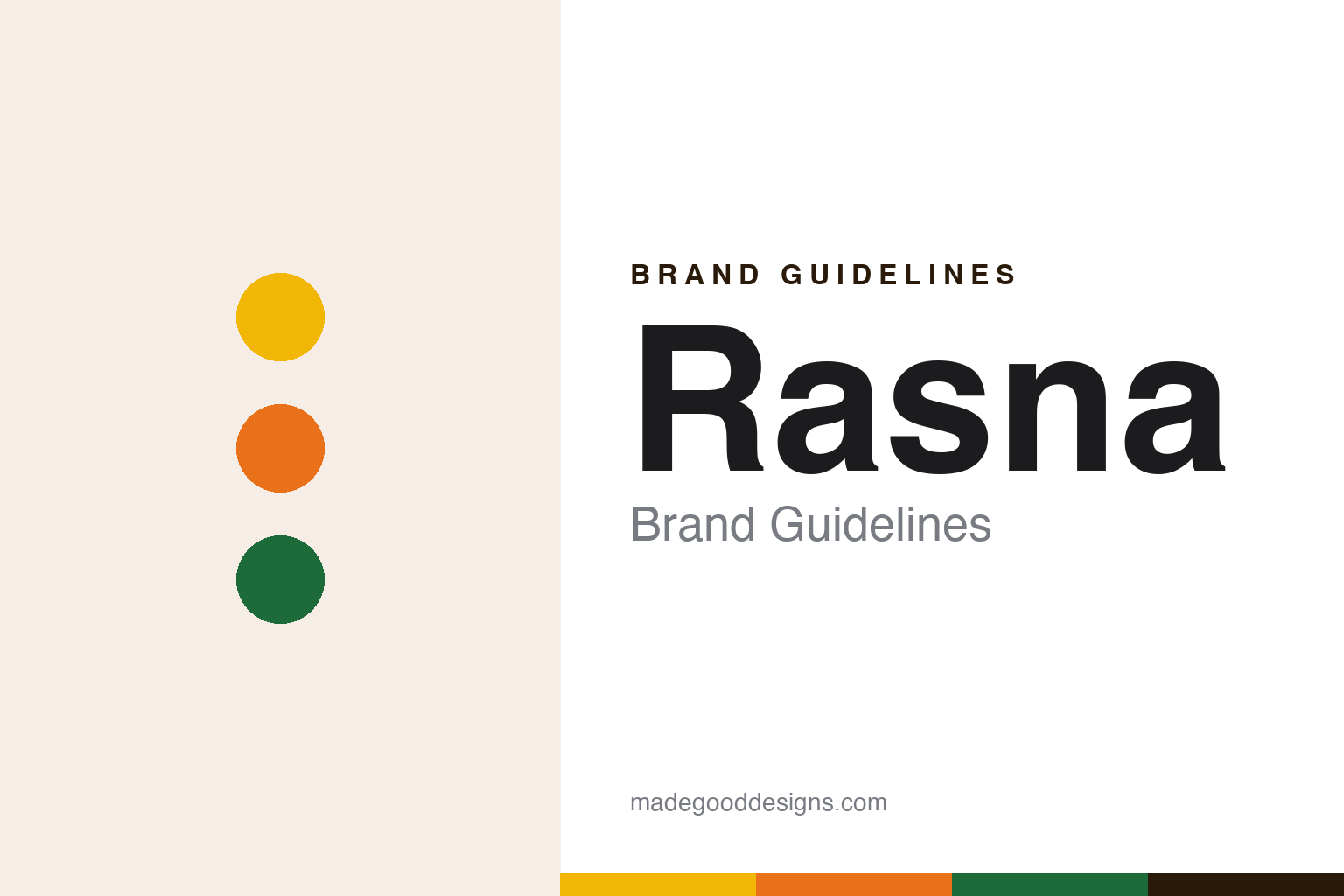
Two constants: a Rasna mango, orange and green palette and a rounded sans register. Abstract homage — not a Rasna product or mark; no pack, logo or advertisement is reproduced.
Jaffe
A home-mixed drink from Ahmedabad.
Rasna began in Ahmedabad in 1976, as a soft-drink concentrate created by Areez Khambatta. The Hindu reported in 2015 that it was first sold as Jaffe, a name taken from the mangoes of Jaffna, and that when the name did not work the company chose an Indian one: “Rasna,” meaning juice, coined in 1980. English Wikipedia also dates the product to 1976, citing a 2009 Tata McGraw-Hill textbook on advertising.
Khambatta, a chemistry graduate of Gujarat College according to a 2023 DNA profile, had joined his father’s business in 1962. The idea, as the Rasna group described it in 2022, was an affordable pack of concentrate in the 1970s, offered as an alternative to soft drinks sold at high prices: one small pack, mixed at home with water and sugar, made 32 glasses, The Hindu reported.
The first flavours were mango, orange and lemon; pineapple, kala khatta and more than a dozen others followed, with litchi among the later additions, The Hindu said in 2015. Distribution was first handled by Voltas, according to a 2008 book by Rajat Kanti Baisya on India’s processed-food industry, before the company built its own network.
Areez Khambatta’s son Piruz Khambatta joined the family business at 18 and took over in 1997, The Hindu reported; he is the company’s chairman. Areez Khambatta, the group’s founder and chairman, died in November 2022 at 85, The Hindu and PTI reported. He was awarded the Padma Shri posthumously in 2023; the company says it was presented at Rashtrapati Bhavan on 5 April 2023.
Colour
I love you Rasna.
Rasna’s identity was built on television. The Economic Times reported in 2011 that the company had advertised on national TV since the 1980s, with a line aimed at children: “I love you Rasna.” The commercials ended with a girl holding a glass and delivering it. The first “Rasna girl” was Ankita Jhaveri, who went on to act in South Indian films; in 2012 DNA reported that the new one would be Piruz Khambatta’s daughter, Avan, and The Hindu pictured her in the role in 2015.
The agencies changed over the decades. According to The Economic Times, Mudra Communications handled the brand from 1984 to 2005, Dentsu from 2005 to 2009 and Rediffusion from 2009. Celebrity faces have included Karisma Kapoor, Hrithik Roshan, Genelia D’Souza and the cricketers Kapil Dev and Virender Sehwag, the Times of India reported in 2012, and in March 2015 the Indian Express reported that Akshay Kumar had signed as brand ambassador. Piruz Khambatta told The Hindu that year that Rasna had also made a commercial focused on rural India, sung by Asha Bhosle.
The company’s own awards page lists honours including Cannes Lions 2010, a London International Award for package design and an Indian Telly Award in 2021.
The brand has also tried new formats. In 2000 it launched Oranjolt, a fizzy fruit drink; Matt Haig’s 2005 book Brand Failures attributes its failure to the need for constant refrigeration in shops that often switched their fridges off at night. Juices followed in 2002, the Times of India reported, and in 2019 the company opened its first Rasna Buzz non-alcoholic drinks bar, in Pune, the Financial Express reported.
Typography
India’s drink brands.
The seven brands in this group are all drink names from India: Thums Up, Limca, Frooti, Paper Boat, Rasna, Bisleri and Maaza. Indian drink brands in general sit at many different points in the trade, from family firms that still carry a founder’s name to names that now belong to much larger food and drink groups, and a single brand can be sold everywhere from a corner shop to a supermarket shelf.
A drink brand’s identity is usually carried less by a single product than by a pack, a name and the drink it promises, because the company behind the name may have changed hands, moved its production or grown far beyond the place where it started. That makes the questions behind each name worth asking plainly: who started it, who owns it now, and where its products are actually made and packed.
Each guide separates what independent sources record from what the company says about itself — its founding story, its owners over time, where its products are made and how its packaging has changed — and marks plainly what rests only on the company’s own word.
Aa
A rounded sans for a children’s drink. (Specimen set in Nunito, a sans STAND-IN; NOT the Rasna logo.)
Rasna today
Concentrate, cordials and Jumpin.
Rasna remains a family business. English Wikipedia names the owner as Pioma Industries of Ahmedabad, citing Rediff in 2004; the company’s website today trades as Rasna Pvt. Ltd., describes “a family-owned business that is professionally managed,” and calls Rasna “a 100% Made in India product.” In 2004 the Financial Express reported five plants in Gujarat and one in Himachal Pradesh, and in 2008 The Economic Times reported facilities abroad in Bangladesh, Dubai, Saudi Arabia and Egypt; in 2015 Piruz Khambatta told The Hindu of nine plants across India, with another planned in Chittoor.
Its reach is largely self-reported. The group’s 2022 statement called Rasna the world’s largest soft-drink concentrate maker, sold in about 60 countries; its website now says “more than 53 countries.” The website lists a range that has spread beyond concentrate into fruit cordials, a rose syrup, iced tea and a cola.
Rasna has met multinational rivals in its own category. Kraft set up a plant in Hyderabad to make Tang in 2001 and shut it by 2003, the Financial Express reported, and Coca-Cola’s powdered Sunfill, launched in India in 2001, was withdrawn in 2004. In May 2025 Rasna bought the Jumpin ready-to-drink brand from Hershey India, PTI reported in The Economic Times; Jumpin had been launched by the Godrej group, and Piruz Khambatta said Rasna had bought the brand only, not the factory, and would relaunch it in PET bottles and cartons.
For a design guide, Rasna shows how a powder mixed at home became a household name through one line of television copy and a run of child presenters. Compare Frooti, another Indian fruit-drink brand, and Bournvita, a powdered malt drink long sold in India. For this guide we use mango yellow, orange and a deep green with a rounded sans, an unofficial interpretation; no product or logo is reproduced.
Explore & save
Keep Rasna’s identity on hand — save it to a board in the Made Good inspiration library.
Rasna identity set
Pin the Rasna mango, orange and green palette and the rounded sans register to your own board.