Bisleri Brand Guidelines
The Italian water name the Chauhans bought in 1969.
Aa
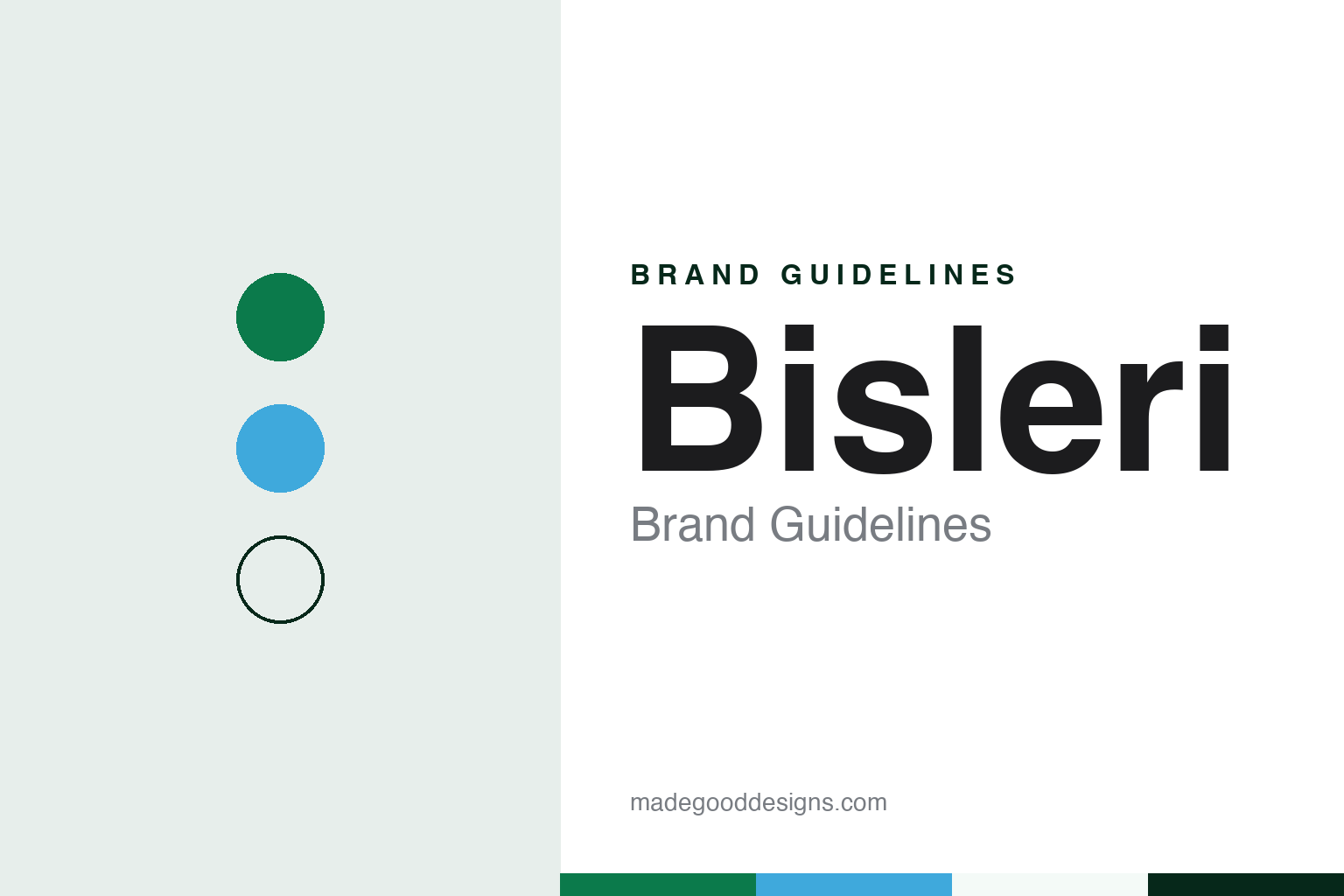
Two constants: a Bisleri green, blue and clear palette and a clean sans register. Abstract homage — not a Bisleri product or mark; no bottle, label or logo is reproduced.
From Milan to Thane
An Italian name, an Indian market.
The name is Italian. Felice Bisleri, a self-taught chemist from the province of Brescia who had fought with Garibaldi as a teenager, built a business in Milan on Ferro-China Bisleri, an amaro made with cinchona bark, herbs and iron salts, and on Nocera Umbra mineral water, according to Italian Wikipedia, citing the Dizionario Biografico degli Italiani. He died in September 1921 at San Pellegrino Terme, the Giornale di San Pellegrino reported that month.
Bisleri reached India through Dr Rossi, who, the Deccan Herald reported in 2022, had been the Bisleri family’s doctor and took over the company after Felice Bisleri’s death. With his friend Khushroo Suntook, an Indian businessman, he set up a Bisleri water plant at Thane, outside Mumbai — in 1965 according to the Deccan Herald, in 1966 according to Firstpost. Bisleri mineral water and soda were sold in glass bottles, at first mainly in luxury hotels and restaurants.
In 1969 the Chauhan family of Parle bought the brand. “When we bought Bisleri mineral water from the Italian company, Felice Bisleri, in 1969 — the company had been unable to market bottled water and wanted to exit the market — we too did not see any potential for the product at that time,” Ramesh Chauhan told Rediff’s The Strategist in 2005. The Parle soft-drinks business needed a soda, he said, so it used the name, and “the Italian name added a dash of class to it.”
The Parle name now covers separate companies. In the 1970s Jayantilal Chauhan divided his soft-drinks business between his sons, Quartz reported in 2017: Prakash Chauhan took Parle Agro, and Ramesh Chauhan took Parle Exports, today Bisleri International. The biscuit maker Parle Products is a different company again.
Colour
Veri veri extraordinari.
Under Parle Exports, Bisleri sat alongside a run of Indian soft drinks. The company launched the mango drink Maaza in 1976, The Economic Times reported, and after Coca-Cola left India in 1977 it built Thums Up, Limca and Gold Spot. In 1993 it sold those carbonated brands, with Citra and RimZim and the Indian rights to Maaza, to The Coca-Cola Company, India Today and the Times of India reported, under a non-compete that kept it out of fizzy drinks for 15 years. Chauhan then concentrated on water.
Advertising had to sell a product with no colour or taste of its own, Chauhan said in 2005. The first print campaign showed a butler in a bow tie holding two bottles under the line “Bisleri is veri veri extraordinari” — spelled that way, he said, to catch the eye. Packaging did much of the rest. Bisleri moved from glass to PVC in the early 1980s and to PET bottles in the mid-1980s, which Chauhan said let the company show the water itself; it launched a 500 ml bottle in 1995, added a tamper-evident seal in 1998 and later sold bulk jars of 12 and 20 litres.
The colour followed. In 2006, the Deccan Herald reported in 2022, Bisleri changed its packaging from blue to the green that is now its signature, to stand out from competitors. In 2017 its “one nation, one water” campaign printed labels in different Indian languages, the same paper said.
Success brought imitation. The Deccan Herald reported that customers in India asked for “a Bisleri” rather than for a bottle of water, and Forbes India has reported on rival bottles sold under lookalike spellings of the name.
Typography
India’s drink brands.
The seven brands in this group are all drink names from India: Thums Up, Limca, Frooti, Paper Boat, Rasna, Bisleri and Maaza. Indian drink brands in general sit at many different points in the trade, from family firms that still carry a founder’s name to names that now belong to much larger food and drink groups, and a single brand can be sold everywhere from a corner shop to a supermarket shelf.
A drink brand’s identity is usually carried less by a single product than by a pack, a name and the drink it promises, because the company behind the name may have changed hands, moved its production or grown far beyond the place where it started. That makes the questions behind each name worth asking plainly: who started it, who owns it now, and where its products are actually made and packed.
Each guide separates what independent sources record from what the company says about itself — its founding story, its owners over time, where its products are made and how its packaging has changed — and marks plainly what rests only on the company’s own word.
Aa
A clean sans for a clear product. (Specimen set in DM Sans, a sans STAND-IN; NOT the Bisleri logo.)
Bisleri International
One brand, many bottlers.
The water business was reorganised in 2000, when Ramesh Chauhan announced that Bisleri, then run by eight companies from 16 locations, would be brought under one entity, Rediff reported; Bisleri International, based in Mumbai, was incorporated in 2001. In 2006 it sold the Maaza trademark for Europe to Infra Beverages and for the United States to House of Spice, The Economic Times reported.
Production is spread across many sites. In 2022 the Deccan Herald counted 122 operational plants, 13 of them owned by the company, served by about 4,500 distributors; The Economic Times gave 150 plants in 2023, when Bisleri announced a supply agreement to enter the UAE. The range now includes Vedica, a premium water from a spring in the Himalayan foothills of Uttarakhand, and the Bisleri Pop soft drinks of 2016 — Limonata, Fonzo, Spyci and Pina Colada — with which the company returned to carbonated drinks after 23 years, the Business Standard reported. An energy drink, Urzza, was launched in 2014 and withdrawn in 2017, BusinessLine reported.
In November 2022 Ramesh Chauhan said he was looking for a buyer for Bisleri International and was in talks with several parties, including Tata Consumer Products, the Deccan Herald reported; in March 2023 Tata Consumer said it had ended the negotiations, The Economic Times reported.
For a design guide, Bisleri shows how a colourless product can be identified by a colour: the 2006 switch to green set its bottles apart on the shelf. Compare Maaza, the mango drink Parle Exports launched in 1976, and Thums Up, the cola it sold to Coca-Cola in 1993. For this guide we use a bottle green, a water blue and a clear white with a clean sans, an unofficial interpretation; no product or logo is reproduced.
Explore & save
Keep Bisleri’s identity on hand — save it to a board in the Made Good inspiration library.
Bisleri identity set
Pin the Bisleri green, blue and clear palette and the clean sans register to your own board.