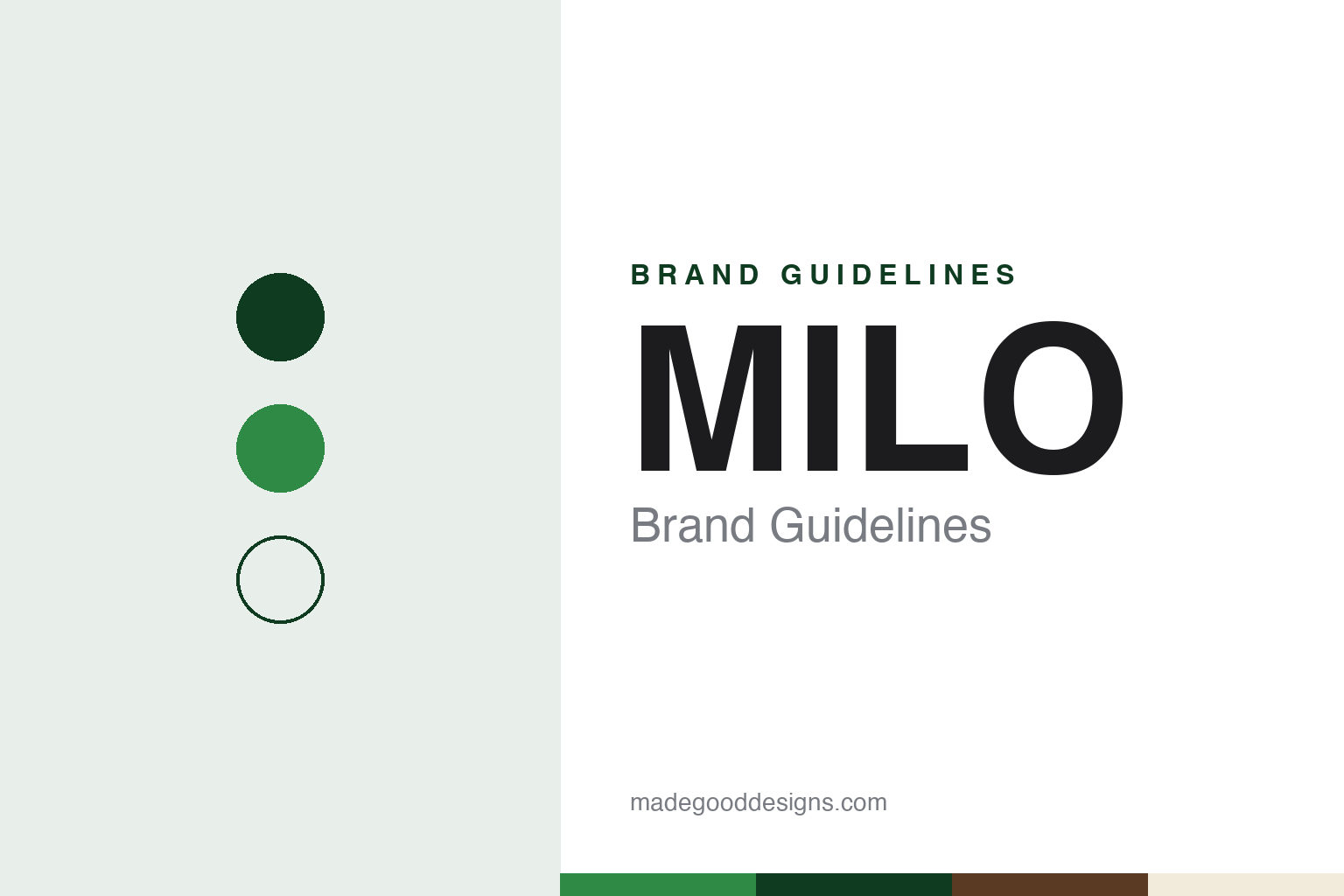
MILO Brand Guidelines
Thomas Mayne’s 1934 chocolate malt drink from Smithtown.
Aa
Two constants: a MILO green and malt brown palette and a bold sport sans register. Abstract homage — not a MILO product or mark; no can, logo or pack is reproduced.
Smithtown
A Nestlé chemist and a show in Sydney.
MILO was developed in Australia by Thomas Mayne (1901–1995), an industrial chemist working for Nestlé. Time, in its 1995 obituary, said he spent four years experimenting before he perfected the recipe for the powder that Nestlé launched in 1934; Nestlé’s own Australian website, in 2015, called him “a Nestlé Engineer” and said he worked during the Depression, combining “local milk knowledge and Swiss cocoa expertise.” The drink was launched at the Sydney Royal Easter Show in 1934, the company says, in an area of the show used to present new products to the public. Nestlé’s corporate history lists the same year: “Malted chocolate drink Milo launches in Australia, and is later exported to other markets.”
The name came from Milo of Croton, the athlete of ancient Greece remembered in legend for his strength, the company says. Nestlé writes the brand in capitals as MILO, and English Wikipedia describes the product as a chocolate-flavoured malted powder, usually mixed with milk, hot water or both.
Production began at Smithtown, a small town in rural New South Wales. ABC News reported in May 2021, when the factory marked its centenary, that the site had begun as a milk-processing plant in 1896 and passed to Nestlé in 1921, and that mass production of MILO started there shortly after the 1934 launch. The machines that turn malt into MILO arrived in the 1950s, according to the same report. The company’s 2015 website said the launch coincided with the opening of the Smithtown plant, “where it is still produced today.”
Colour
One brand, many local factories.
Smithtown still makes MILO for Australia and New Zealand. In 2021 ABC News reported that the factory employed more than 200 people, could fill up to 200,000 cans a day — about 13,000 tonnes a year — and exported, particularly to South-East Asia; its manager told the broadcaster the original recipe was “virtually” unchanged. The plant then made four varieties: original, high protein, plant-based and reduced sugar. More than 80 per cent of its energy was renewable, ABC News said, with sawdust from local sawmills burned in its boilers.
Elsewhere MILO is made locally, and English Wikipedia notes that its composition and taste differ from country to country. In 2015 Nestlé Singapore told The Straits Times that the MILO sold there is made at its factory in Jurong. In December 2020 Japan suspended sales after demand rose following a viral social-media post, because its MILO used ingredients imported from Singapore, the Mainichi reported. In August 2016 Reuters reported that Nestlé Philippines was building a new MILO plant. In Colombia, where the brand arrived in 1944, it is made at Nestlé’s plant in Bugalagrande, Valle del Cauca, El Colombiano reported in October 2024, marking its 80th year there; a Nestlé Colombia director told the paper MILO held 60 per cent of the country’s milk-modifier market, and the paper cited Kantar figures putting it in three-quarters of Colombian households.
The brand is strongest in South-East Asia. A Singapore newspaper reported in 2009 that Malaysia had the world’s highest MILO consumption per head, with Singapore second. In both countries, English Wikipedia and CNA Lifestyle describe MILO vans — trucks serving the drink at sports days, community events and schools — and coffee shops serve local versions such as iced “Milo Peng” and the “Milo Dinosaur,” a cup topped with a heap of undissolved powder. Nestlé also sells MILO Nuggets, a snack sold in South-East Asia and Colombia since 1994, according to Nestlé’s Colombian and Singapore websites.
Typography
Design and documentation.
The seven brands in this group are all milk, chocolate and fruit drink names: Milo, Nido, La Lechera, Cacaolat, Granini, Ting and Bigga. Milk, chocolate and fruit drink brands in general sit at many different points in the trade, from family firms that still carry a founder’s name to names that now belong to much larger food and drink groups, and a single brand can be sold everywhere from a corner shop to a supermarket shelf.
A drink brand’s identity is usually carried less by a single product than by a pack, a name and the taste or moment it promises, because the company behind the name may have changed hands, moved its production or grown far beyond the place where it started. That makes the questions behind each name worth asking plainly: who started it, who owns it now, and where its drinks are actually made and packed.
Each guide separates what independent sources record from what the company says about itself — its founding story, its owners over time, where its products are made and how its packaging has changed — and marks plainly what rests only on the company’s own word.
Aa
A bold sport sans — the register of a green can. (Specimen set in Archivo, a sans STAND-IN; NOT the MILO logo.)
MILO
A green can and a name taken from an athlete.
MILO’s packaging is best known as a green can. In Australia and most other countries the can is green and shows people playing sports, English Wikipedia says; Spanish Wikipedia describes the same green can with images of athletes. The design has changed with local campaigns. English Wikipedia, citing the Peruvian design archive Arkivperu, says that in Peru in the 1970s, under the military government, MILO labels carried Peruvian motifs — towns, history, crops, fruits, animals and plants — and that sport returned to the labels after 1980.
Sport has also been the brand’s main channel. In Australia, MILO has sponsored junior cricket with Cricket Australia for more than 25 years, Nestlé said in 2017, through programmes now called MILO in2CRICKET and MILO T20 Blast; in Colombia it has run the Copa MILO and worked with the Colombian Olympic Committee, El Colombiano reported. In October 2026 Nestlé announced a multi-year international marketing partnership with the NBA naming MILO, Nescau and Nesquik as official partners, according to its newsroom. Advertising has also drawn criticism: in 2017 Nestlé Philippines ran a schools campaign with the Department of Education built on an “energy gap” message, which an article in BusinessWorld criticised as marketing to children.
The brand has stretched beyond the powder. English Wikipedia lists ready-to-drink versions, cereals and snack bars in various markets; in Australia a MILO chocolate bar was dropped in 2003, and Nestlé launched dairy-free versions made with almond and soy in Asia in 2021, Dairy Reporter reported. In May 2013 Nestlé brought MILO back to Portugal after more than 20 years away, its Portuguese website said at the time. In Australia McDonald’s sold a MILO McFlurry from September 2023 and added a MILO thickshake in January 2026.
For a design guide, MILO shows how a single colour and a sporting name can hold one brand together across dozens of local factories and recipes. Compare Ovaltine, the Bern malt drink, and Horlicks, the malted milk with British and American roots. For this guide we use a can green, a deep green and a malt brown with a bold sans, an unofficial interpretation; no product or logo is reproduced.
Explore & save
Keep MILO’s identity on hand — save it to a board in the Made Good inspiration library.
MILO identity set
Pin the MILO green and malt brown palette and the bold sport sans register to your own board.