La Lechera Brand Guidelines
Nestlé’s milkmaid, made in Spain since 1910.
Aa
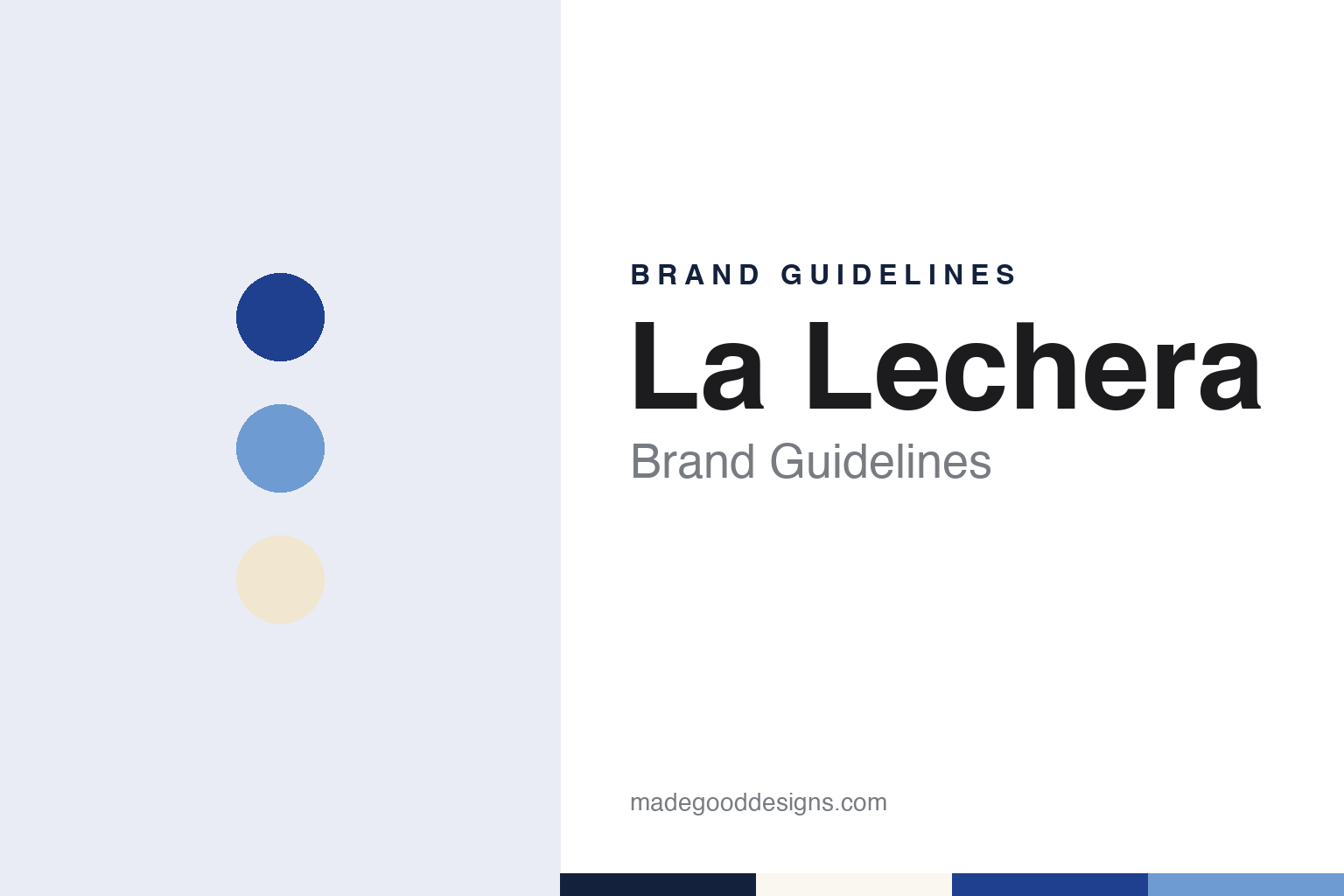
Two constants: a La Lechera cobalt, dairy blue and cream palette and a warm pictorial serif register. Abstract homage — not a La Lechera product or mark; no can, label or logo is reproduced.
The Anglo-Swiss
A milkmaid from Cham.
La Lechera — Spanish for “the milkmaid” — is a Nestlé brand of sweetened condensed milk sold in Spain, across Latin America and to Hispanic shoppers in the United States. Its name and its milkmaid picture go back to a company that was once Nestlé’s rival. In 1866 the American brothers Charles and George Page founded the Anglo-Swiss Condensed Milk Company at Cham, in Switzerland, to make condensed milk for European markets, using machinery and methods taken over from the American Gail Borden, according to English Wikipedia. The company grew quickly, it says: by the mid-1870s it had factories in England, at Chippenham and Aylesbury among others, and at Lindau in Germany, and from 1882 it expanded into the United States, building a large plant at the Pages’ home town of Dixon, Illinois, before selling its American business to Borden in 1902.
The Anglo-Swiss sold its milk under a milkmaid name that changed with the language. English Wikipedia gives the German “Milchmädchen”; Nestlé España, in a 2016 history of the brand, gives the French “La Laitière”; in English-speaking markets, including Britain and its empire, the name was “Milkmaid,” the Indian magazine Scroll reported in 2022. Nestlé, founded by Henri Nestlé at Vevey, competed with the Anglo-Swiss for decades. Early in 1905 the two merged as the Nestlé and Anglo-Swiss Condensed Milk Company, a name later shortened to Nestlé.
Nestlé España says that its share of the merger included a newly opened factory at La Penilla de Cayón, in Cantabria, and that in 1910 the factory began producing condensed milk under the name La Lechera, after rebuilding its tinplate shop, machine room and milk reception. The company marked a century of La Lechera in Spain in 2010.
Colour
Radio songs and a royal warrant.
Nestlé España’s history gives La Lechera a long record of promotion in Spain. In 1920 the company let shoppers exchange labels from Harina Lacteada Nestlé and La Lechera for shares in that year’s Christmas lottery, and on 1 September 1927 Nestlé renewed its title of official supplier to the royal household, which allowed it to print the royal arms on the invoices and labels of both products.
The Civil War all but stopped production. Afterwards Nestlé opened a factory at Pontecesures, in Pontevedra, in 1939. Condensed milk stayed under state control until 1950, and when the press announced that La Lechera “had returned,” it came in glass jars because tinplate was scarce, the company says. In the 1950s, it says, Morcillo’s song “La vaca lechera” became La Lechera’s radio jingle, played up to 14 times a day, and in 1954 La Lechera and Nescafé were promoted together as “la combinación perfecta.” In the 1960s the brand was attached to Antonio Losada’s radio serials, followed daily as “La novela La Lechera,” and in 1967 it adopted the slogan “La Lechera, cada día, en cada hogar” (“every day, in every home”). A prize promotion, the Feriatómbola La Lechera, followed in 1968 and 1969.
Production left Cantabria for Pontecesures at the end of 1978. Nestlé España says sterilised milk then reduced demand for condensed milk as a drink, and that in the 1990s La Lechera turned towards baking and desserts; in the mid-1990s it moved to a taller, narrower can with an easy-open lid, and in 2001 it launched “Sirvefácil,” a plastic squeeze bottle with a dispensing valve.
Typography
Milk, cocoa and fruit in a bottle.
The seven brands in this group are all milk, chocolate and fruit drink names: Milo, Nido, La Lechera, Cacaolat, Granini, Ting and Bigga. Milk, chocolate and fruit drink brands in general sit at many different points in the trade, from family firms that still carry a founder’s name to names that now belong to much larger food and drink groups, and a single brand can be sold everywhere from a corner shop to a supermarket shelf.
A drink brand’s identity is usually carried less by a single product than by a pack, a name and the taste or moment it promises, because the company behind the name may have changed hands, moved its production or grown far beyond the place where it started. That makes the questions behind each name worth asking plainly: who started it, who owns it now, and where its drinks are actually made and packed.
Each guide separates what independent sources record from what the company says about itself — its founding story, its owners over time, where its products are made and how its packaging has changed — and marks plainly what rests only on the company’s own word.
Aa
A warm pictorial serif for a brand named after its milkmaid. (Specimen set in Playfair Display, a serif STAND-IN; NOT the La Lechera logo.)
La Lechera
One milkmaid, several names.
Outside Spain the brand took different routes. Milkmaid condensed milk reached Brazil as an import: on 22 January 1890 the newspaper O Estado de S. Paulo carried an advertisement for Milkmaid-brand condensed milk sold in pharmacies, Portuguese Wikipedia says, citing Terra Magazine. It says local manufacture began in 1921 at Araras, in São Paulo state, and that because shoppers found the English name hard to say they asked for the milk of the “moça,” the girl on the label; Nestlé adopted the name Leite Moça in Brazil around the 1930s. In Portugal the product is sold simply as Leite Condensado Nestlé. Nestlé’s US website for La Lechera said in 2010 that the brand had been “sweetening the lives of Latin American families since 1921,” and in 2022 eDairy News reported that La Lechera was marking a century in Colombia, where its products first arrived via Panama in 1922.
The milkmaid name is used in France by a separate product line. La Laitière is a yogurt and dessert brand launched by Chambourcy in 1973, whose advertising was built on Johannes Vermeer’s painting The Milkmaid, Spanish Wikipedia says, citing Le Figaro (2012). It is not the condensed milk.
For a design guide, La Lechera shows how a single pictorial idea — a woman carrying milk — can travel through translation and keep its meaning, from Milchmädchen and Milkmaid to La Lechera and Moça. Compare Nido, another Nestlé milk brand, and Peak, the evaporated milk Nigeria has known since 1954. For this guide we use cobalt, dairy blue and cream with a warm serif, an unofficial interpretation; no product or logo is reproduced.
Explore & save
Keep La Lechera’s identity on hand — save it to a board in the Made Good inspiration library.
La Lechera identity set
Pin the La Lechera cobalt, dairy blue and cream palette and the warm pictorial serif register to your own board.