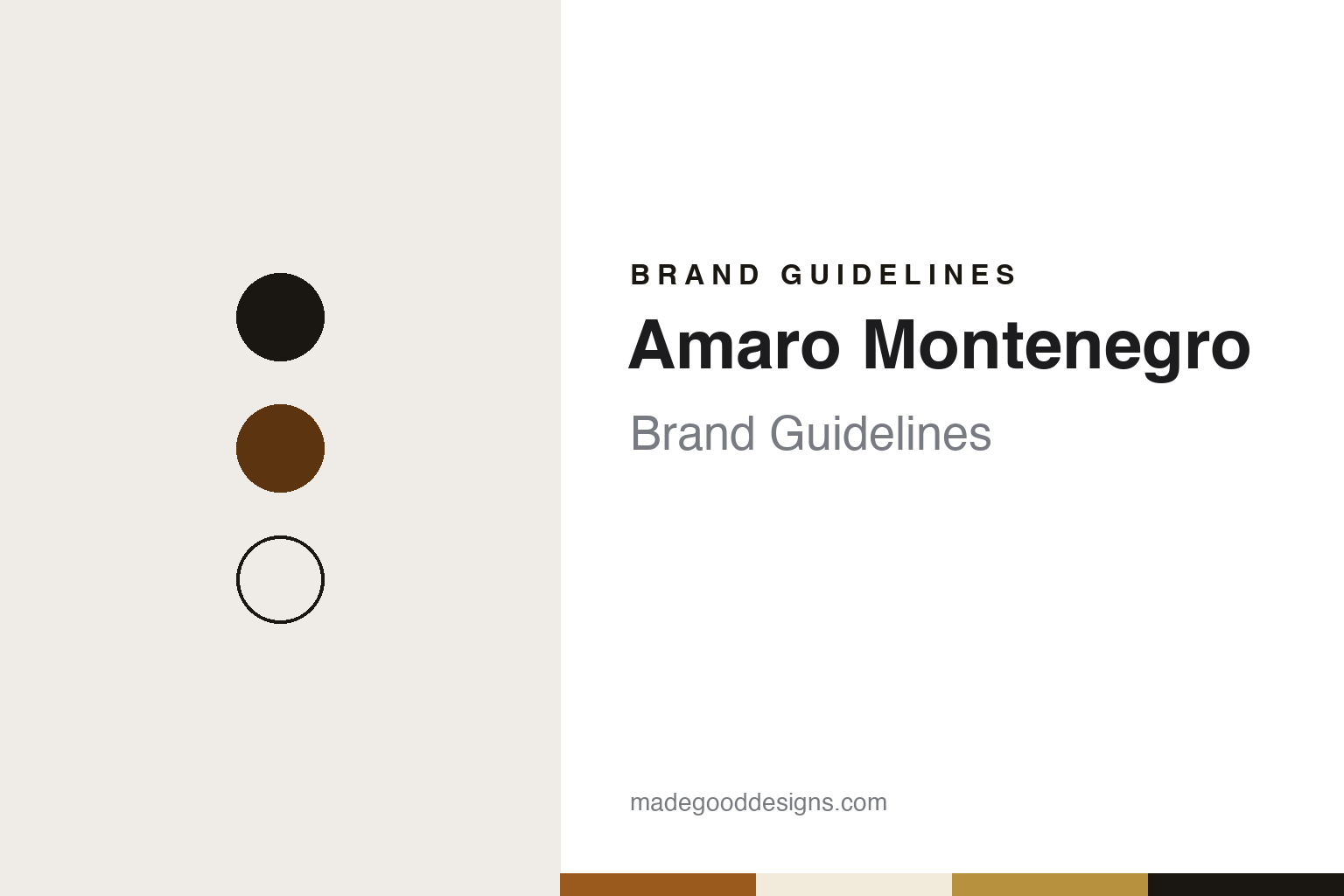
Amaro Montenegro Brand Guidelines
Stanislao Cobianchi’s 1885 Bologna amaro named for a princess.
Aa
Two constants: an Amaro Montenegro amber, gold and ivory palette and an Old-style serif register. Abstract homage — not an Amaro Montenegro product or mark; no bottle, label or logo is reproduced.
Elisir Lungavita
A steam distillery in Bologna.
Amaro Montenegro comes from Bologna. Gruppo Montenegro, the company that makes it, says it began in 1885, when Stanislao Cobianchi, whom it calls a young alchemist and an expert herbalist, founded the “Cobianchi Stanislao Distilleria a Vapore” — a steam distillery — in the city. Italian Wikipedia says Cobianchi had been intended by his family for the priesthood, and that he instead travelled widely and came home with an interest in unusual botanical ingredients.
The distillery made many products. The company lists bitters and vermouth as well as liqueurs whose names, it says, are now almost forgotten: ratafià, alchermes, arquebuse, persico, latte di vecchia and rosolio. Among them was a drink called Elisir Lungavita — roughly, “long-life elixir.”
In 1896 Cobianchi renamed it. That year Princess Elena of Montenegro married the Italian crown prince, the future King Victor Emmanuel III, and, Italian Wikipedia says, Cobianchi dedicated his elixir to her on the occasion of the wedding, calling it Amaro Montenegro. The company describes the dedication the same way, naming Elena as the “future queen of Italy.” The name thus honours the princess, not the country.
Italian Wikipedia, citing the company, says the poet Gabriele D’Annunzio called it the “liquore delle Virtudi,” the liqueur of virtues, in 1921.
Colour
Forty botanicals and an ampoule.
The company says Amaro Montenegro is still made to Cobianchi’s original recipe, with a secret formula of 40 aromatic botanicals. English Wikipedia names vanilla, orange peel and eucalyptus among them. Italian Wikipedia, drawing on a 2017 interview with the company’s Master Herbalist, Matteo Bonoli, says the written recipe has been kept in a safe since 1885 and is known to only a few people.
The method is described in unusual detail. According to a 2017 report in Italia a Tavola, cited by Italian Wikipedia, the botanicals are boiled, macerated and distilled to produce twelve essences, from which six aromatic notes are drawn; a seventh note, called the “Premio,” comes from the micro-distillation of five herbs. The blend is then mixed with alcohol, water and sugar and bottled, and the whole process takes six months. The amaro is bottled at 23 per cent alcohol, according to the brand’s website.
The bottle is the brand’s main visual signature. Italian Wikipedia, citing the trade magazine Mixer Planet, says Cobianchi designed it himself, taking the shape of an ampoule — the kind of vessel associated with potions and alchemy. That shape stayed unchanged until 2017, when the bottle was redrawn with firmer lines while keeping its traditional look; the year 1885 is now embossed on the shoulder and Cobianchi’s signature on the foot, according to Distribuzione Moderna, also cited by Italian Wikipedia. The company itself calls the bottle “iconic.” Its slogan, Italian Wikipedia says, is “Amaro Montenegro. Sapore vero” — “true taste.”
Typography
The amaro tradition.
The seven brands in this group are all Italian amaro and liqueur names: Fernet-Branca, Averna, Ramazzotti, Montenegro, Cynar, Strega and Galliano. Italian amaro and liqueur brands in general sit at many different points in the trade, from family firms that still carry a founder’s name to names that now belong to much larger drinks groups, and a single brand can be sold everywhere from a neighbourhood bar to a supermarket shelf.
A drinks brand’s identity is usually carried less by a single product than by a bottle, a label, a name and the ritual it promises, because the company behind the name may have changed hands, moved its production or grown far beyond the town where it started. That makes the questions behind each name worth asking plainly: who started it, who owns it now, and where its drinks are actually made and bottled.
Each guide separates what independent sources record from what the company says about itself — its founding story, its owners over time, where its drinks are made and how its bottles and labels have changed — and marks plainly what rests only on the company’s own word.
Aa
An old-style serif — a Bologna name of 1885. (Specimen set in Cormorant Garamond, a serif STAND-IN; NOT the Amaro Montenegro logo.)
Gruppo Montenegro
An amaro that built a food group.
The amaro became the base of a much larger business. The company says its expansion began in 1986, when it took half of Stucker Zesiger, the maker of Thè Infrè tea, buying the rest in 2011. In 1988 it added the Bonomelli camomile brand and the Pilla company, bringing in the Select aperitif and Oro Pilla brandy; in 1999 it added the Buton distillery’s Vecchia Romagna brandy. Food brands followed, among them Cannamela spices in 1995 and Olio Cuore in 2002. In 2024 it acquired the Venezuelan rum Pampero from Diageo, Il Sole 24 Ore reported. It also distributes other companies’ spirits in Italy, including Rémy Cointreau’s from 2025, Pambianco reported.
The group is run from Zola Predosa, west of Bologna, where Montenegro S.r.l. has its registered office. Sources differ on where the amaro is made: Italian Wikipedia gives the Zola Predosa plant, while English Wikipedia names a factory at San Lazzaro di Savena, east of the city; the company’s own history records major investment in its San Lazzaro plant in 2015. The brand’s website says only that the amaro is “produced and bottled by Montenegro Srl.” The company’s website names Sergio Fava as chief executive since 2023 and Lorenza Guerra Seràgnoli as chair of its board. It began a development plan for the United States in 2013 and founded Montenegro Americas in July 2018, it says.
The spirits list keeps growing beyond the amaro. The company launched Edgar Sopper, a London dry gin whose bottle, it says, takes its ribbing from the glasshouses of Kew Gardens, in 2021, and Maysta, a Polish rye vodka, in 2024. In 2023 it opened Ca’ Select, a production and visitor space in Venice’s Cannaregio district for the Select aperitif, returning part of that brand’s production to the city where the Pilla brothers first made it in 1920.
In November 1995, Italian Wikipedia says, citing the Corriere della Sera, Montenegro joined Ramazzotti and Branca in obtaining a ban on a state-railways television advertisement in which an actor playing a station master spat out an amaro.
For a design guide, Amaro Montenegro shows how a single bottle shape, a founder’s signature and a date can carry a brand for well over a century. See our note on the Amaro Montenegro font, and compare Ramazzotti, the Milan amaro of 1815, and Averna, the Sicilian amaro. For this guide we use amber, antique gold and ivory with a serif, an unofficial interpretation; no product or logo is reproduced.
Explore & save
Keep Amaro Montenegro’s identity on hand — save it to a board in the Made Good inspiration library.
Amaro Montenegro identity set
Pin the Amaro Montenegro amber, gold and ivory palette and the Old-style serif register to your own board.