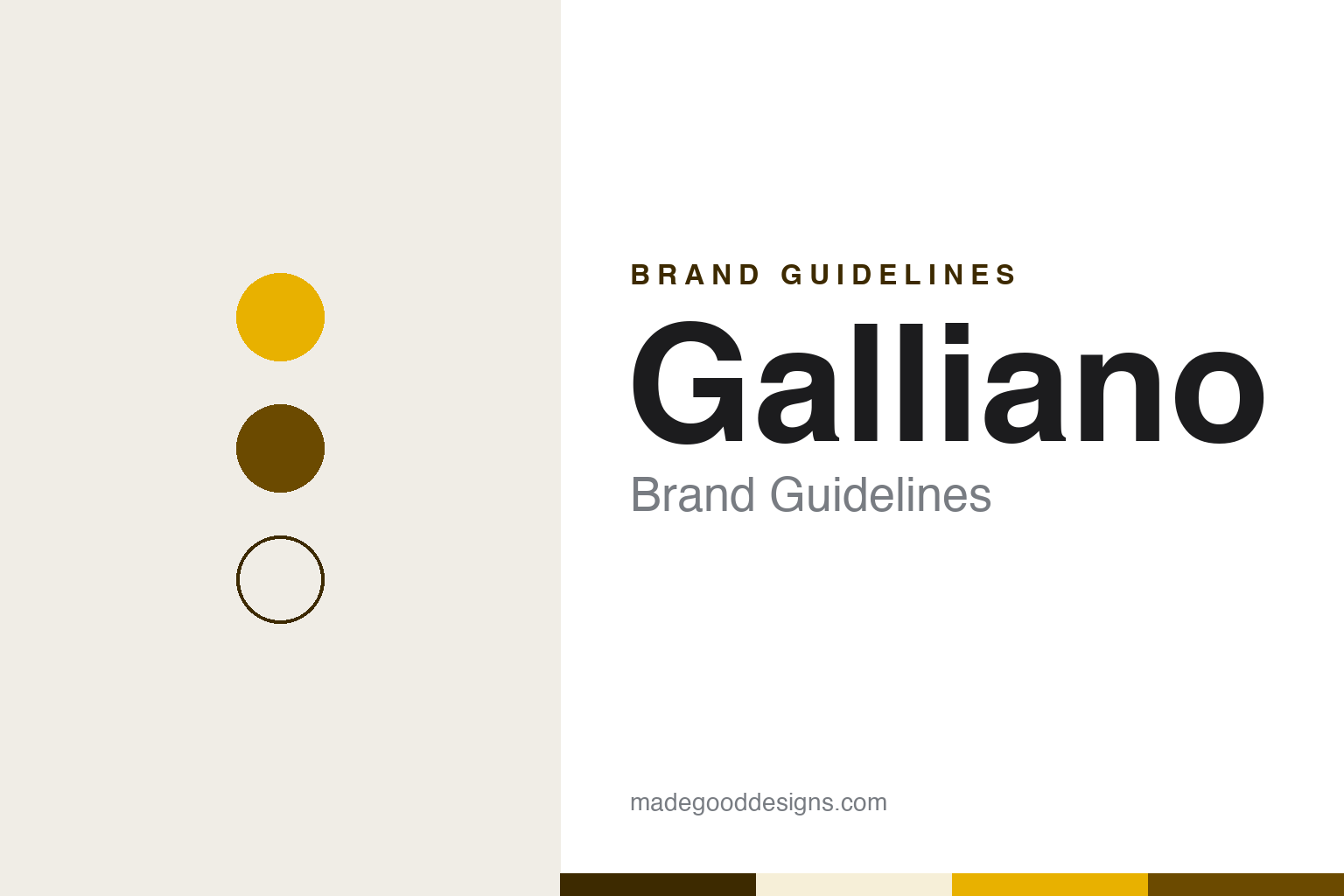
Galliano Brand Guidelines
The Livorno gold liqueur in a column-shaped bottle.
Aa
Two constants: a Galliano gold, amber and marble cream palette and a Roman capital serif register. Abstract homage — not a Galliano product or mark; no bottle, label or logo is reproduced.
Arturo Vaccari
A Livorno distiller and a name taken from the news of 1896.
Galliano is a sweet, bright yellow herbal liqueur from Italy, and its story starts with one distiller in Tuscany. Italian Wikipedia, citing a 1997 article in the Corriere della Sera, says Arturo Vaccari of Livorno founded the distillery that carried his name in 1872, and in 1896 created a new liqueur at the Distilleria Arturo Vaccari. English Wikipedia describes him as a Tuscan distiller and brandy producer.
Vaccari named the liqueur after Giuseppe Galliano, an officer of the Royal Italian Army in the First Italo-Ethiopian War; Italian Wikipedia says Vaccari chose the name to honour the officer. The full name used today is Liquore Galliano L’Autentico, though most people simply say Galliano. The name has nothing to do with the fashion designer John Galliano or with the London band of the same name.
The company’s own account adds a second place to the story. Its heritage page says Vaccari turned to Fratelli Maraschi, a firm it says was established in Turin in 1888 and is now known as Maraschi & Quirici, based in Chieri, just outside Turin. The company calls Chieri “the birthplace of Galliano,” where it says Vaccari first crafted his liqueur in 1896, and says many of the herbs and spices used in the recipe grow in that area. Italian Wikipedia and the Corriere place the distillery in Livorno, so the two accounts are given here side by side. Italian Wikipedia includes an advertisement for the Distilleria Arturo Vaccari dated 1901.
Colour
A gold liqueur, a column and a cartoon surfer.
The liquid is the first part of the identity. English Wikipedia describes Galliano as sweet, with a vanilla-and-anise flavour and citrus and woody herbal notes behind it, and says it is the vanilla that sets it apart from other anise liqueurs such as sambuca and pastis. It lists star anise, Mediterranean anise, juniper, yarrow, lavender, peppermint, cinnamon and vanilla among the ingredients, citing the company. The original blend is bottled at 42.3% alcohol by volume, and a version with a stronger vanilla taste at 30%. Its golden yellow colour is the brand’s most visible signal.
The second part is the bottle. Italian Wikipedia describes the tall bottles with a tapering, many-sided shape as characteristic of the brand, and English Wikipedia, citing the drinks distributor Maxxium in 2007, says it is reminiscent of a classical Roman column. The company says the tall, slender shape with its many tapered flat sides was “inspired by the columns of the ancient temples of Rome,” and jokes that its height kept it on the top shelf. Italian Wikipedia also records collectors’ bottles in the shape of a Carabiniere in full dress uniform, with the plumed hat forming the stopper, and ceramic miniatures called Gallianino made by the Coronetti works of Cunardo and C.A.S.A. of Cameri. It adds that the liqueur was named in a story by Emilio Salgari and in John Fante’s novel Full of Life.
The third part is the cocktail. English Wikipedia says the Harvey Wallbanger — vodka and orange juice with Galliano floated on top — was created in 1969 as a marketing campaign by McKesson Imports Company, Galliano’s importer in the United States. The campaign was led by its marketing director, George Bednar, and a cartoon surfer named Harvey was commissioned from the graphic artist William J. “Bill” Young of Lima, New York, the Democrat & Chronicle of Rochester reported in 2016. Bednar claimed to have written the tagline “Harvey Wallbanger is the name. And I can be made!”, Connecticut’s News-Times reported in 2007. The drink itself is credited to the Hartford bartender Donato “Duke” Antone, Saveur reported in 2012, and was very popular in the United States in the 1970s. Galliano is also one of the ingredients in the Golden Dream, Yellow Bird and Barracuda, which Italian Wikipedia lists among the International Bartenders Association’s official cocktails.
Typography
Design and documentation.
The seven brands in this group are all Italian amaro and liqueur names: Fernet-Branca, Averna, Ramazzotti, Montenegro, Cynar, Strega and Galliano. Italian amaro and liqueur brands in general sit at many different points in the trade, from family firms that still carry a founder’s name to names that now belong to much larger drinks groups, and a single brand can be sold everywhere from a neighbourhood bar to a supermarket shelf.
A drinks brand’s identity is usually carried less by a single product than by a bottle, a label, a name and the ritual it promises, because the company behind the name may have changed hands, moved its production or grown far beyond the town where it started. That makes the questions behind each name worth asking plainly: who started it, who owns it now, and where its drinks are actually made and bottled.
Each guide separates what independent sources record from what the company says about itself — its founding story, its owners over time, where its drinks are made and how its bottles and labels have changed — and marks plainly what rests only on the company’s own word.
Aa
A Roman capital serif for a bottle the company likens to a temple column. (Specimen set in Cinzel, a serif STAND-IN; NOT the Galliano logo.)
Galliano
From a Livorno distillery to a Dutch drinks group.
The Vaccari family business did not last. Italian Wikipedia says the Distilleria Arturo Vaccari no longer exists, and that the liqueur was acquired in 1989 by the French drinks group Rémy Cointreau. Rémy Cointreau bought the Dutch liqueur maker Bols in 2000, English Wikipedia says, and in March 2006 it sold the Bols business to the investment fund ABN AMRO Capital, which took 75%, and a management team led by Huub van Doorne, which took 25%, according to press releases from ABN AMRO and Rémy Cointreau at the time. The new company, Lucas Bols B.V., was based in Amsterdam, and its brands included Bols, Galliano, Vaccari Sambuca and Pisang Ambon.
Lucas Bols was listed on Euronext Amsterdam from February 2015, according to Dutch Wikipedia, citing Het Financieele Dagblad and the broadcaster NOS. In October 2023 the Schiedam family distiller Nolet offered to buy the shares it did not already hold, Marketing Tribune reported; Nolet declared its offer unconditional in February 2024, and trading in Lucas Bols shares ended on 30 August 2024, Dutch Wikipedia says, citing nu.nl. Under its Dutch owners the Galliano name now covers a family of products. The company’s website lists Galliano L’Autentico, Galliano Vanilla, Galliano Espresso, Galliano Amaretto, white and black sambucas and Galliano L’Aperitivo, which English Wikipedia says was developed with the bartender Ago Perrone.
Where Galliano is made is described differently by different sources. Italian Wikipedia says the liqueur is produced today in the Netherlands by Lucas Bols. The company says Galliano is distilled by Maraschi & Quirici near Turin, in two traditional copper pot stills, each holding less than 100 litres, which it says that firm dedicates exclusively to Galliano. Dutch Wikipedia notes that Lucas Bols contracts out most of its production. The company presents the brand as Italian, with the line “Spirito Italiano” on its heritage page.
For a design guide, Galliano shows how a colour, a tall bottle and a single campaign character can carry a liqueur brand across owners and countries. Compare Strega, another yellow Italian herbal liqueur that Italian Wikipedia says looks and tastes similar, and Averna, the Sicilian amaro. For this guide we use a Galliano gold, an amber brown and a marble cream with a serif, an unofficial interpretation; no product or logo is reproduced.
Explore & save
Keep Galliano’s identity on hand — save it to a board in the Made Good inspiration library.
Galliano identity set
Pin the Galliano gold, amber and marble cream palette and the Roman capital serif register to your own board.