Havana Club Brand Guidelines
The Cárdenas rum of 1934 that became “El Ron de Cuba.”
Aa
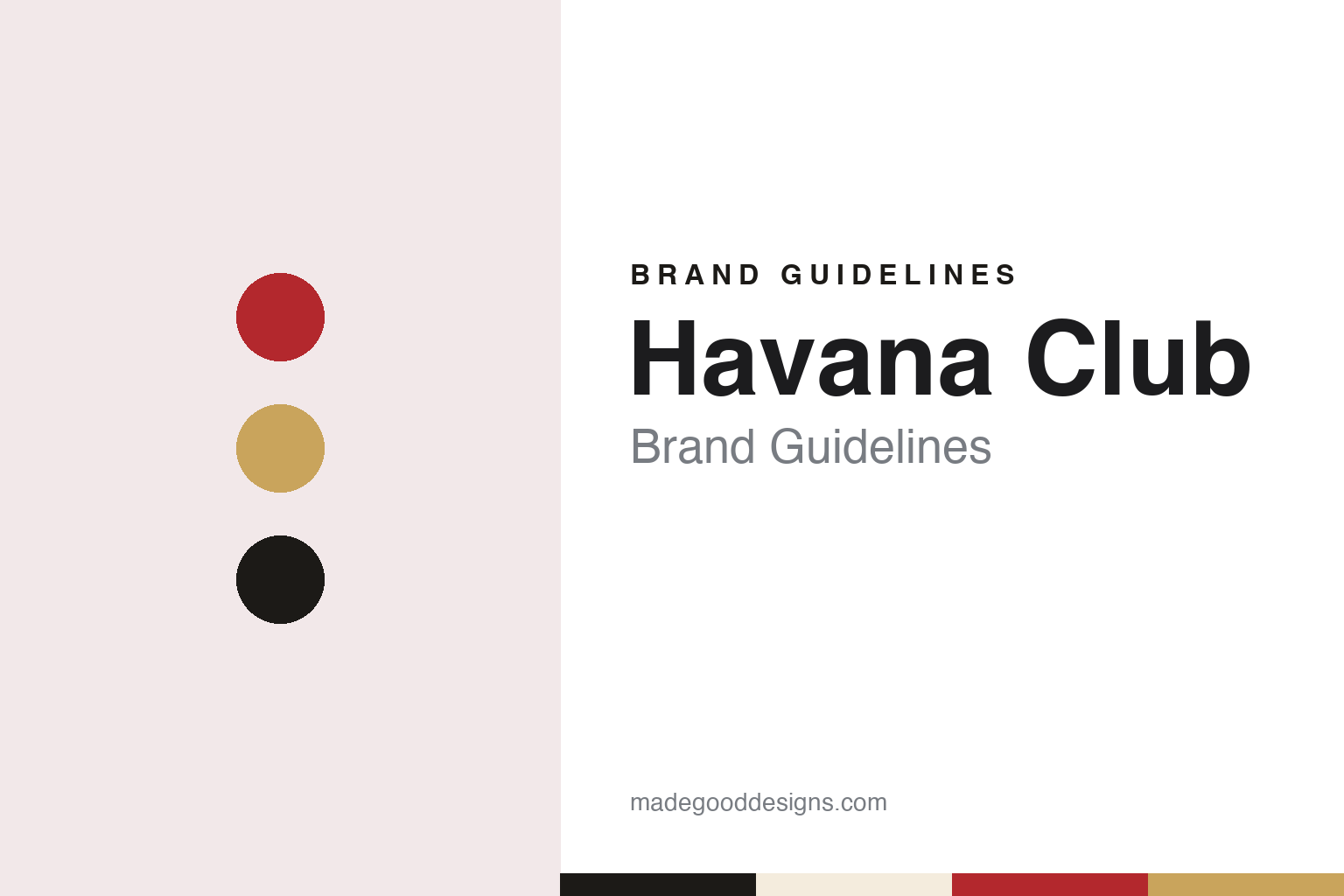
Two constants: a Havana red, label gold and añejo amber palette and a colonial display serif register. Abstract homage — not a Havana Club product or mark; no bottle, label, Giraldilla or logo is reproduced.
Cárdenas, 1934
A family firm, a sugar port and a new rum.
Havana Club began not in Havana but in Cárdenas, a sugar port on Cuba’s north coast in Matanzas province. The Arechabala family founded a distillery there in 1878, according to Tom Gjelten’s history Bacardi and the Long Fight for Cuba (2008). English Wikipedia’s article on the company names the founder as José Arechabala Aldama, a Spanish industrialist, and the first distillery as La Vizcaya; it made rum and other spirits from the molasses left over from sugar refining. The family business grew to include sugar refineries, a power plant, a barrel works and port warehouses, and in January 1921 it was incorporated as José Arechabala S.A.
The company created the Havana Club brand in 1934 and sold the rum in Cuba and the United States. The same article says a new rum plant opened in March 1934 to launch Havana Club alongside a second label, Doubloon, for the American market, and that the company opened a private bar called the Havana Club opposite Havana Cathedral, which became a stop for locals and visitors.
The Arechabala labels carried heraldry. The original emblem, used on the distillery’s products from its founding, showed the arms of Biscay, with the oak tree of Guernica and the wolves of the López de Haro family, the article says; in 1943 the Havana Club label turned blue with an emblem combining the arms of Biscay and Bilbao, and in late 1954 it returned to a version close to the original. A 75th-anniversary rum, Arechabala 75, followed in 1953.
Colour
Nationalisation, a new distillery and a joint venture.
The Cuban Revolution changed the brand’s ownership. In 1960 José Arechabala S.A. was nationalised without compensation, Bloomberg reported in 2011. The Cuban state kept the name: it began selling rum abroad as Havana Club in 1972, mainly to the Soviet Union and Eastern Europe, according to a 2006 article in World Trademark Review, and in 1977 production moved to a new plant at Santa Cruz del Norte, on the coast east of Havana, Gjelten writes. Its sales in East Germany still echo in the brand’s German marketing today, the scholar Jennifer Ruth Hosek wrote in Sun, Sex, and Socialism (2012).
In 1993, Pernod Ricard says, the French group and the state-owned Cuba Ron corporation created a joint venture, Havana Club International S.A., to sell Havana Club around the world; English Wikipedia describes it as a 50:50 partnership. The rum is still made in Cuba and sold in more than 120 countries, the Miami Herald reported in 2012, though not in the United States because of the US embargo. Since 2008 it has also been bottled in India, The Economic Times reported that year.
Pernod Ricard says the rum is made by a team of Maestros del Ron Cubano, Cuban rum masters working to traditional Cuban methods, whose know-how it says UNESCO recognised as intangible cultural heritage in 2022. The range runs from the white Añejo 3 Años, made for mixing, through the darker Añejo 7 Años to the aged Selección de Maestros and the Máximo Extra Añejo, which English Wikipedia says comes in a hand-blown glass bottle; a blend called Unión was made to be paired with cigars.
Typography
Design and documentation.
The seven brands in this group are all American whiskey and rum names: Jim Beam, Maker’s Mark, Wild Turkey, Havana Club, Captain Morgan, Sailor Jerry and The Kraken. American whiskey and rum brands in general sit at many different points in the trade, from family distilleries that still carry a founder’s name to names that now belong to much larger drinks groups, and a single brand can be sold everywhere from a neighbourhood bar to a supermarket shelf.
A spirits brand’s identity is usually carried less by a single bottling than by a bottle, a label and the story the name promises, because the company behind the name may have changed hands, moved its production or grown far beyond the place where it started. That makes the questions behind each name worth asking plainly: who started it, who owns it now, and where its spirits are actually distilled and bottled.
Each guide separates what independent sources record from what the company says about itself — its founding story, its owners over time, where its spirits are made and how its bottles and labels have changed — and marks plainly what rests only on the company’s own word.
Aa
A colonial display serif for a rum sold as the rum of Cuba. (Specimen set in Playfair Display, a serif STAND-IN; NOT the Havana Club logo.)
Havana Club
Red and gold, a weathervane and one name in two places.
The Havana Club that most of the world knows is dressed in red and gold. That labelling was created by Cubaexport, the Cuban state exporter, in the 1970s, and it features the Giraldilla, the bronze weathervane figure that stands on the Castillo de la Real Fuerza, Havana’s old fort, Gjelten writes. English Wikipedia says the figure is used on the Havana Club logo and labelling, and the Cuban Havana Club is marketed under the line “El Ron de Cuba” — “the rum of Cuba,” as Gjelten and the law textbook International Business and Economics (2010) both record. In its 2012–13 year it sold almost four million cases, which made it the fifth-largest rum brand in the world, the site Cuba Contemporánea reported in 2013.
The name itself has been contested. Since the mid-1990s the Havana Club trademark has been the subject of litigation in the United States, Spain and the World Trade Organization between Pernod Ricard and Cuba on one side and Bacardi, which bought the Arechabala family’s remaining rights in 1994 and makes its own Havana Club in Puerto Rico for the US market, on the other; in January 2025 a federal court in Virginia dismissed Bacardi’s latest challenge, Reuters reported. Spanish Wikipedia adds that Havana Club International registered a separate name, Havanista, in 2011 for a possible future US launch, and English Wikipedia says that label was planned in similar gold and red.
Pernod Ricard presents the rum through the bar culture of the city in its name, saying its aromas suit the mojitos and daiquiris served in the iconic bars of Havana, and it calls Añejo 7 Años one of the best aged rums in the world.
For a design guide, Havana Club shows how a city’s name, a colonial weathervane and a red-and-gold label can carry a rum across a change of ownership and an embargo. A separate guide covers the font Havana Club uses. Compare Brugal and Barceló, two Dominican rum houses. For this guide we use Havana red, label gold and añejo amber with a display serif, an unofficial interpretation; no product or logo is reproduced.
Explore & save
Keep Havana Club’s identity on hand — save it to a board in the Made Good inspiration library.
Havana Club identity set
Pin the Havana Club red, label gold and añejo amber palette and the colonial display serif register to your own board.