Captain Morgan Brand Guidelines
The Seagram rum named after a Welsh privateer.
Aa
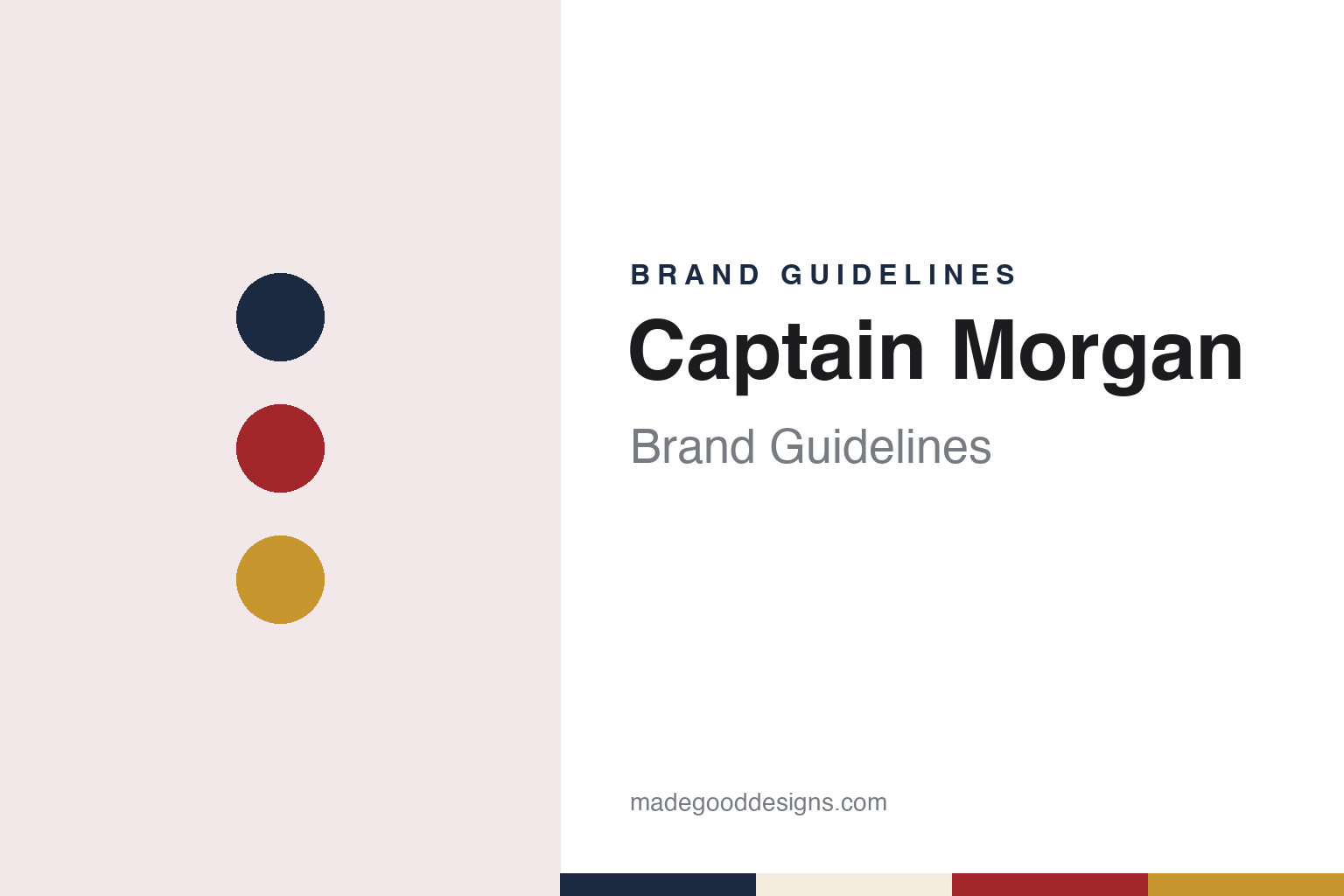
Two constants: a captain red, navy and spiced gold palette and an old-style engraved serif register. Abstract homage — not a Captain Morgan product or mark; no bottle, label, character or logo is reproduced.
A privateer’s name
Seagram, a Jamaican distillery and a 17th-century captain.
Captain Morgan is a rum brand built around a name from Caribbean history. English Wikipedia, citing Wayne Curtis’s 2007 book And a Bottle of Rum, says the Seagram Company, the Canadian drinks group, began making the Captain Morgan brand of rum in 1944. The name refers to Sir Henry Morgan, the 17th-century Welsh privateer of the Caribbean who later served as lieutenant governor of Jamaica, as Reader’s Digest explained in 2017. The brand’s link to him is a name only: Morgan did not make rum.
Jamaica supplied the early rum. Writing on Cocktail Wonk in March 2016, the rum writer Matt Pietrek reported that around 1953 Seagram bought the Long Pond distillery from the Jamaican government to secure rum for its recently launched Captain Morgan brand. Seagram kept the brand for more than half a century.
The product most people now know came later. English Wikipedia, citing Diageo’s own company history as archived in 2007, says Captain Morgan Original Spiced Rum was introduced to the United States in 1984; Diageo’s current brand page gives the launch as 1982. Diageo says the brand is now sold in more than 100 countries, and in 2007 its company pages named the United States, Canada, Great Britain, South Africa and travel retail as the markets where most Captain Morgan rum was sold, English Wikipedia says.
One complication remains in Jamaica itself. There, Pietrek reported, Diageo does not own the Captain Morgan trademark, and a completely unrelated rum under the same name is made by J. Wray & Nephew. English Wikipedia repeats the point: outside Jamaica, Captain Morgan means Diageo’s rum; inside Jamaica, it means something else.
Colour
Diageo, St Croix and a family of spiced rums.
Ownership changed in 2001. In May of that year Diageo, in a joint venture with the French group Pernod Ricard, bought the drinks business of Seagram, and the Captain Morgan brand passed to Diageo, the multinational drinks company headquartered in London, English Wikipedia says, citing Diageo’s archived history. Captain Morgan has stayed with Diageo since.
Where the rum is made has also moved. Diageo now runs a large distillery on St Croix that produces Captain Morgan rum, Pietrek reported in 2016; The Spirits Business described the St Croix site in October 2019 as employing a workforce of about 70. Pietrek added that Captain Morgan sold in Europe uses rum from the Clarendon distillery in Jamaica instead.
The range has grown well beyond one bottle. English Wikipedia lists the flagship Original Spiced Gold, a Dark Rum, a White Rum and Black Spiced, along with a 100 Proof Spiced Rum, coconut and pineapple-and-mango flavours and an alcohol-free Spiced Gold 0.0%. On 15 April 2005 the brand added Captain Morgan Tattoo, a black spiced rum since discontinued. The Tiki flavour followed in 2020, The Spirits Business reported that March.
Labelling differs by market. At 35% alcohol by volume, the UK Original Spiced Gold is classed as a “rum-based spirit drink” under EU spirits rules rather than as a rum, English Wikipedia says, while it is still sold as Original Spiced Rum elsewhere. In Atlantic Canada, Marketing magazine reported, the White Rum keeps a greenish tinge that is filtered out in other markets, a detail the magazine presented as honouring the brand’s East Coast connection.
Typography
Design and documentation.
The seven brands in this group are all American whiskey and rum names: Jim Beam, Maker’s Mark, Wild Turkey, Havana Club, Captain Morgan, Sailor Jerry and The Kraken. American whiskey and rum brands in general sit at many different points in the trade, from family distilleries that still carry a founder’s name to names that now belong to much larger drinks groups, and a single brand can be sold everywhere from a neighbourhood bar to a supermarket shelf.
A spirits brand’s identity is usually carried less by a single bottling than by a bottle, a label and the story the name promises, because the company behind the name may have changed hands, moved its production or grown far beyond the place where it started. That makes the questions behind each name worth asking plainly: who started it, who owns it now, and where its spirits are actually distilled and bottled.
Each guide separates what independent sources record from what the company says about itself — its founding story, its owners over time, where its spirits are made and how its bottles and labels have changed — and marks plainly what rests only on the company’s own word.
Aa
An old-style engraved serif for a brand named after a 17th-century captain. (Specimen set in IM Fell English, a serif STAND-IN; NOT the Captain Morgan logo.)
Captain Morgan
A character, a pose and a trade-dress case.
The brand’s strongest asset is its character: a costumed captain who appears on the label, standing in a pose with one foot raised. That pose has had a life of its own. In November 2009 the National Football League said it would not tolerate a promotion in which Diageo pledged money to a charity for retired players each time a player struck the “Captain Morgan” pose on camera, USA Today reported, after a celebration by the Philadelphia Eagles’ Brent Celek.
The character has also been defended in court. In 2014 Diageo Canada filed a trade dress lawsuit against Heaven Hill Distilleries, arguing that the captain figure on Heaven Hill’s Admiral Nelson’s rum was strikingly similar to its own and would dilute the Captain Morgan mark, The Drinks Business reported; Diageo Canada won in 2017, The Globe and Mail reported.
The label has occasionally played with the name. In 2016, after Wes Morgan captained Leicester City to the Premier League title, Diageo produced limited-edition bottles marking the achievement, English Wikipedia says. The design story behind the type itself is told in our separate Captain Morgan font guide.
For a design guide, Captain Morgan shows how a historical name, a single costumed figure and a warm spiced-gold liquid can hold a mass-market brand together for eight decades. Compare Appleton Estate, the Jamaican rum, and Sailor Jerry, another spiced rum with a nautical name. For this guide we use captain red, navy and spiced gold with an engraved serif, an unofficial interpretation; no product or logo is reproduced.
Explore & save
Keep Captain Morgan’s identity on hand — save it to a board in the Made Good inspiration library.
Captain Morgan identity set
Pin the Captain Morgan captain red, navy and spiced gold palette and the old-style engraved serif register to your own board.