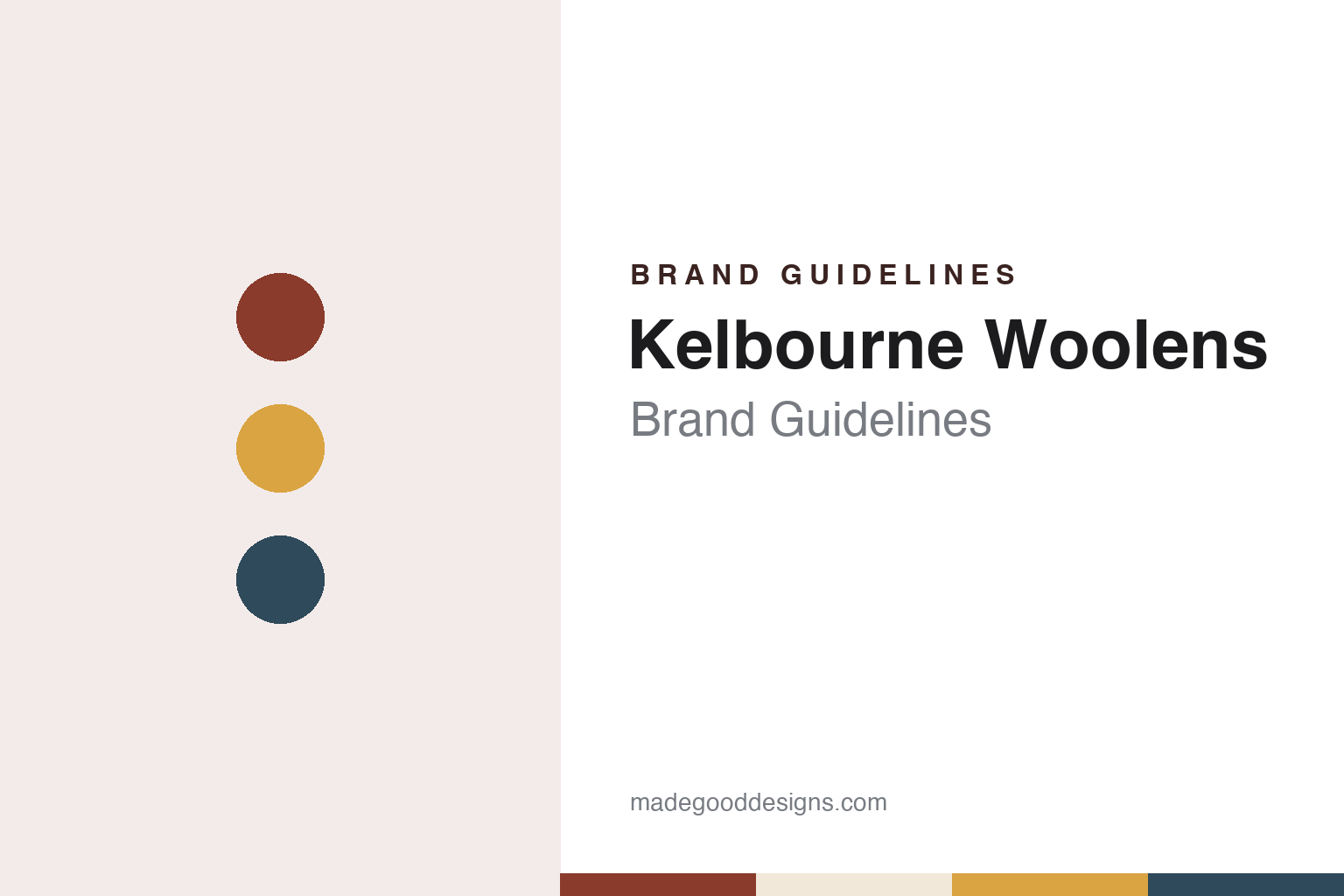
Kelbourne Woolens Brand Guidelines
The Philadelphia distributor that became a yarn brand.
Aa
Two constants: a Kelbourne brick, mustard and blue palette and a warm editorial serif register. Abstract homage — not a Kelbourne Woolens product or mark; no yarn, label, pattern photograph or logo is reproduced.
A kitchen table
Two colleagues from a Philadelphia yarn shop.
Kelbourne Woolens is an American yarn company in Philadelphia, Pennsylvania. It describes itself as “an independently owned yarn wholesaler, distributor, and retailer,” selling its own yarns and those of other makers mainly through independent yarn shops.
The company says it was founded in 2008 by two friends, Courtney Kelley and Kate Gagnon Osborn, “who met while working in a local yarn store in Philadelphia.” By its own account Kelley was a new mother and Gagnon Osborn was in her final year of graduate school, and they started the business at Gagnon Osborn’s kitchen table. They have run it together as owner-operators since, with a small staff, and describe it as women-owned.
For its first decade Kelbourne Woolens was a distribution company rather than a yarn brand. Its website in August 2013, preserved by the Internet Archive’s Wayback Machine, opened with the words “Kelbourne Woolens is Courtney Kelley + Kate Gagnon Osborn” and explained that “when the opportunity to distribute The Fibre Company’s unique artisan yarns presented itself, they jumped at the chance.” It listed the founders’ shared background in fine art, textiles, retail and knitwear design, and gave a business address in Conshohocken, a borough just outside Philadelphia. The company says that as distributors the two also designed patterns for the yarns they carried, which is how much of their early work reached knitters.
That arrangement changed in 2017, when, the company says, the founders “poured their years of experience into their own line of yarns.”
Colour
Germantown, North Carolina and Donegal.
The best known of those yarns is Germantown, a worsted-weight wool whose name points back to Philadelphia. Germantown is a neighbourhood in the city’s northwest, and “Germantown” was the trade name of a machine-spun, four-ply yarn made in Pennsylvania in the 19th century; English Wikipedia’s article on Navajo weaving records that this aniline-dyed yarn, “known as Germantown because the yarn was manufactured in Pennsylvania,” came into use among Navajo weavers in the early 1880s with the arrival of the railroad. Kelbourne Woolens calls its version “a revival of the very first commercial American yarn” — the company’s description — and says Germantown originated in Philadelphia in the early 1800s.
On where it is made, the company is specific. It says Germantown is “100% grown and manufactured in the USA,” with wool from western states, and that the yarn is spun and dyed in North Carolina; it does not name the mill. Germantown DK, listed on its website from 2025, began, it says, as “a mix-up at the mill” — a skein spun with three plies instead of four — that the founders liked enough to refine. Keystone, listed from July 2025, blends Germantown’s wool with deadstock acrylic: the company says it is using more than 59,000 pounds of acrylic fibre that had been left in the mill’s warehouse, and describes the yarn as made in the USA.
Its tweeds come from Ireland. The company says Lucky Tweed is “an authentic Donegal Tweed from Donegal, Ireland,” that Cricket is spun at the same Donegal mill, and that Erin, a bulky heathered yarn listed from 2024, is also made in Donegal. Skipper is made from Peruvian Tanguis cotton. For other lines — Scout, a heathered wool from a Corriedale and Merino cross; Camper, its lighter cousin; and Perennial, a merino, alpaca and nylon blend — the product pages we read describe the fibre but not the mill or country of spinning.
Typography
Design and documentation.
The seven brands in this group all sell yarn for hand knitting and crochet, and they come from six countries on two continents: Filcolana from Denmark, Kelbourne Woolens and Harrisville Designs from the United States, Rosários 4 from Portugal, La Bien Aimée from France, Koigu from Canada and Atelier Zitron from Germany. Most knitters meet them first as a name on a ball band or a skein tag in a yarn shop, rather than as a company.
Behind those labels the yarn trade takes several shapes. Some brands own the mill that spins their fibre; others design a yarn and its colours and have it spun, dyed or finished by partners; still others dye undyed yarn by hand in small batches. A label’s country is not always the country where every step happened, and “made in” can mean spinning, dyeing or only the final winding.
Each guide sets out what independent sources record about the brand — who founded it, who owns it and where its yarn is made — and separates that from what the company says about itself, marking plainly what rests only on the company’s own word.
Aa
A warm editorial serif for a pattern-led yarn company. (Specimen set in Fraunces, a serif STAND-IN; NOT the Kelbourne Woolens logo.)
Kelbourne Woolens
A distributor that became a brand.
Kelbourne Woolens still works on both sides of the trade. Alongside its own yarns it distributes other makers’ products to North American shops. In October 2026 its website listed Manos del Uruguay, the Uruguayan cooperative-made yarn; BC Garn, a Danish line of GOTS-certified organic yarns; Navia, from the Faroe Islands; and Soak, a wool wash. It says it works only with manufacturers it has a personal relationship with, and that all its mills are committed to good social and environmental practice — claims we give as the company’s own.
Patterns are central to how it presents its yarns. The founders came to the business as pattern designers as well as distributors, and the website sells and gives away patterns grouped by yarn and by collection, along with kits built around them, such as a year-long series of hat patterns in DK-weight yarn. That keeps the yarn and the finished object together in its photographs and its marketing.
The company also states its employment and community policies publicly. It says it supports the Fight for Fifteen campaign for a higher minimum wage, uses the MIT Living Wage Calculator to set pay, and has given yarn, money and volunteer time to causes it supports. We have not verified those statements independently. For Germantown and its relatives, it also presents US manufacturing as a selling point in itself, describing the yarns as “tariff-free” and “import-stable.”
We found no documented colour codes or typeface for the Kelbourne Woolens name, so the palette here is our own.
For a design guide, Kelbourne Woolens shows how a distributor can turn its knowledge of other brands into a line of its own, and how a place name with a long history — Germantown — can anchor a modern yarn. Compare Brooklyn Tweed, another American company built on domestic wool, and Manos del Uruguay, one of the yarns it distributes. For this guide we use brick red, mustard and a deep blue with a serif, an unofficial interpretation; no product or logo is reproduced.
Explore & save
Keep Kelbourne Woolens’s identity on hand — save it to a board in the Made Good inspiration library.
Kelbourne Woolens identity set
Pin the Kelbourne Woolens brick, mustard and blue palette and the warm editorial serif register to your own board.